Vintage Toy Values: Are Your Childhood Toys Worth Real Money?
That dusty box of 80s toys in your attic could be worth hundreds—or thousands. Here's how to find out what your childhood collection is actually worth.
That cardboard box in the attic. The one with the faded Hasbro logo and a few Star Wars figures rattling around inside. You've been meaning to deal with it for years.
Here's the question you should be asking: what's actually in there, and how much could it be worth?
The global vintage toy market is projected to surpass $35 billion by 2030, and values for the right items — particularly toys from the 1970s, 80s, and 90s — have surged. An original 1978 Star Wars Boba Fett figure in mint condition sells for $5,000 to $32,000. A sealed 1959 Barbie routinely fetches over $27,000 at auction. A rare 1968 Hot Wheels prototype sold for $72,000.
Most toys won't approach those numbers. But understanding vintage toy values is the first step to knowing whether you're sitting on something genuinely valuable — or just a fond memory.
Table of Contents
- What Makes a Vintage Toy Worth Money?
- The Most Valuable Toy Categories Right Now
- How Much Is My Vintage Toy Worth?
- Understanding Toy Condition Grading
- Original Packaging: The Single Biggest Value Driver
- Where to Sell Vintage Toys for the Best Price
- FAQ
What Makes a Vintage Toy Worth Money?
The value of a vintage toy comes down to four factors, and they interact in sometimes surprising ways.
Rarity is the foundation. Toys made in small production runs, discontinued quickly, or produced as regional variants command the highest prices. The famous "double-telescoping" Darth Vader figure from 1978 — where the lightsaber extends in two stages rather than one — exists in very limited numbers and can sell for tens of thousands of dollars. The standard version sells for far less.
Condition is nearly as important. A toy graded C-10 (flawless, factory-fresh) can be worth ten times an identical toy graded C-6 (played-with, minor wear). For action figures, collectors use the C-scale from 1 to 10. For board games and boxed sets, the standard is AFA (Action Figure Authority) professional grading.
Completeness matters enormously. A vintage G.I. Joe figure missing its original weapons and accessories loses 40–70% of its value versus a complete example. Even a missing instruction sheet can reduce a toy's grade.
Cultural relevance drives demand. When a franchise gets a reboot, a sequel, or a anniversary — think Star Wars, Transformers, He-Man — collector interest spikes and prices follow.
Toys that were considered "premium" at retail — die-cast metal, detailed articulation, large sets — tend to hold value better than mass-market plastic toys made cheaply for high volume.
The Most Valuable Toy Categories Right Now
Star Wars Action Figures (1977–1985)
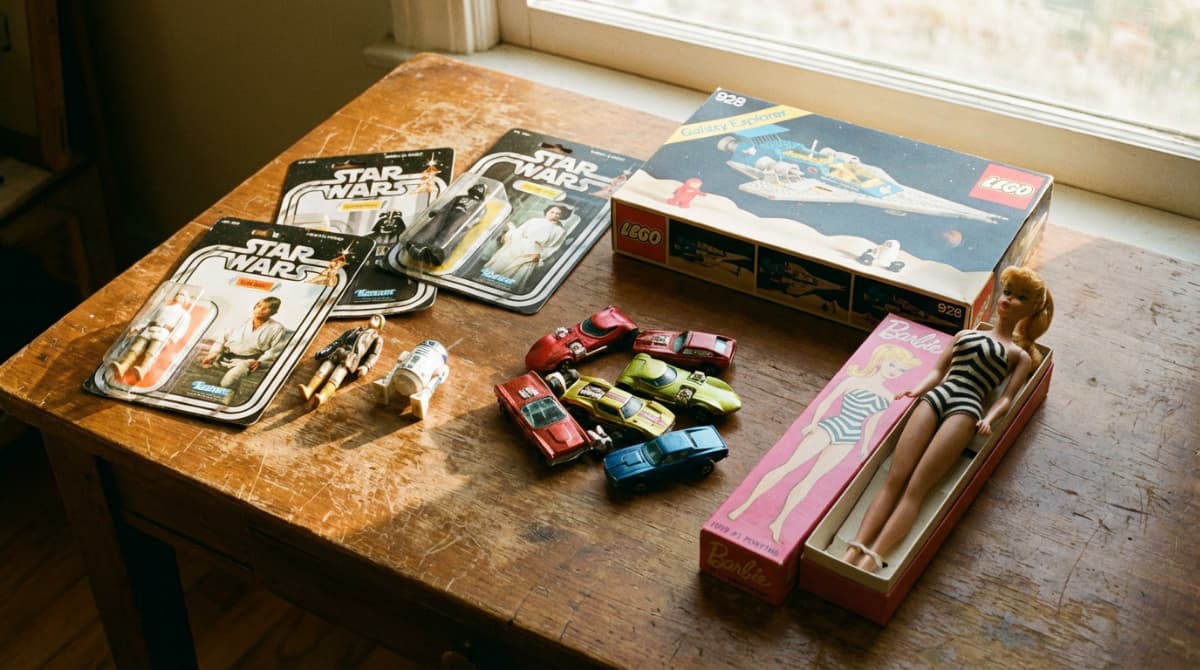
Kenner's original Star Wars line is the benchmark for vintage toy collecting. Common loose figures sell for $5–$30. Rare characters (Vinyl Cape Jawa, double-telescoping Obi-Wan) in excellent condition command $5,000–$25,000+. Mint on card (MOC) examples of any figure multiply value by 5–15x.
Transformers Generation 1 (1984–1987)
Hasbro's first generation, especially Japanese Takara releases, is highly sought after. Sealed examples of Optimus Prime, Megatron, and the Dinobots range from $500 to $5,000+. Incomplete figures are worth a fraction of that — always check for all accessories.
Hot Wheels (1968–1977)
Early "redline" Hot Wheels (named for the red stripe on the tire) are the most collectible. The 1971 Purple Olds 442 reaches over $1,000; a 1970 Mad Maverick prototype sold for $15,000. The Holy Grail — the Pink Rear Loading Beach Bomb prototype — sold for $72,000.
Original Barbie Dolls (1959–1967)
The original 1959 Barbie (#1) in original swimsuit and box commands $27,000+ at major auction houses. Even 1960s Barbies in good condition reach $200–$2,000 depending on the variant, outfit, and accessories.
LEGO Sets (1980s–2000s)
Sealed, mint-in-box LEGO sets from this era have become serious investment vehicles. A 2007 Star Wars Millennium Falcon sold for $9,500. Original 2008 Taj Mahal sets regularly reach $5,000+. Even smaller sets in sealed condition command 5–10x retail price.
Pokémon Cards (1999–2002)
First Edition Base Set holofoil cards — particularly Charizard, Blastoise, and Venusaur — sell for thousands. A PSA 10 First Edition Charizard sold for over $300,000. Even common First Edition cards in top grade are worth $20–$200.
Typical value range for high-grade vintage toys by category (USD)
Other notable categories include: PEZ dispensers (rare political variants up to $13,000), Beanie Babies (specific error variants and early editions up to $9,000), GI Joe (1964–1969 prototypes and rare variants), Cabbage Patch Kids (early hand-signed Xavier Roberts editions), and vintage video games (factory-sealed NES cartridges reaching $5,000–$25,000).
How Much Is My Vintage Toy Worth?
The fastest way to get an estimate is to upload a photo to WorthLens.ai. The AI identifies the toy, cross-references its condition from the image, and provides an instant appraisal — without spending hours comparing eBay listings.
For deeper research, here are the key steps collectors use:
1. Identify exactly what you have. Check for manufacturer, year, country of manufacture (printed on the toy or packaging), and any variant markings. For Star Wars figures, look at the foot stamp. For Barbie, check the back of the head and the swimsuit color.
2. Check eBay completed listings. Go to eBay, search your item, and filter by "Sold" listings. This shows real prices paid — not asking prices, which are meaningless. Heritage Auctions (ha.com) publishes comprehensive historical results for high-end pieces.
3. Assess condition honestly. Use the C-scale (below) or compare against photos of graded examples on collector forums. Be honest — wishful grading leads to disappointment at sale time.
4. Check for completeness. Compare against a complete accessory list for your specific figure or set. Sites like Wheeljack's Lab have detailed checklists for Transformers, G.I. Joe, and other lines.
Never clean vintage toys with harsh products, repaint worn areas, or attempt to re-seal packaging. Any modification — even well-intentioned restoration — is considered damage by collectors and will drastically reduce value.
Understanding Toy Condition Grading
Vintage toy condition uses the C-scale, a 1–10 rating originally developed for the action figure market but now widely applied across categories:
| Grade | Description | Value Impact |
|---|---|---|
| C-10 | Factory mint, never handled | Maximum value |
| C-9 | Near mint, minimal handling marks | 70–90% of C-10 |
| C-8 | Excellent, very light wear | 50–70% of C-10 |
| C-7 | Very good, light play wear | 30–50% of C-10 |
| C-5/6 | Good, visible wear, possibly incomplete | 15–30% of C-10 |
| C-1/2 | Heavy damage, heavily played | 5–15% of C-10 |
For carded or boxed toys, AFA (Action Figure Authority) offers professional third-party grading. An AFA-graded figure typically sells for 2–3x more than the same ungraded figure — because the grade removes uncertainty for buyers. A toy worth $100 loose can reach $1,000+ with a high AFA grade.
For Pokémon cards and trading cards, PSA and BGS (Beckett) are the standard grading services.
Original Packaging: The Single Biggest Value Driver
Packaging transforms toy values more dramatically than any other single factor. Consider:
- A loose 1978 Luke Skywalker figure: $10–$40
- The same figure MOC (mint on card): $500–$2,500+
- A sealed 1980 Yoda figure: $2,000+
MOC (Mint on Card) means the figure is still sealed in its original bubble on the original card — no punches, no creases, bubble intact. MIB (Mint in Box) applies to boxed toys: all inner packaging present, toy unplayed-with, instructions included.
Even non-pristine original packaging adds value. A punched card (where the hanger hole has been punched through) is worth less than an unpunched card, but still far more than no card at all.
If you find a toy still in any original packaging — even damaged — do not discard the box or card. It is part of the collectible. Store everything together.
Where to Sell Vintage Toys for the Best Price
The right venue depends on value. Lower-value items (under $200) sell well on eBay or Facebook Marketplace. Mid-range items ($200–$2,000) benefit from specialist platforms like Whatnot or dealer networks. High-value pieces deserve specialist attention:
- Heritage Auctions — the leading auction house for vintage toys, comics, and pop culture collectibles. Reaches the deepest pool of serious collectors.
- Morphy Auctions — strong for antique toys, cast iron, and early 20th century pieces.
- Local specialist dealers — especially useful for LEGO, Hot Wheels, and regional toy lines with dedicated collector communities.
Before listing anywhere, get an appraisal at WorthLens.ai. Knowing your baseline value means you won't accept an underpriced offer — and won't list at an inflated price that drives buyers away.
What most affects vintage toy resale value
FAQ
You don't need to be an expert collector to find out what your childhood toys are worth. Upload a photo, get an instant AI analysis, and know your number before you decide what to do next.