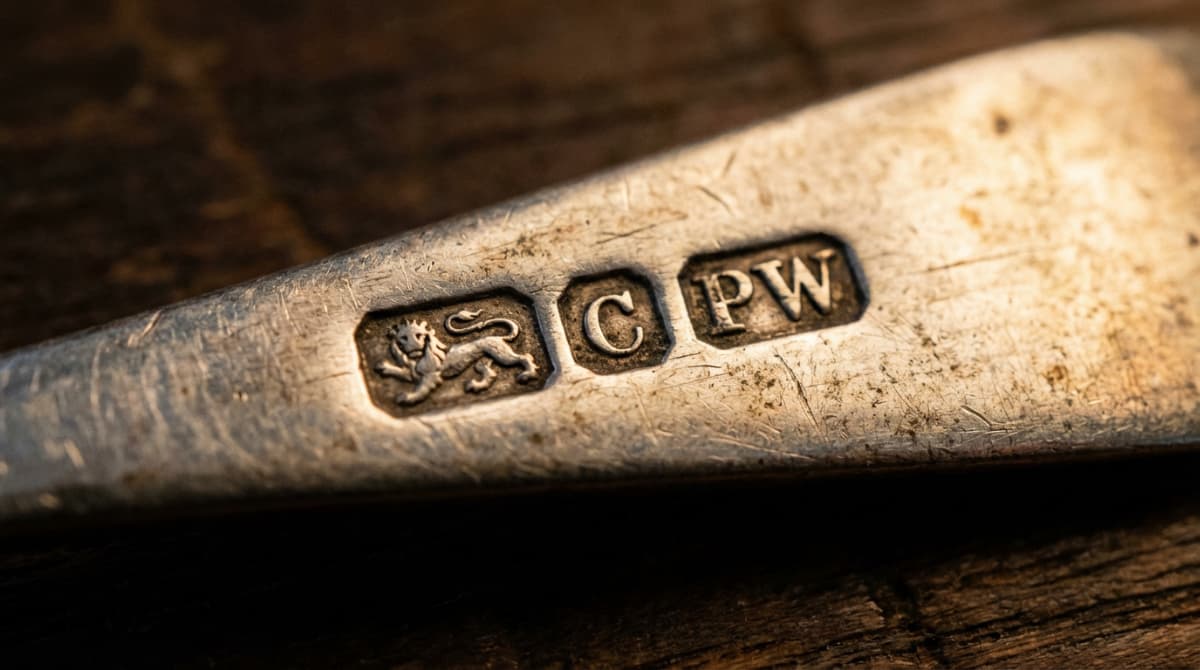
Silver Hallmarks Explained: What Do the Stamps on Your Jewelry Mean?"
Found a stamp on your silver jewelry or cutlery and not sure what it means? This guide decodes every mark — from 925 and 800 to lion passant and EPNS.
You flip over a silver spoon, squint at the back of a ring, or turn over a candlestick — and there's a cluster of tiny symbols stamped into the metal. A lion. A letter. Some numbers. Maybe the letters "EPNS." What does any of it mean? And does it matter for the piece's value?
It matters enormously. A set of cutlery stamped "EPNS" is worth a fraction of what the same set stamped "925" is worth. An antique silver teapot with a full set of British hallmarks can be traced to a specific city, a specific year, and sometimes a specific silversmith. The stamps tell the whole story — if you know how to read them.
This guide explains every major mark you're likely to encounter, country by country.
Table of Contents
- What Is a Hallmark and Why Does It Matter?
- The Purity Numbers: What 925, 800, 950, and Others Mean
- British Hallmarks: The World's Oldest Guarantee System
- Silver Marks Around the World
- The Silverplate Trap: EPNS, EP, and Stamps That Mean No Real Silver
- How Much Does the Stamp Affect Value?
- How to Read the Stamps Yourself
- Frequently Asked Questions
What Is a Hallmark and Why Does It Matter?
A hallmark is an official stamp — applied by an independent assay office or required by law — that certifies the metal content of a silver (or gold) item. The word itself comes from Goldsmiths' Hall in London, where English silver has been tested and marked since 1300.
Hallmarks exist to prevent fraud. Without them, a seller could pass off silverplated brass as solid silver, or low-purity silver as sterling. The stamps are a consumer protection system that has been running, in some form, for over 700 years.
For collectors and inheritors today, they're also a dating and provenance tool. A full set of British hallmarks tells you not just what the metal is, but where it was made, when it was tested, and often who made it.
Hallmarks are usually very small — 1–3 mm across — and found in discreet locations: inside ring shanks, on clasp tongues, under the handles of flatware, or on the foot of candlesticks. A 10x jeweler's loupe (under $20) makes them easy to read.
The Purity Numbers: What 925, 800, 950, and Others Mean
The most universal silver marks are three-digit numbers that express silver content in parts per thousand (‰). A "925" mark means 925 parts per 1,000 are pure silver — or 92.5%.
| Mark | Purity | Common name | Where used |
|---|---|---|---|
| 999 | 99.9% | Fine silver | Bullion bars, some modern jewelry |
| 980 | 98.0% | — | Mexican silver (traditional) |
| 958 | 95.8% | Britannia silver | UK (introduced 1697) |
| 950 | 95.0% | French first standard | France, high-end jewelry |
| 925 | 92.5% | Sterling silver | UK, US, most modern jewelry |
| 900 | 90.0% | Coin silver | US, Latin America |
| 835 | 83.5% | — | Germany, Netherlands, Belgium |
| 830 | 83.0% | — | Scandinavia (Norway, Denmark) |
| 800 | 80.0% | Continental silver | Germany, Austria, Italy, Central Europe |
The most common mark you'll encounter on jewelry is 925 (sterling). On older European tableware — particularly German, Austrian, and Italian pieces from the late 19th and early 20th century — 800 is very common. Both are solid silver with real melt value.
Don't confuse silver purity marks with gold marks. The number 750 on a piece means 18-karat gold (75% pure gold) — not silver. Always check the context and other marks on the piece before assuming which metal you're looking at.
British Hallmarks: The World's Oldest Guarantee System
British hallmarking is the most systematic in the world, and antique British silver is typically the easiest to date and attribute precisely. A fully hallmarked piece carries up to five separate marks:
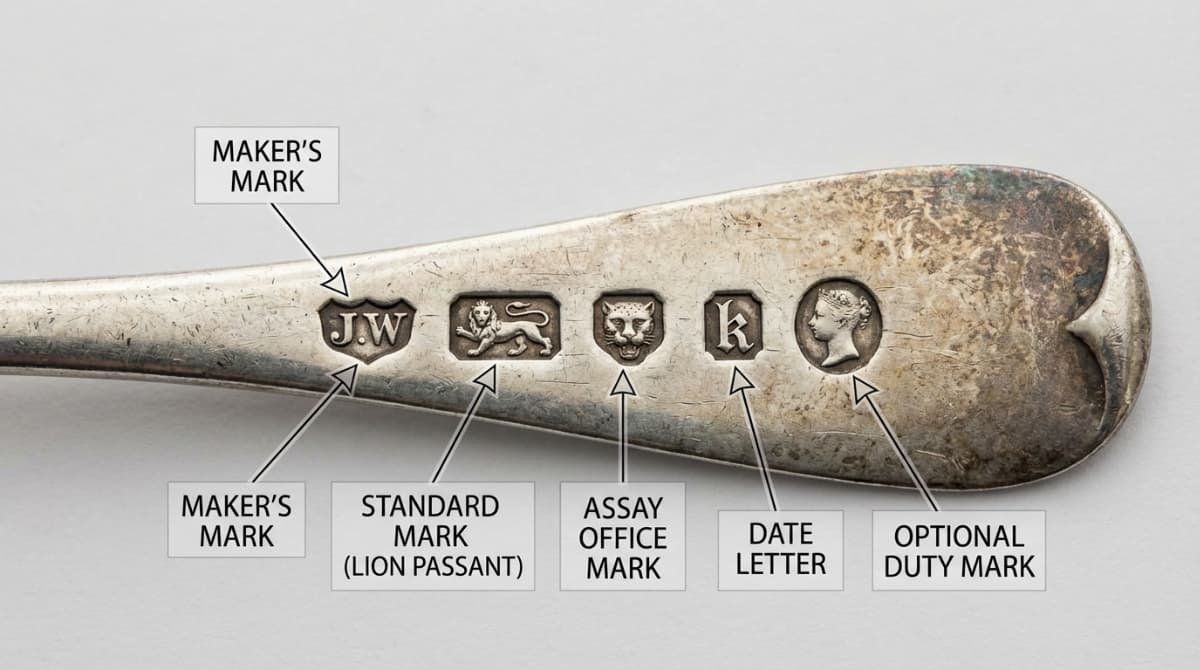
1. Maker's Mark
The initials or symbol of the silversmith or manufacturer, registered with the assay office. Every professional maker has had a unique registered mark since the 14th century.
2. Standard Mark (Lion Passant)
The walking lion — facing left, with one paw raised — is the most recognizable mark in silver. It has certified sterling silver (92.5%) in England since 1544. If you see a lion passant, you have English sterling silver.
Scotland uses a different mark for sterling: a lion rampant (rearing up on hind legs). Ireland uses a harp.
3. Assay Office Mark
Indicates which city tested and stamped the piece:
| Symbol | Assay Office |
|---|---|
| Leopard's head | London (in use since 1300) |
| Anchor | Birmingham (since 1773) |
| Rosette / Crown | Sheffield (Crown pre-1975, Rosette after) |
| Three-turreted castle | Edinburgh |
| Three-turreted castle | Chester (closed 1962) |
4. Date Letter
A letter of the alphabet indicating the year of assay. The letter cycles through the alphabet each cycle, with the font, letter case (upper/lower), and shape of the surrounding cartouche all varying by assay office and era. To decode a date letter precisely, cross-reference it with an online hallmark dating chart — the most complete is at The Silver Society.
5. Duty Mark (1784–1890)
A crowned sovereign's head, indicating that excise duty had been paid on the piece. Only found on pieces made during this period — useful for narrowing down dating.
Silver Marks Around the World
Not all silver was made in Britain. Here's how to recognize marks from the other major silversmithing traditions:
France
French silver uses a Minerva head (the goddess, facing right) as its primary guarantee mark. The number beside the head tells you the standard: "1" = 950 silver (first standard), "2" = 800 silver (second standard). An owl mark in a small oval indicates imported silver that was assayed in France — very common on pieces brought in from Germany or Eastern Europe during the 19th century.
Germany
Germany's national silver guarantee, introduced in 1888, is a crescent moon + imperial crown — two symbols stamped together. They always appear alongside a purity number: most commonly 800 on antique pieces and 925 on modern work. Before 1888, individual German states had their own marks.
Russia
Russian silver carries a kokoshnik mark — a woman's head in a traditional Russian headdress — used from 1896 onward as the state assay guarantee. The number beside it tells you the fineness. Older pre-1896 pieces often carry the mark "84", which refers to 84 zolotniki — a now-obsolete Russian unit equivalent to 87.5% silver. Russian 84 pieces are frequently heavily gilded with fine decorative work; their value is usually driven by craftsmanship and rarity more than melt weight.
United States
The US has no official government hallmarking system. American silversmiths simply stamp the word "Sterling" or the number "925" directly onto the metal — in letters, with no symbolic assay mark. If you see "Sterling" with no accompanying symbols, it's almost certainly American. Some older US pieces carry "Coin" or "900", indicating coin silver (90% pure), melted down from circulating coinage.
Italy
Italian silver uses a star symbol alongside a fineness number. A star with "1" = 800 silver; a star with "2" = 925 silver. Modern Italian pieces often carry just the 925 numeric stamp in the European format.
The Silverplate Trap: EPNS, EP, and Stamps That Mean No Real Silver
This is where the biggest confusion — and the biggest value gap — lies. Many pieces that look like solid silver are actually silverplated base metal. The silver layer is typically just 10–30 microns thick. There is no meaningful melt value.
The telltale stamps:
| Stamp | Meaning |
|---|---|
| EPNS | Electroplated Nickel Silver |
| EP | Electroplated |
| EPBM | Electroplated Britannia Metal |
| EPGS | Electroplated German Silver |
| IS | International Silver (US maker) |
| WM | White Metal (base metal, no silver) |
| A1, AA | Silverplate quality grades (NOT purity marks) |
"A1" or "AA" on a piece does NOT mean high silver content. These are manufacturer quality grades for silverplate — indicating the thickness of the silver layer. They are often mistaken for purity marks. A piece marked "A1" has no more silver value than one marked "EPNS."
How to confirm without a loupe: Silverplate wears through at high-contact points — the edges of a tray, the back of a spoon bowl, the tines of a fork. If you see yellowish brass or grey base metal showing through in those spots, you're looking at plate, not solid silver.
A magnet test also helps: sterling silver is not magnetic. If a magnet pulls on a piece, it contains magnetic base metals — a strong indicator of silverplate rather than sterling.
How Much Does the Stamp Affect Value?
The difference between sterling silver and silverplate is not just academic — it's the difference between an item with material value and one without.
Relative value of similar Victorian-era serving pieces by metal type
A Victorian sterling silver place setting can be worth 3 to 8 times more than a similar EPNS set, because sterling has intrinsic melt value as a floor price — regardless of design or condition. EPNS has no floor price; its value depends entirely on decorative appeal and collector demand.
Beyond the sterling-vs-plate divide, the maker's mark is the second biggest value driver. Pieces from recognized silversmiths — Paul Storr, Hester Bateman, Georg Jensen, Tiffany & Co. — carry a significant premium over unmarked sterling of identical weight. A Georg Jensen piece in sterling doesn't just sell for its silver content; it sells for the designer's name.
For precious metals price context, current silver spot prices directly determine the melt-value floor of any sterling piece:
How to Read the Stamps Yourself
You don't need special equipment to get started — just good light, a loupe, and a systematic approach.
Step 1: Find the mark. Check ring shanks, clasp tongues, pendant bails, the handles or backs of flatware, the foot rims of bowls and candlesticks. Marks on hollow pieces (teapots, jugs) are often on the base or just below the lip.
Step 2: Look for numbers first. A three-digit number (925, 800, 750, 585) is the clearest signal. Note the exact number.
Step 3: Look for letters. "Sterling," "EPNS," "EP," or "IS" in letters are definitive. A single letter in a shaped cartouche is likely a British date letter.
Step 4: Look for symbols. A lion passant = English sterling. A Minerva head = French. A crescent moon + crown = German. A kokoshnik = Russian.
Step 5: Look for an anchor, castle, or leopard. These identify British assay offices and confirm you have genuine British silver.
If you can photograph the marks clearly (macro mode on a phone works well), WorthLens.ai can identify hallmarks from photos and estimate the piece's value — useful when the stamps are worn or you're not sure what you're looking at.