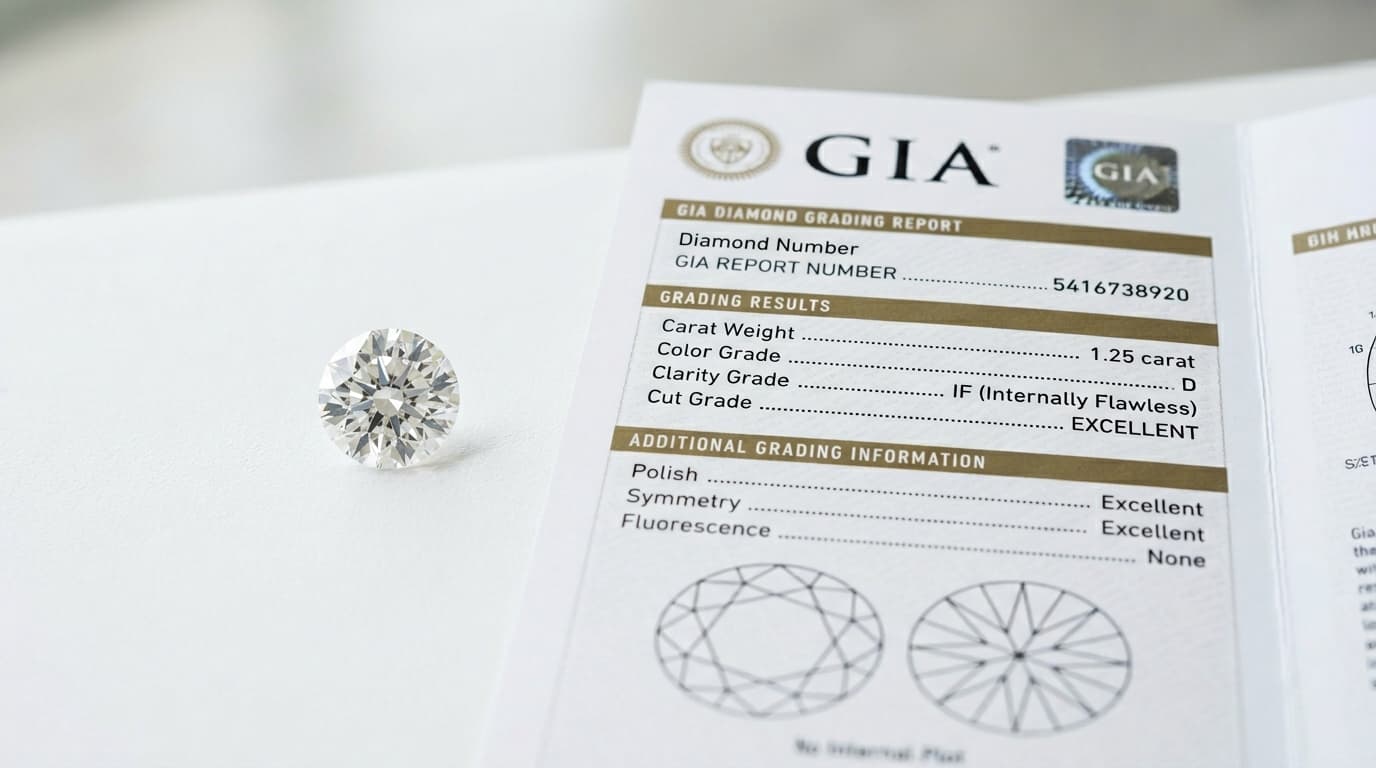
GIA vs. IGI vs. AGS: Which Diamond Certificate Should You Trust?
Not all diamond grading labs measure the same way — and paying for the wrong certificate can cost you thousands. Here's what each lab actually means for your purchase.
You're looking at two diamonds side by side. Same carat weight. Same stated color grade. Same stated clarity. One is GIA certified. The other is IGI certified. The IGI stone is 12% cheaper — and the salesperson tells you it's "the same quality."
Are they right? And does it matter which lab graded your stone?
The answer is: yes, it matters — and the reasons are more nuanced than most buyers expect.
Table of Contents
- Why the Grading Lab Matters More Than You Think
- GIA: The Global Standard for Natural Diamonds
- IGI: The Lab-Grown Leader with a Price Advantage
- AGS: What Happened and What It Means Today
- Labs to Avoid: EGL and Others
- Which Certificate Should You Choose?
- How to Verify a Certificate Before You Buy
- Frequently Asked Questions
Why the Grading Lab Matters More Than You Think
A diamond grading report is only as reliable as the lab that issued it. The report tells you a stone's carat weight, color grade, clarity grade, and cut grade — but if the lab is lenient in its grading, those grades may be overstated. An "H color" from a loose grading lab might actually be closer to an "I" or "J" when re-evaluated by a stricter one.
This is not a theoretical concern. Research on 29 diamonds certified by both GIA and IGI found that the two labs agreed on clarity grades in 69% of cases (20 of 29 stones) and on color grades in only 34% of cases (10 of 29). In the majority of color comparisons, the labs assigned different grades to the same stone.
The practical consequence: if you buy on the basis of a grade from a lenient lab, you may be paying for quality that doesn't quite exist. And when you sell, the secondary market will reprice the stone against stricter standards — meaning you'll likely receive less than you paid.
There is no universal regulatory body overseeing diamond grading labs. Each operates its own standards. The reputation of the lab — built over decades of industry use — is the only quality signal buyers have.
GIA: The Global Standard for Natural Diamonds
The Gemological Institute of America (GIA) is the organization that invented the modern 4 Cs system — carat, color, clarity, and cut — and it remains the most widely trusted grading authority in the world for natural diamonds.
Founded in 1931 and operating as a non-profit, GIA has no commercial incentive to inflate grades. Its consistency is backed by decades of data: its grading reports are accepted without question by dealers, auction houses, and resale platforms globally.
Key characteristics:
- Strictest and most consistent grading standards in the industry
- Non-profit with no financial stake in grading outcomes
- Reports universally accepted by the resale market
- GIA-certified stones command a price premium of approximately 12% over equivalent IGI-certified stones
- Best choice for: natural diamonds, high-value purchases, and any stone where resale value matters
The premium you pay for a GIA certificate reflects real resale protection. When you eventually sell or trade the stone, a GIA report removes doubt — buyers know exactly what they're getting and pay accordingly.
The price premium for a GIA certificate is not just a brand tax — it reflects stricter grading. A GIA "H color" and an IGI "H color" may not be the same stone quality. Comparing price without comparing the lab issuing the grade is a common and expensive mistake.
IGI: The Lab-Grown Leader with a Price Advantage
The International Gemological Institute (IGI), founded in 1975 in Antwerp, has become the dominant grading authority for lab-grown diamonds — and for that specific category, it is a fully reliable choice.
IGI processes a higher volume of diamonds than any other lab and has built particular expertise in lab-grown stone grading. As the lab-grown market has grown, IGI has refined its standards for synthetic stones significantly.
For natural diamonds, the picture is more complex. IGI's grading has historically been slightly more lenient than GIA's — though recent research suggests the gap is not as one-directional as often assumed. In the same 29-diamond study referenced above, IGI actually graded stricter than GIA in 12 cases, while grading more loosely in 7, and identically in 10. The average, however, results in IGI stones trading at a 12% discount to equivalent GIA stones on the secondary market.
Key characteristics:
- Dominant standard for lab-grown diamonds
- Slightly more lenient on average for natural diamonds, but not uniformly so
- Certificates cost less than GIA
- IGI diamonds priced 5–15% lower than GIA-equivalent stones
- Best choice for: lab-grown diamonds, buyers optimizing for value over resale premiums
When IGI makes sense
- Buying a lab-grown diamond (IGI is the industry standard)
- Budget is a genuine constraint and resale is not a priority
- The stone is for personal use, not investment
- The price saving (typically $1,000–$3,000 on a 1-carat stone) outweighs the resale risk
When GIA is the better choice
- Buying a natural diamond over 0.5 carats
- Resale or trade-in value matters to you
- Buying as part of an estate or investment portfolio
- The diamond will be appraised independently for insurance
- You want a report the entire global market accepts without question
AGS: What Happened and What It Means Today
The American Gem Society (AGS) was once considered the equal of GIA — and in some respects, its superior. AGS pioneered scientific cut grading, developed the round ideal cut standard, and introduced a 0–10 grading scale with finer gradations than GIA's Excellent–Poor system.
In December 2022, AGS Laboratories closed its doors and merged its operations with GIA.
The closure was a strategic decision by the American Gem Society to focus on education and membership rather than laboratory operations. AGS's intellectual property, technology, and research expertise were integrated into GIA's systems.
What this means practically:
- AGS no longer issues new grading reports
- Existing AGS certificates remain valid and are respected by the trade
- GIA now offers an AGS Ideal® supplemental report for eligible round and fancy-shape diamonds, available as an add-on to standard GIA reports for an additional $25
- If you encounter a pre-2022 AGS-certified stone, it can be re-graded by GIA if needed
For buyers today, AGS certification is a historical designation you may encounter on estate or vintage diamonds. It represents genuinely reliable grading — but the lab is no longer active.
Labs to Avoid: EGL and Others
Not every diamond certificate represents reliable grading. EGL (European Gemological Laboratory) was historically the most prominent example of a lab known for significantly inflated grades — often 1–2 full grades above GIA standards for the same stone. The inflated grades allowed sellers to advertise higher-quality specifications while charging lower prices, creating the illusion of value.
The practical result: an EGL "G color, VS1 clarity" stone might be a GIA "I color, SI1" when accurately assessed. The price difference between those grades on a 1-carat stone can exceed $3,000.
If a seller presents an EGL or other non-GIA/IGI certificate, treat the stated grades as unverified. The only way to confirm actual quality is independent re-grading by GIA or IGI — or to have a gemologist examine the stone in person.
Other labs — GSI, HRD, GCAL — occupy middle ground. They are more reliable than EGL and acceptable for lower-value purchases, but GIA or IGI remain the preferred standard for any significant transaction.
Which Certificate Should You Choose?
The right choice depends on what you're buying and why.
Diamond lab certificate — trust and reliability score by category (0–10)
Summary decision table:
| Situation | Recommended certificate |
|---|---|
| Natural diamond, any size | GIA |
| Lab-grown diamond | IGI |
| Natural diamond on a tight budget | IGI (understand the resale trade-off) |
| Estate or vintage diamond (pre-2023) | GIA or AGS; avoid EGL |
| Investment or resale priority | GIA only |
How to Verify a Certificate Before You Buy
A certificate is only useful if it's genuine. Forgeries and certificate misrepresentation exist — particularly in online transactions.
Before any significant purchase:
-
Verify the report number — every GIA, IGI, and AGS report has a unique number that can be checked against the issuing lab's online database:
- GIA: gia.edu/report-check
- IGI: igi.org/verify
-
Check the laser inscription — GIA and IGI inscribe the report number on the diamond's girdle (the edge between the crown and pavilion). This inscription should match the number on the certificate. Ask the jeweler to show you the inscription under magnification.
-
Match the 4 Cs to the stone — an independent gemologist can verify in person that the stone in front of you matches the certificate's specifications. For purchases over $5,000, this step is worth the cost.
AI-powered appraisal tools like WorthLens.ai can cross-reference a diamond's reported specifications against market pricing data — helping you verify whether the price you're being asked to pay is consistent with what certified stones of those specifications actually sell for. This is a useful sanity check before you commit.