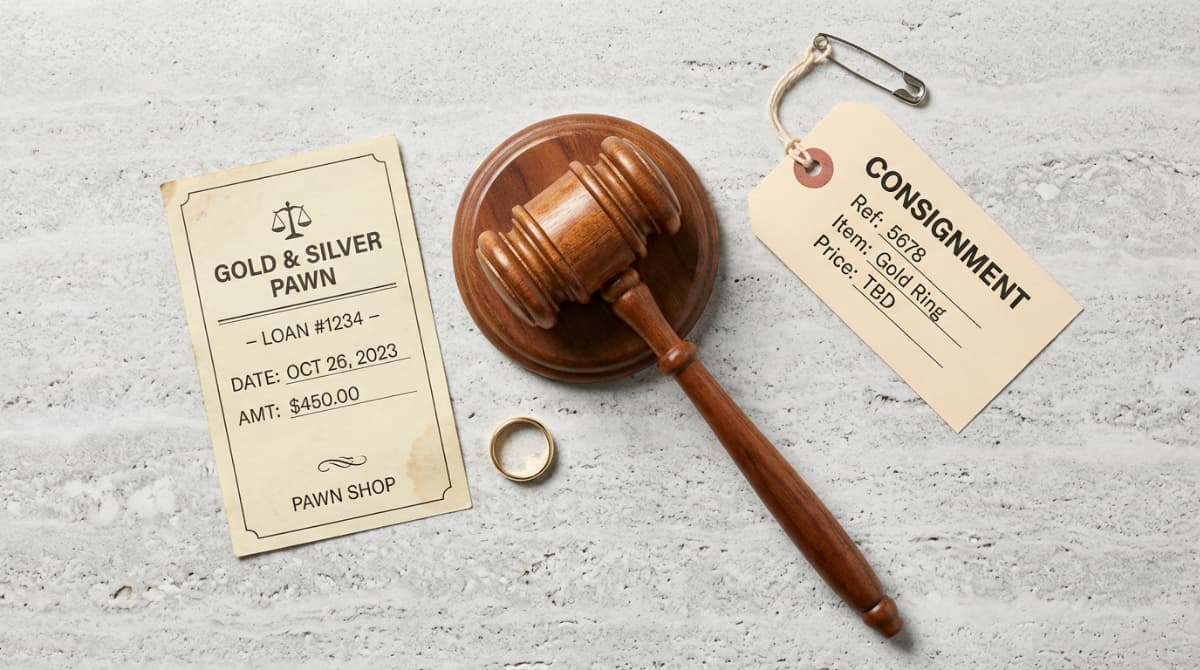
Pawn Shop vs. Auction vs. Consignment: Where to Get the Best Price?
Selling jewelry, antiques, or collectibles? Here's exactly how much each option pays — and which channel to choose based on what you're selling.
You have something valuable to sell. Maybe it's a gold ring, a vintage watch, a piece of art, or a coin collection. The question isn't whether it's worth money — it's how much money you'll walk away with, and that depends almost entirely on where you sell it.
The same item can fetch $200 at a pawn shop, $800 at auction, or sit in a consignment shop for three months before selling for $600. The difference isn't luck. It's knowing which channel fits your item, your timeline, and your priorities.
This guide breaks down every major selling option — what they pay, what they charge, and who they're actually right for.
Table of Contents
- The Three-Way Trade-off: Speed, Price, and Effort
- Pawn Shops: When Fast Cash Is the Priority
- Auction Houses: When Competitive Bidding Works in Your Favor
- Consignment: The Patient Seller's Option
- Selling Online: Maximum Control, Maximum Effort
- Which Option Gets You the Most Money?
- The Step You Should Always Take First
- Frequently Asked Questions
The Three-Way Trade-off: Speed, Price, and Effort
Every selling channel sits somewhere on a triangle: how fast you get paid, how much you get, and how much work you have to do. No single option wins on all three.
| Channel | Speed | Payout | Effort |
|---|---|---|---|
| Pawn shop | Same day | Lowest (20–50% of value) | Minimal |
| Auction house | 2–6 weeks | High (60–85% of market value) | Low (they handle it) |
| Consignment | Weeks to months | Medium-high (50–70% of sale price) | Low (they handle it) |
| Online (eBay, Etsy) | Days to weeks | Medium-high (you set the price) | High (you handle everything) |
The right choice depends on your specific situation — and on what the item actually is.
Pawn Shops: When Fast Cash Is the Priority
Pawn shops are designed for speed, not maximum return. They make you a single take-it-or-leave-it offer, and if you accept, you walk out with cash the same day. That's genuinely useful when you need immediate funds — but it comes at a steep cost.
What pawn shops actually pay:
For gold jewelry and coins, expect offers in the range of 40–60% of melt value — not market value. The melt value is the raw metal worth at spot price, ignoring craftsmanship, designer marks, gemstone quality, or collector demand. Some shops offer as low as 20% in competitive or slow-inventory situations.
For non-metal items like antiques, electronics, or collectibles, pawn shops typically work from their own resale estimates — and they have to leave significant margin to profit on the flip. General pawnbrokers also frequently misjudge specialized items. A rare coin that's worth $1,200 to a numismatist might get a $40 offer from a pawn shop that only sees the metal.
Never sell gold bullion coins (American Eagles, Maple Leafs, Krugerrands) or investment-grade items to a pawn shop. Specialist bullion dealers and coin auction houses will consistently pay 95–100% of spot price on these items. A pawn shop may offer 50–60%.
When a pawn shop makes sense:
- You need cash within hours, not weeks
- The item has modest value (under $300) and the opportunity cost of waiting isn't worth it
- It's a common item the shop deals in regularly (standard gold jewelry, basic watches)
Auction Houses: When Competitive Bidding Works in Your Favor
An auction house doesn't make you a single offer — it puts your item in front of multiple buyers who bid against each other. When demand is strong, that competition can push prices significantly above what any single buyer would offer outright.
What auction houses pay:
Auction results show that sellers typically receive 60–85% of the item's fair market value after fees. Seller commissions usually run 10–20% of the hammer price at regional houses, with major houses like Sotheby's and Christie's negotiating rates individually for high-value consignments.
Additionally, buyers pay a buyer's premium (currently 27% at Sotheby's for lots hammering under $2 million) — which indirectly affects desirability and final sale prices.
The key advantage: Competitive bidding can exceed expectations entirely. A Cartier Love bracelet, a rare Morgan dollar, or a signed first edition can trigger a bidding war that no pawn shop or consignment deal would ever produce.
Minimum thresholds: Many regional auction houses set minimums of $300–$500 per lot. Major houses like Christie's and Heritage Auctions generally prefer items with estimated values of $1,000 or more. Below that threshold, look at specialist online auction platforms like LiveAuctioneers or Catawiki.
Best items for auction
- Designer jewelry (Cartier, Tiffany, Van Cleef)
- Rare coins and banknotes
- Fine art and signed prints
- Vintage watches (Rolex, Patek Philippe)
- High-demand collectibles (rare toys, sports memorabilia)
- Silver and sterling sets from notable makers
Items that underperform at auction
- Common gold jewelry with no designer mark
- Damaged or heavily worn pieces
- Very low-value items (fees outweigh the gain)
- Items with limited or niche collector appeal
- Anything with unclear provenance
Timeline: Expect 2–6 weeks from dropping off your item to receiving a check. Some online auction platforms are faster — 7–14 days from listing to payment.
Consignment: The Patient Seller's Option
Consignment sits between auction and doing everything yourself. You hand the item to a specialist dealer or shop, they market and sell it on your behalf, and you split the proceeds when it sells.
What consignment pays:
Typical consignment arrangements return 50–80% of the final sale price to the seller, depending on item value and the shop:
- High-end jewelry consignment: 60–70% to seller (30–40% commission)
- Antique dealers: 50–60% to seller (40–50% commission)
- High-value items at specialist dealers: up to 80% to seller (20% commission)
The key distinction from a pawn shop: the consignment shop is incentivized to get the highest possible price for your item, because their commission is a percentage of that price. A pawn shop just needs to buy low and resell — they profit from the spread.
Downsides:
- No guaranteed sale. If the item doesn't sell within the consignment period (often 60–120 days), it gets returned to you.
- Slow payout. You only get paid after the item sells. This could take weeks or months.
- Variable expertise. A generalist antique shop may not attract the right buyers for specialized items like coins or fine jewelry. Match the shop's specialty to what you're selling.
For jewelry specifically, specialist consignment platforms like Worthy (for diamonds and fine jewelry) use a hybrid model: your item is listed at online auction to a vetted buyer network, combining the reach of auction with the hands-off experience of consignment.
Selling Online: Maximum Control, Maximum Effort
Selling directly on eBay, Etsy, or specialist platforms removes the middleman — but makes you responsible for everything: photography, research, listing, communication, shipping, returns, and dispute resolution.
Real cost of eBay: While eBay's advertised final value fee is around 13.25%, total platform costs including payment processing typically land at 15–20% of the sale price. Add shipping materials and insurance for fragile or valuable items, and your net is closer to 70–75% of sale price — comparable to consignment, but far more time-consuming.
Where online selling wins:
- Niche collectibles with a dedicated online buyer community (vintage toys, trading cards, specific coin series)
- Items under $200 where auction house minimums make the channel impractical
- Items you can price confidently because you've done the research
Where online selling struggles:
- High-value items that require trust (buyers are cautious about fakes above $500–$1,000)
- Fragile antiques where shipping damage risk is significant
- Anything that benefits from competitive bidding in a room of specialists
Which Option Gets You the Most Money?
The answer depends entirely on what you're selling. Here's a practical breakdown by item type:
Estimated payout as % of fair market value by channel
For designer jewelry (Cartier, Tiffany, Van Cleef): Auction house first. Secondary market data shows Van Cleef Alhambra pieces selling at 86% of retail, Cartier Love at 78%. A pawn shop will offer melt value — a fraction of this.
For plain gold or silver jewelry: Calculate the intrinsic melt value first. A cash-for-gold buyer or bullion dealer will pay 90–95% of melt value for scrap metal — better than a pawn shop. For pieces with gemstones, consignment or auction makes more sense.
For coins: Specialist coin auction houses (Heritage Auctions, Stack's Bowers) consistently outperform everything else for numismatic coins. Common-date bullion coins go to bullion dealers at near-spot prices.
For antiques and collectibles: Specialist consignment or a relevant auction house. A generalist pawn shop will undervalue these almost every time.
For low-value everyday items: eBay, Facebook Marketplace, or a local estate sale is often the most practical — auction house minimums and consignment periods aren't worth it.
The Step You Should Always Take First
Before you choose a channel, know what you have. Walking into a pawn shop without any baseline puts you entirely at the mercy of their offer. Walking into an auction house negotiation without knowing your item's value means you can't evaluate their terms.
An independent appraisal is ideal — but not always practical before a quick sale. WorthLens.ai lets you photograph your item and get an AI-powered price estimate in under a minute. It's not a formal appraisal, but it gives you a realistic starting point to evaluate any offer you receive.
A pawn shop offering $150 feels very different when you know the item's fair market value is $400 vs. $160. That number changes the entire negotiation — and whether you walk out the door.
The single most common mistake sellers make is accepting the first offer they receive because they have no independent reference point. An AI estimate takes 60 seconds. A professional appraisal takes a day. Either one is worth more than selling blind.