How to Tell If a Painting Is Valuable: Art Authentication for Non-Experts
Inherited a painting or spotted something interesting at a sale? Here's how to tell if it's worth anything — no art degree required.
You find a painting at the back of a closet. It's old, the frame is dusty, and there's something that might be a signature in the lower right corner. Is it worth a fortune? Is it a mass-produced print? Is it even original?
Most people in this situation have no idea what they're looking at. That's completely normal — the art world has its own language, its own gatekeepers, and its own methods for establishing what something is worth. But the basics of identifying whether a painting has real value are surprisingly accessible.
This guide walks you through exactly what to look for — the physical clues, the provenance questions, the signature research — and how to get an informed starting point before spending money on a professional appraisal.
Table of Contents
- The Five Factors That Determine a Painting's Value
- How to Physically Examine a Painting
- Reading the Signature: What It Means and How to Check It
- Provenance: Why Ownership History Changes Everything
- How to Research a Painting's Value Online
- When to Hire a Professional Appraiser
- FAQ
The Five Factors That Determine a Painting's Value
A painting's market value is set by the intersection of five elements. Understanding them helps you quickly sense whether something is worth pursuing.
1. Artist identity. This is the single most important factor. A painting by a recognized artist — whether a 19th-century regional painter or a major 20th-century name — can be worth thousands to millions. An identical painting by an unknown hand might sell for a few hundred dollars at most. Everything else flows from attribution.
2. Authenticity and provenance. Even if you identify an artist's name, the painting must be genuinely by that hand. Forgeries and copies exist in every price range. Provenance — the documented ownership history — is the primary tool for establishing authenticity.
3. Condition. Damage, restoration, and aging all affect value. A painting in original, unrestored condition typically commands a premium. Extensive overpainting, canvas tears, or severe cracking can make restoration uneconomical and dramatically reduce worth.
4. Subject matter and quality. Not all works by the same artist are equal. Major exhibition pieces, celebrated subjects, and paintings from an artist's best period command premiums. Sketches, studies, and minor works sell for less.
5. Market demand. The art market fluctuates. An artist who was out of fashion for decades can re-enter demand after a museum retrospective or critical reassessment. Current auction results are the ground truth for what a painting will actually sell for today.
What determines a painting's market value
How to Physically Examine a Painting
Before researching anything online, examine the object itself. The physical evidence is often the fastest way to answer basic questions.
Front of the painting
Look at the surface with a raking light (a lamp held at an angle across the surface). Real hand-painted works show visible texture — the physical build-up of paint, brushstroke ridges, and variation in surface depth. A completely flat, uniform surface usually indicates a reproduction print, not an original.
Use a magnifying glass or your phone's camera zoomed in close. Printed reproductions show a regular pattern of tiny dots (called a halftone or rosette pattern). Original paintings have no such pattern — their surface is irregular, organic, and three-dimensional.
Check for craquelure — the network of fine cracks that develops naturally in old oil paint. Authentic aged paintings typically show characteristic craquelure patterns that are extremely difficult to fake convincingly. Artificially induced cracking (a forgery technique) tends to look uniform and mechanical under magnification.
Back of the painting
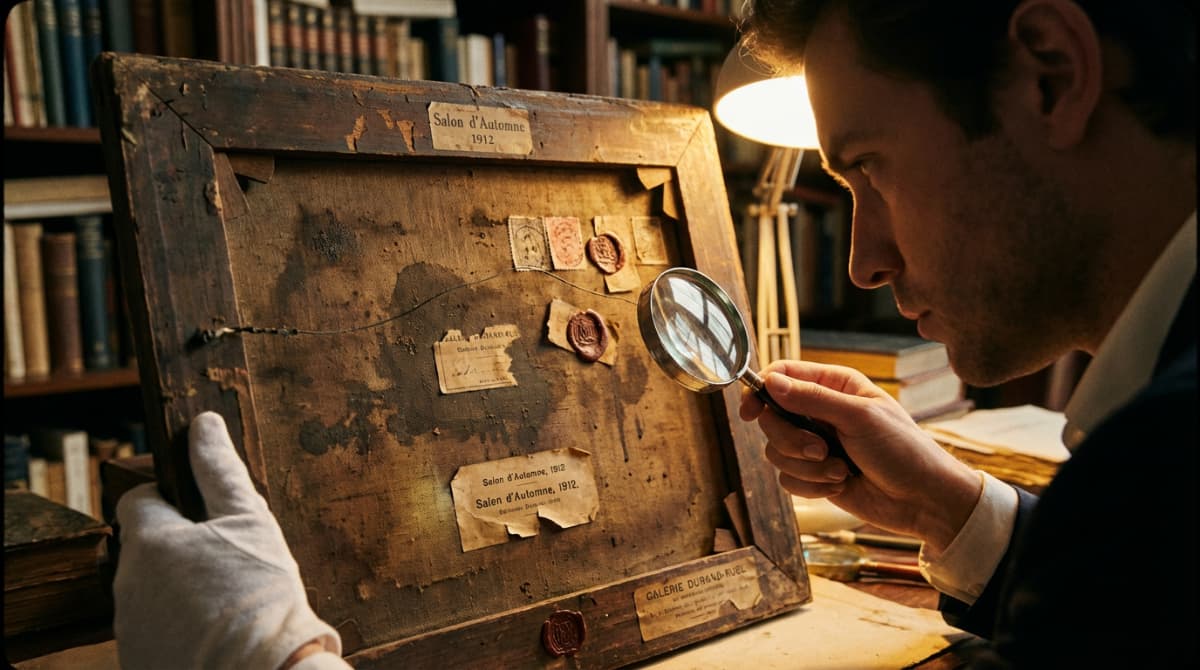
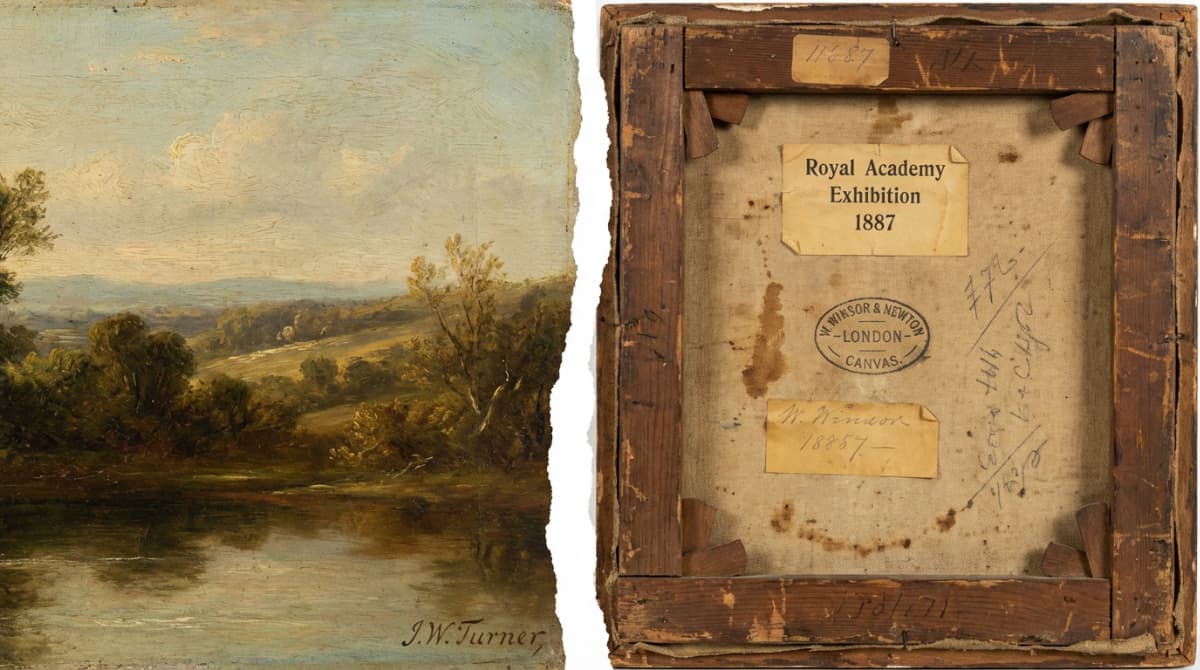
The reverse of a canvas or panel is a goldmine of information. Look for:
- Exhibition labels and stamps — stickers or stamps from galleries, auction houses, or exhibitions identify where the work has been shown and sold
- Inventory numbers — handwritten numbers or codes from dealers or estates
- Canvas stamps — fine art canvas suppliers often stamped their product; Parisian canvases from the 19th century have specific known stamps
- Inscriptions — titles, dates, and dedication inscriptions written in pencil or ink by the artist or a previous owner
Never remove old labels, stamps, or inscriptions from the back of a painting. They are provenance evidence. Even a small, faded auction house sticker can trace a painting's ownership history back decades.
Medium and support
Oil on canvas typically commands higher prices than works on paper, board, or other supports. Watercolors and drawings sell for less than oils by the same artist, in most cases. Identifying the medium is part of establishing the painting's place in an artist's oeuvre.
Reading the Signature: What It Means and How to Check It
A signature is not proof of authenticity — but its presence, absence, style, and placement are all meaningful data points.
Most artists sign in the lower left or lower right corner of the front. Some sign on the back. Signatures can be in paint, pencil, or chalk. Some artists used consistent signature styles throughout their career; others varied considerably.
How to verify a signature:
- Photograph it clearly and search online for the artist's known signature examples. Museums and catalogue raisonné databases often include signature exemplars.
- Compare the style of handwriting, the way letters connect, and whether the signature uses initials, a full name, or a monogram — all of these are consistent within an artist's authentic works.
- Check the medium consistency: a signature painted in the same material as the work itself is more credible than one that looks applied later in a different substance.
Signatures can be — and routinely are — added to unsigned paintings to inflate their value. A suspicious signature is one that appears "fresher" than the surrounding paint, sits on top of the aged varnish layer, or differs visually from documented examples of the artist's handwriting.
For scientific verification of signatures, laboratories use infrared spectrometry (FTIR), Raman spectrometry, and X-ray fluorescence (XRF) to analyze the chemical composition of paint layers. A signature using pigments that weren't manufactured until after an artist's death is conclusive proof of forgery. This level of analysis requires a specialist lab, but it's only warranted for pieces with significant value at stake.
Provenance: Why Ownership History Changes Everything
Provenance is the documented chain of ownership from the artist's studio to the present day. A well-documented provenance serves two functions: it helps establish authenticity, and it independently adds value.
A painting with clear provenance — auction records, gallery invoices, exhibition history, estate documentation — commands 3 to 5 times more at auction than an equivalent work with no known history.
What good provenance looks like:
- Auction house records (Christie's, Sotheby's, Bonhams, Heritage Auctions)
- Gallery purchase receipts or invoices
- Exhibition catalogue entries with the work illustrated
- Published catalogue raisonné entries (the definitive scholarly listing of an artist's works)
- Letters or correspondence mentioning the specific work
- Clear inheritance documentation through named estates
What to do with provenance documents you find:
Gather everything. Old receipts, auction catalogues, letters, photographs of the painting hanging in a previous owner's home — all of it matters. Cross-reference names and dates. Search for the painting in online auction databases using partial descriptions.
The Smithsonian American Art Museum and the International Foundation for Art Research (IFAR) both publish guidance on provenance research and maintain authentication databases.
How to Research a Painting's Value Online
Once you have a potential artist attribution, the research process is straightforward.
Step 1: Search auction records. The two most comprehensive databases are Artnet and Invaluable. Both archive decades of auction results and allow you to search by artist name to see what comparable works have sold for. Christie's, Sotheby's, and Heritage Auctions all publish their full sale results online for free.
Step 2: Check the catalogue raisonné. For significant artists, scholars compile a definitive catalogue of their entire known output. If your painting isn't in the catalogue raisonné, that doesn't automatically make it a forgery (catalogues are periodically updated), but it warrants investigation.
Step 3: Use AI appraisal as a first screen. Upload a clear photo to WorthLens.ai and get an instant AI analysis of the painting — style, period, medium, and an estimated value range. This is particularly useful when you have no starting point; the AI can suggest potential attributions and flag obvious red flags before you invest in professional consultation.
Step 4: Contact the artist's estate or foundation. For 20th-century artists, many foundations exist specifically to authenticate works. The Warhol Foundation, the Basquiat Authentication Board, and similar bodies issue formal opinions on whether works are genuine.
When to Hire a Professional Appraiser
Not every painting warrants a paid appraisal. Use this framework to decide:
Self-research is enough if:
- The painting has no signature or attribution
- Auction records show similar unsigned works selling for under $500
- The painting is clearly a reproduction or decorative print
Professional appraisal is warranted if:
- You have a potential artist attribution and auction records show works selling for $1,000+
- You need a value for insurance, estate purposes, or a tax deduction
- You're planning to sell and want a defensible valuation
- You suspect the work may be significant but can't confirm attribution
Certified appraisers affiliated with the American Society of Appraisers (ASA) or the Appraisers Association of America (AAA) charge $200–$400 per hour. For insurance and tax purposes, only a qualified appraiser's written opinion holds legal standing.
Before paying for an appraisal, use WorthLens.ai to upload a photo and get an AI-generated starting point. If the AI identifies a plausible attribution with meaningful value range, you have a much clearer basis for deciding whether a paid appraisal makes financial sense.
What Separates a $200 Painting from a $200,000 One
The gap between decorative and genuinely valuable is often narrower than people expect — and sometimes wider. Here's a quick orientation:
Typical auction value ranges by artist category (USD)
The jump from "listed regional artist" to "recognized national" is mostly driven by auction history, museum representation, and critical documentation. The jump to "blue chip" involves all of those plus sustained market demand from major collectors and institutions.
Most paintings people discover in attics or at estate sales fall into the first two categories. That doesn't mean worthless — a regional painter with a strong local market can produce work that sells consistently for $1,000–$5,000. But the expectation of a hidden masterpiece should be tempered by realistic base rates.
FAQ
You don't need an art history degree to take the first step. Upload a clear photo of your painting — front, back, and a close-up of the signature — and get an instant AI analysis in seconds.