Antique Vase Identification: How to Read Makers' Marks and Find the Value
That small stamp on the bottom of your vase could mean it's worth hundreds — or thousands. Here's how to decode ceramics marks and find a real value.
You pick up an old vase from an estate sale — nice shape, decent glaze, nothing obvious about it. Then you flip it over and see a small stamp or painted symbol on the base. What does it mean? Is it worth $15 or $15,000?
The truth is, that mark on the bottom is often the single most important clue to identifying your piece and understanding its value. Ceramics manufacturers have been stamping, painting, and pressing marks into their work for centuries — and once you know what to look for, those marks tell you exactly who made it, when, and roughly how much it could sell for today.
This guide walks you through how to read antique vase and ceramics marks, which manufacturers command real money at auction, and what else affects the final price beyond the mark itself.
Table of Contents
- Step 1: Flip It Over — What to Look for on the Base
- The 6 Types of Marks Found on Antique Ceramics
- Famous Makers' Marks and What They're Worth
- Chinese Reign Marks: The Most Misunderstood Marks in Ceramics
- How to Date a Vase Without a Mark
- How Much Is Your Antique Vase Worth?
- FAQ
Step 1: Flip It Over — What to Look for on the Base
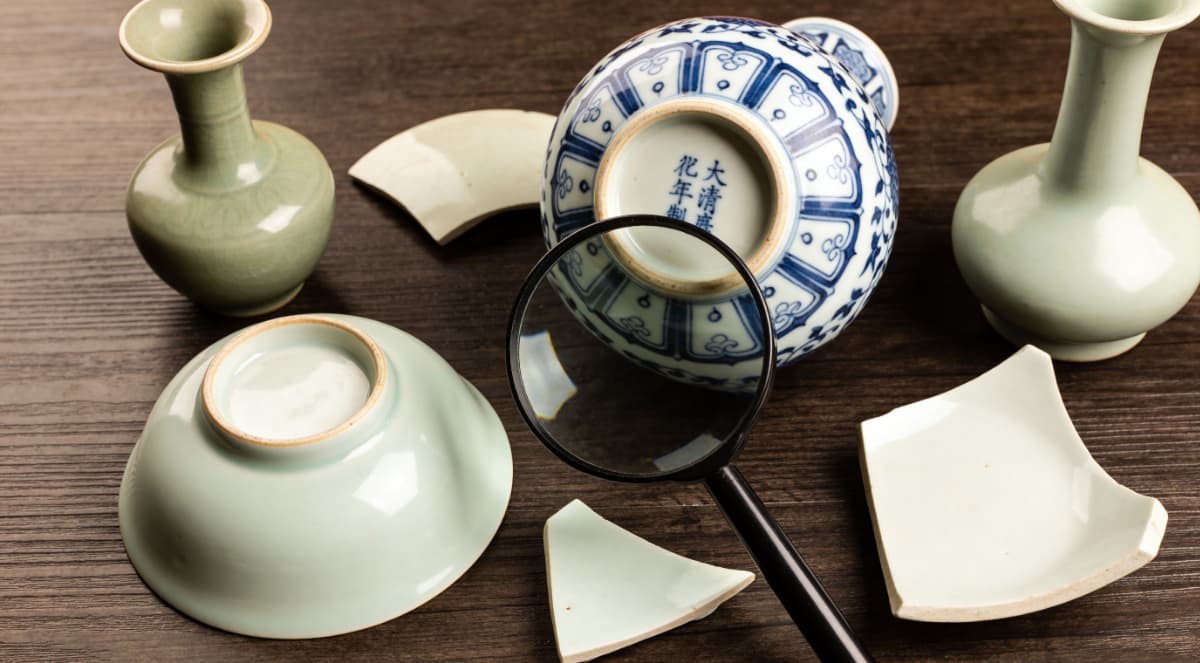
The base of a ceramic piece is where manufacturers left their fingerprints. Before doing any research, set the vase upside down on a soft surface and examine the bottom carefully — ideally with a loupe or magnifying glass and good raking light.
You're looking for:
- Painted marks — applied with cobalt blue, red, or black ink over or under the glaze
- Impressed marks — stamped into the clay before firing, leaving a raised or sunken impression
- Incised marks — scratched into unfired clay with a tool, like an engraving
- Transfer-printed marks — printed mechanically, common from the 1800s onward
- Stenciled or ink-stamped marks — often used by 20th-century factories
Take clear photographs of every mark from multiple angles. Oblique lighting helps reveal impressed marks that are easy to miss straight-on.
A simple test for porcelain vs. pottery: hold the piece up to a bright light source. Porcelain is slightly translucent — light passes through thin walls. Earthenware and stoneware remain fully opaque. Porcelain generally commands higher values.
The 6 Types of Marks Found on Antique Ceramics
Not all marks are factory marks. Understanding the type helps you narrow down where to look.
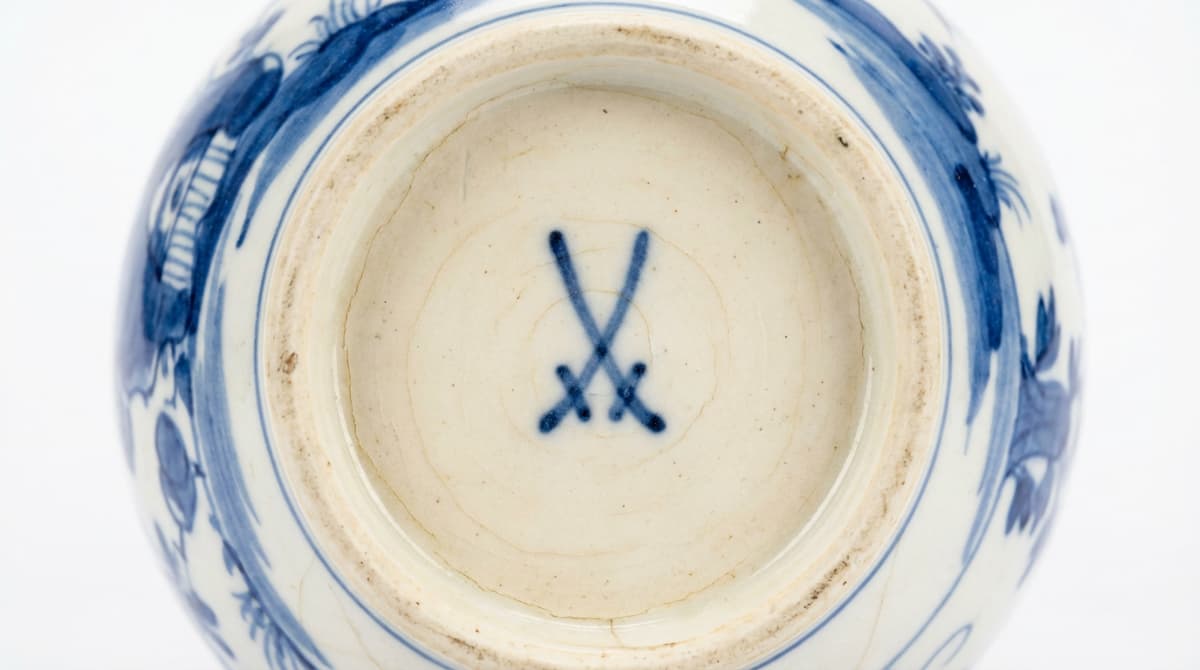
1. Factory or manufactory marks — The most common. Includes the company name, logo, initials, or a symbol (like Meissen's crossed swords). These tell you who made the piece.
2. Country of origin marks — Required by the McKinley Tariff Act of 1891 for goods imported into the US. If your piece says "England," "Germany," or "France" (not "Made in England"), it was likely made between 1891 and roughly 1921. This is a reliable dating shortcut.
3. Pattern or shape marks — A name or number indicating the specific design or mold. Common on English transferware and studio pottery.
4. Decorator or artist marks — The initials or signature of the individual who painted or decorated the piece. On high-end manufacturers like Royal Doulton or Meissen, named decorators add significant value.
5. Date codes — Some manufacturers (notably Royal Doulton, Minton, and Wedgwood) used systematic date codes — letters, symbols, or numbers — to record the exact year of manufacture.
6. Retailer marks — Some pieces were made by one factory but sold under a retailer's name (like Tiffany & Co. or a department store). The maker's mark is often alongside or beneath the retailer's name.
Famous Makers' Marks and What They're Worth
Meissen — The Crossed Swords
Founded in 1710 in Saxony, Germany, Meissen was Europe's first hard-paste porcelain manufacturer. The crossed swords mark, derived from the Saxon coat of arms, has been used since around 1720 and is one of the most recognized marks in ceramics.
Authentic Meissen is identified by blue underglaze crossed swords, often with a dot, star, or extra line between the hilts depending on the period. Meissen has been extensively faked — look for sharp, precise brushwork, correct proportions, and the quality of the porcelain itself.
Value range: Common Meissen pieces: $300–$2,000. Rare figures, large vases, or named decorators: $5,000–$50,000+.
Wedgwood — The Impressed Name Mark
Josiah Wedgwood, often called the "Father of English Potters," founded his company in 1759. Look for "WEDGWOOD" impressed (never painted) into the clay. Pieces marked "WEDGWOOD & BENTLEY" date to the partnership years 1768–1780 and are particularly early and collectible.
A useful dating rule: pieces marked "Wedgwood England" were made after 1891; pieces marked just "Wedgwood" without a country are pre-1891. "Made in England" indicates post-1920s production.
Value range: Common jasperware: $50–$400. Early Wedgwood & Bentley pieces: $1,000–$10,000+.
Royal Doulton — The Lion and Crown
Royal Doulton received its Royal Warrant from King Edward VII in 1901, and the lion-and-crown mark appeared from that year forward. Earlier pieces (marked simply "Doulton Lambeth" or "Doulton Burslem") predate 1901 and are often more desirable to serious collectors.
Royal Doulton used printed date codes — a letter system for year and month — that allow precise dating when you know how to read them. Pieces by named Doulton artists like Hannah Barlow (etched animals) or George Tinworth (sculptural work) carry significant premiums.
Value range: Common Royal Doulton figurines or vases: $50–$500. Signed artist pieces or early Lambeth studio work: $500–$5,000+.
Other marks worth knowing
- Limoges (France): Quality French porcelain; look for "Limoges France" with a factory mark. Value: $100–$3,000+.
- Moorcroft (England): Hand-painted botanical designs with a distinctive raised outline technique. Look for "Moorcroft" in script, often with "W.M." for William Moorcroft pieces. Value: $500–$10,000+.
- Roseville Pottery (USA): Raised "Roseville" mark with shape/size numbers. Depression-era florals. Value: $50–$800 for common pieces.
- Coalport (England): Founded late 1700s; the most valuable pieces post-1881. Look for "Coalbrookdale" or crown imagery. Value: $200–$4,000.
Chinese Reign Marks: The Most Misunderstood Marks in Ceramics
Chinese porcelain reign marks are perhaps the most misunderstood — and most often misrepresented — marks in the antiques world.
A reign mark consists of six Chinese characters arranged in two columns. Read right to left, top to bottom: the first two characters name the dynasty, the next two name the emperor, and the final two mean "made during the reign of." A Qianlong mark, for example, reads: "Da Qing Qianlong Nian Zhi" — "Made during the reign of Qianlong of the Great Qing [dynasty]."
The critical problem: Chinese artisans have applied earlier reign marks to later pieces for centuries — sometimes as artistic homage, sometimes to deceive. A piece marked "Qianlong" (1736–1795) may have been made in 1890, 1960, or last year. According to specialists at Christie's and leading auction houses, reign marks alone cannot authenticate Chinese ceramics.
Never buy a Chinese porcelain vase based on the reign mark alone. Authentication requires examining the clay body, glaze quality, decorative technique, and foot rim — ideally by a specialist with hands-on experience. Thermoluminescence (TL) testing can definitively date the clay but costs $300–$500 per piece.
What actually matters for value is the designation "mark and period" — meaning the mark matches the actual period of manufacture, verified by physical examination. A blue-and-white hu-form vase with a genuine Qianlong mark sold at Christie's Hong Kong for over 1.5 million HKD. The same shape with an apocryphal mark might fetch $5,000–$10,000.
For Chinese ceramics authentication, consult specialist resources like Invaluable's Reign Marks Guide or seek an Asian ceramics specialist at a major auction house.
How to Date a Vase Without a Mark
Many antique pieces are unmarked — especially pre-1750 European ceramics, studio pottery, and folk pottery. Age can still be estimated from physical characteristics:
Foot rim: Older ceramics often show unglazed foot rims with kiln grit or stacking marks. Machine-perfect foot rims suggest 20th-century manufacture.
Glaze: Antique glazes may show crazing (fine crack networks) caused by differential cooling over decades. Be cautious — crazing can be faked by rapid cooling, but authentic age-crazing usually shows dirt absorbed into the cracks.
Weight and wall thickness: Handmade pieces show slight irregularities in wall thickness. Machine-made pieces are perfectly uniform. Early porcelain tends to be lighter than later earthenware equivalents.
Color palette: Certain colors were unavailable before specific dates. True puce (pink-purple) in enamel wasn't used before the 1720s. Bright synthetic orange ("chrome orange") didn't exist before the 1820s. Certain bright synthetic colors appear only post-1860.
Decoration style: Transferware patterns, Art Nouveau florals, Art Deco geometry, and Mid-Century Modern forms each have characteristic visual signatures that narrow the date range significantly.
How Much Is Your Antique Vase Worth?
Once you've identified the maker and approximate date, value depends on five additional factors:
What drives antique vase value
1. Condition — Chips, cracks, repairs, and restoration all reduce value. A general rule: damage reduces value by 50–75% versus a mint example. Professional restoration is less damaging but should always be disclosed. Check under ultraviolet light to reveal hidden repairs — restored areas glow differently.
2. Decoration quality — Hand-painted decoration by a named artist adds a premium. Factory-decorated pieces are worth more than retailer-decorated ones. Original gilding (not worn) adds value; re-gilded pieces are less desirable.
3. Rarity — Limited production runs, unusual colorways, prototype pieces, or items from a factory's early years command more than common production items.
4. Provenance — Documented history — auction records, collection labels, estate documentation — increases buyer confidence and can add 20–40% to the price.
5. Current market — Taste changes. Victorian majolica was out of fashion for decades; it's back. Mid-Century studio pottery is currently strong. Check recent sold prices on LiveAuctioneers or eBay's completed listings to see what the market is actually paying right now.
Rough price ranges by category
| Category | Common examples | Typical range |
|---|---|---|
| Unmarked 20th-century factory vase | Generic European, Asian | $20–$200 |
| Named English pottery (Wedgwood, Royal Doulton) | Common patterns, post-1900 | $50–$500 |
| Meissen, Sèvres, KPM | Decorative vases, figures | $500–$10,000+ |
| Chinese porcelain (apocryphal mark) | Blue and white, famille rose | $200–$5,000 |
| Chinese porcelain (mark and period verified) | Kangxi, Yongzheng, Qianlong | $5,000–$1M+ |
| Signed Art Nouveau glass (Gallé, Lalique) | Overlay vases | $3,000–$100,000+ |
| Studio pottery by known ceramist | 20th-century named makers | $200–$5,000 |
The fastest way to get a baseline estimate is to upload clear photos — especially of the mark — to WorthLens.ai. The AI identifies the maker and decoration style from the image and gives you a realistic price range before you spend time visiting dealers or auction specialists.
For pieces likely worth more than $1,000, always follow up an AI estimate with a written appraisal from a specialist or a specialist auction house. Major houses like Bonhams, Christie's, and Heritage Auctions offer free auction estimate services.