How Much Is My Old Watch Worth? A Complete Valuation Guide
Found an old watch in a drawer or inherited one from a relative? This complete guide walks you through exactly how to determine its value — from identifying the reference number to understanding what condition really costs you.
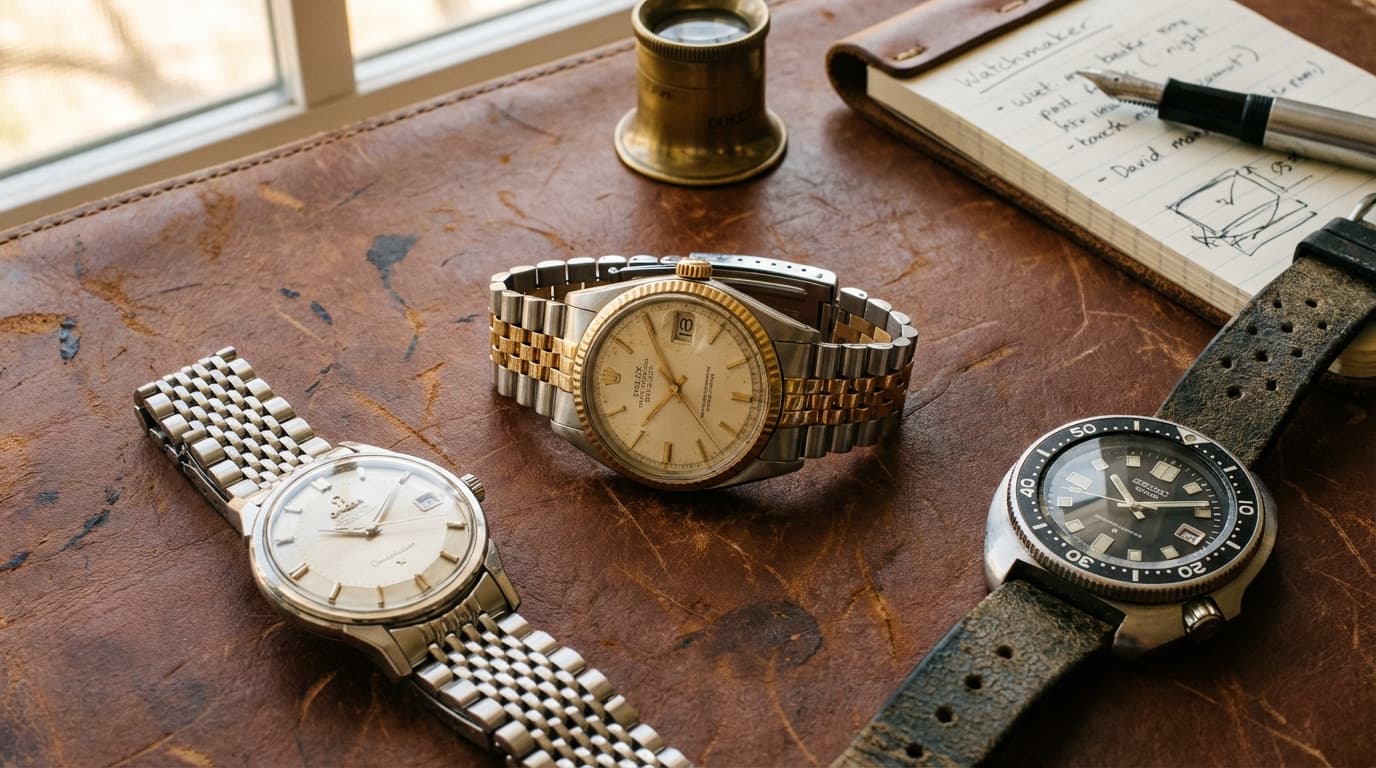
You open a drawer, dig through an old jewelry box, or inherit a collection from a relative — and there it is. A watch you don't recognize, might be worth something, and have no idea how to value. Maybe the case is scratched, maybe the dial looks faded. Maybe it runs, maybe it doesn't.
The vintage watch market is one of the most complex and rewarding in the collectibles world. A battered Rolex Daytona from the 1970s can fetch $30,000. A pristine-looking fashion watch from the same era might sell for $40. Condition matters, but brand matters more. Brand matters, but reference number matters more. Getting the answer right requires understanding all of these layers — and this guide walks you through every one of them.
Table of Contents
- Step 1: Identify Your Watch Before You Value It
- What Factors Actually Determine a Watch's Value?
- Condition Grading: What Do Mint, Excellent, and Good Really Mean?
- Price Ranges by Brand: What Is My Watch Worth?
- Does Having the Box and Papers Really Matter?
- How to Get Your Watch Appraised
- FAQ
Step 1: Identify Your Watch Before You Value It
You cannot value a watch you cannot identify. This is the step most people skip — and it's the one that matters most.
Find the Reference Number and Serial Number
Every serious watch manufacturer assigns each model a reference number (also called a ref. or model number) that identifies the exact variant, and a serial number that identifies the individual piece and reveals its production year.
On most watches, you'll find these numbers engraved on the case in one of three locations:
- Between the lugs (the "horns" at 12 o'clock and 6 o'clock) — standard on Rolex since the mid-1940s
- On the caseback — common on Omega, Seiko, and most non-Swiss brands
- On the inside of the caseback — requires a watchmaker to open the case
Write both numbers down before you do anything else. The reference number tells you exactly which model you have. The serial number lets you date the movement and — in some cases — verify authenticity.
Identify the Movement Type
Flip the watch over or note whether it has a seconds hand that sweeps continuously (automatic or manual mechanical) or ticks once per second (quartz). Movement type significantly affects collector interest:
- Manual mechanical: wound by hand, the oldest technology — high collector appeal when from a prestigious caliber
- Automatic (self-winding): wound by wrist movement — the sweet spot for most collectors
- Quartz: battery-powered, accurate, but generally lower collector value unless it's a rare early model (e.g., the Seiko Astron, the first quartz watch, 1969)
If you can see through the caseback and spot a moving rotor, it's an automatic. If the caseback is solid, use a magnet: mechanical watches are weakly attracted, quartz watches contain a tiny battery and show no attraction to a magnet.
Read the Dial for Clues
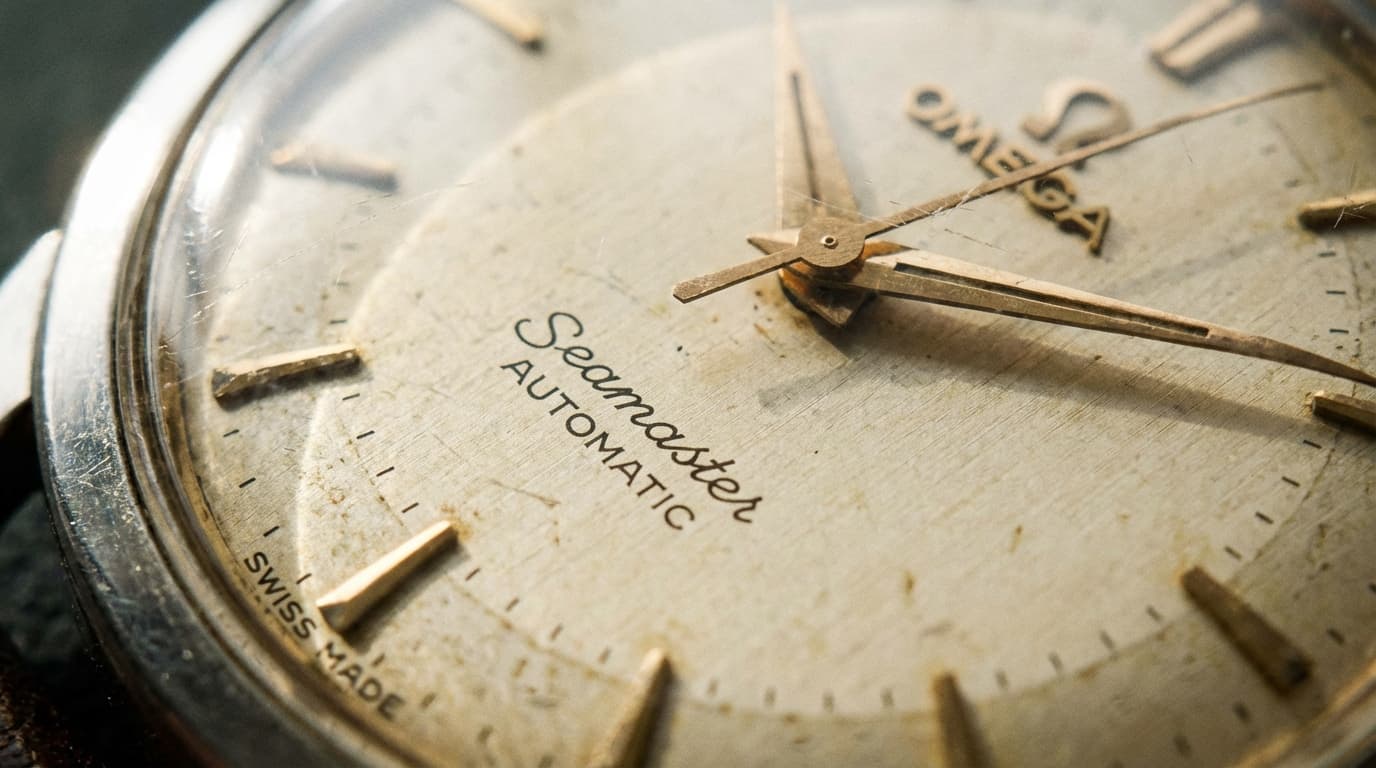
The dial (the face of the watch) carries critical information: brand name, model name, any complications (date, chronograph, moon phase), and sometimes the caliber number. Look for text printed at 6 o'clock under the main dial — this often says "Automatic," "Swiss Made," "17 Jewels," or names the specific caliber.
What Factors Actually Determine a Watch's Value?
Once you know what you have, these are the variables that decide what it's worth on the open market.
Brand and Model Prestige
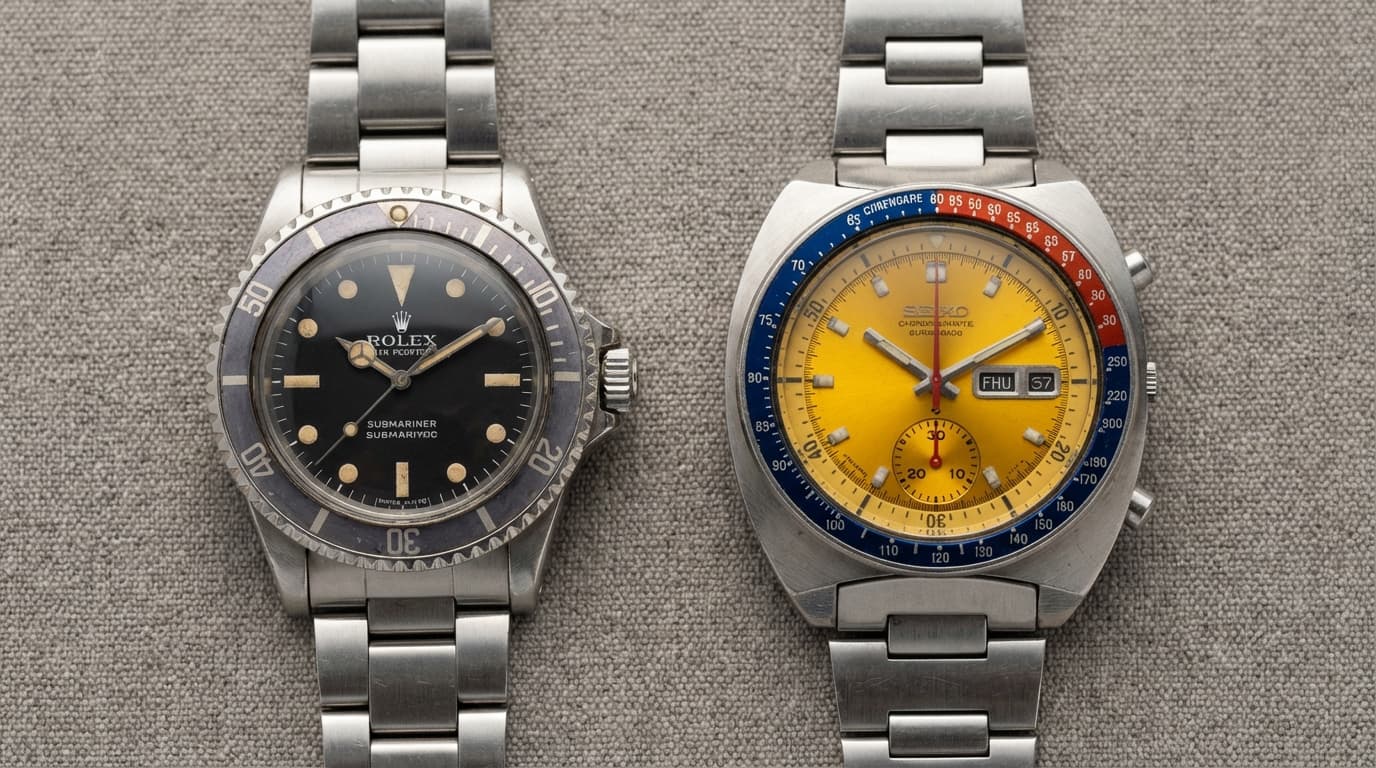
Brand is the single largest value driver. Within each brand, the specific reference determines whether you have an entry-level piece or a grail watch. A Rolex Datejust and a Rolex Daytona are both Rolexes — but the Daytona routinely sells for three to five times more than the equivalent Datejust.
Brands with the strongest vintage collector markets, roughly in order:
- Patek Philippe — consistently the most valuable. Vintage Calatravas start around $5,000; complicated pieces can reach six figures.
- Rolex — most liquid vintage market in the world. Even entry-level vintage pieces rarely sell below $2,500.
- Omega — strong collector demand for Speedmasters (the "Moonwatch"), Seamasters, and Constellations.
- Jaeger-LeCoultre — reversos and complicated dress watches highly sought.
- Vacheron Constantin — prestigious but more niche collector base.
- Seiko — exceptional value for the money; certain references (Grand Seiko, Marinemaster, chronographs) have exploded in value.
- Tissot, Longines, Zenith — strong mid-tier vintage markets, undervalued by mainstream buyers.
Originality: The Most Underrated Factor
In the vintage watch world, originality is king. A replacement dial — even a perfect one — can reduce value by 30–50%. Non-manufacturer replacement hands, a refinished case, or a service-era bracelet where an original should be all drag the price down significantly.
The dial is especially important. Collectors pay a significant premium for original "tropical" dials (dials that have developed a rich brown or chocolate patina from decades of UV exposure), original "glossy" dials, and any dial that shows honest age without refinishing.
Never polish a vintage watch case before getting it appraised. Polishing removes the original surface, erases sharp edges, and can cut the value of a collectable piece by 20–40%. A scratched but original case is worth more than a polished-bright one.
Rarity and Production Numbers
Limited production runs, discontinued references, and watches with unusual dial variants command premiums. The Rolex "Paul Newman" Daytona — a variant with an "exotic" dial design that Rolex produced in small numbers in the late 1960s and early 1970s — sells at auction for $200,000 to $500,000. The standard Daytona from the same era sells for $25,000 to $60,000.
Provenance and Service History
Provenance is the documented ownership and history of a specific watch. A watch worn by a notable person, issued to military personnel, or with documented history adds a significant premium. Service history — records showing the watch was maintained by an authorized watchmaker using original parts — also reassures buyers and supports value.
Market Timing
The vintage watch market is cyclical. Certain references spike in value after appearing on a celebrity's wrist or in a major auction. Checking current prices on WatchCharts (which tracks actual sold prices daily) is essential before forming any value estimate.
Condition Grading: What Do Mint, Excellent, and Good Really Mean?
The vintage watch community uses a standardized condition scale that runs from Poor to Mint/NOS (New Old Stock). Here's what each grade actually means in practice — and roughly how it affects value relative to a theoretical "perfect" specimen.
Approximate value retained by condition grade (relative to Mint)
Mint / Near Mint
Shows only the most minor handling marks, invisible without magnification. Original finish intact on all surfaces. Dial is factory-perfect with no fading, spotting, or damage. Rarely seen on watches over 40 years old — treat this grade with skepticism unless you have supporting documentation.
Excellent
Light, normal wear from careful use. Minor hairline scratches may be visible on the case, but case shape is strong and finishing is clearly original. Dial clean with no chips, cracks, or missing lume. Movement running correctly within normal tolerances.
Very Good
Noticeable but not deep scratches from regular wear. Case shape preserved. Dial may show minor age marks consistent with storage. Movement running, possibly needing service to bring within spec. This is the most common grade for a well-cared-for vintage watch.
Good
Clearly used with visible wear, possible light dings or dents. Dial may have age spots, slight fading, or minor damage at edges. May gain or lose more than a few minutes per day — service recommended. Value significantly reduced from Excellent but still fully collectible.
Fair
Heavy wear, dings, dents, or case deformation. Dial damaged — chips, cracks, missing indices. Movement may run erratically or not at all. Restoration required for wearability.
Poor
Significant abuse or damage. Missing parts, severe corrosion, non-running movement. Value is largely scrap or parts unless the reference itself is rare enough that collectors need components.
Condition grading for vintage watches is more forgiving than for modern pieces — a 60-year-old watch in "Very Good" condition is genuinely impressive. What matters is that wear is honest, consistent with the watch's age, and not the result of damage or amateur repair.
Price Ranges by Brand: What Is My Watch Worth?
These are realistic market ranges based on actual secondary market data. All prices are approximate and assume watches in Very Good to Excellent condition with no major damage. Box and papers add an additional 20–30% to most figures.
Rolex
Rolex dominates the vintage watch market in volume and liquidity. Even modest vintage Rolex pieces hold value exceptionally well.
- Datejust (ref. 1601, 1603, 16014): $3,500–$12,000 depending on dial, bracelet, and case condition. The Datejust 1601 has appreciated approximately 238% since 2010.
- Submariner (ref. 5513, 5512, 1680): $15,000–$35,000. The 5512 has shown 249% appreciation from 2014 to 2025.
- GMT-Master (ref. 1675, 16750): $12,000–$28,000 for steel variants; "Pepsi" bezel examples command a premium.
- Daytona (ref. 6263, 6265): $25,000–$60,000 for standard dials. "Paul Newman" exotic dial variants: $200,000–$500,000+.
- Air-King / Oyster Perpetual: $3,000–$7,000 — the most accessible entry point for vintage Rolex.
Omega
Omega offers some of the best collector value in the market — particularly the Speedmaster, which has a massive and dedicated following.
- Speedmaster Professional "Moonwatch" (pre-1970): $4,000–$12,000 for standard examples; early references with original dials can reach $20,000+.
- Constellation (1950s–1970s "pie pan" dial): $800–$3,500 for steel; gold cases: $2,000–$8,000.
- Seamaster (vintage 1950s–1960s): $500–$3,000 for steel; some rare variants higher.
- Dynamic / De Ville: $300–$1,200 — affordable vintage Omega entry points.
Seiko
The vintage Seiko market has expanded dramatically over the past decade, driven by exceptional mechanical quality at accessible prices.
- Seiko 5 (basic variants): $50–$400 on average; rarer references up to $1,000.
- Seiko 5 Sports / Sportsmatic: $200–$900.
- Grand Seiko (early references): $1,500–$8,000 for steel; gold-cased: $3,000–$15,000.
- Seiko Chronograph (6139, 6138 "Pogue"): $300–$1,500 for standard dials; the 6139 Pogue (worn in space) can reach $2,000–$4,000.
- Seiko Marinemaster / Prospex: $500–$3,000.
- Seiko Astron (1969 quartz): $500–$3,000 as a historically significant piece.
Tissot
Vintage Tissots are often overlooked and undervalued — which represents an opportunity for savvy buyers.
- Standard vintage dress watches: $100–$500.
- Tissot T12 / Tissot PR 516: $200–$800.
- Tissot Lemania-based chronographs: $1,500–$8,000 for well-preserved examples with original dials — a segment that has appreciated sharply.
Longines
Longines has one of the finest archives in Swiss horology and makes excellent starter pieces for new collectors.
- Flagship / Conquest: $300–$1,500.
- Longines chronographs (30L, 13ZN calibers): $500–$4,000.
- Longines Lindbergh Hour Angle Watch (vintage references): $2,000–$8,000.
Does Having the Box and Papers Really Matter?
Yes — significantly more than most people expect.
"Box and papers" refers to the original manufacturer's box, the warranty card (often called the "papers"), hang tags, chronometer certificates, and any original documentation that came with the watch when new. In collector terminology, a complete set is described as "full set" or "B&P".
The premium for a full set varies by brand:
- Rolex: 25–40% premium over a "naked" (no box/papers) example
- Omega: 15–25% premium
- Patek Philippe: 30–50% premium — papers are especially critical for authentication
- Seiko / Tissot: 10–20% premium
Why do papers matter so much? They provide independent verification of the reference number, production date, and sometimes the original retailer — all of which help confirm authenticity and establish provenance. For Rolex specifically, the warranty card's serial number must match the case to be valid.
Store your watch documentation separately from the watch itself — in a safe or document folder. Water, heat, and humidity can damage paper documents far more easily than a well-made watch case. Lost papers cannot be replaced by the manufacturer.
If you've lost your papers, some manufacturers (Rolex, Omega, Patek Philippe) offer archive extracts — official letters confirming the watch's production date and original specifications from factory records. These are not as valuable as original papers but do provide some documentation benefit.
How to Get Your Watch Appraised
Start With a Fast AI Appraisal
Before investing time in research or paying for a professional appraisal, the fastest way to get a ballpark value is to upload photos to WorthLens.ai. The platform uses AI to analyze the watch's visible characteristics — brand, case style, dial design, condition markers — and returns an estimated value range within seconds. It's a useful first filter, especially if you have several watches to evaluate and want to prioritize which ones merit deeper research.
Use Online Price Databases for Comparable Sales
Two platforms dominate the vintage watch pricing research space:
- WatchCharts: Tracks actual sold prices across major secondary market platforms, updated daily. The most reliable source for current market values.
- Chrono24: The world's largest watch marketplace. Browse current listings for your reference — but remember that asking prices are not the same as sold prices. Filter for completed sales or use the valuation tool.
- Bob's Watches: Specializes in Rolex; publishes transparent buy/sell prices and condition grading with photos — useful for calibrating your own condition assessment.
Also check completed eBay listings (filter by "Sold Items") for actual transaction prices. This is often more accurate than dealer asking prices, which are optimistic by design.
Get a Professional Appraisal for High-Value Pieces
For any watch you believe may be worth more than $1,500–2,000, a professional appraisal is worth the cost. Options include:
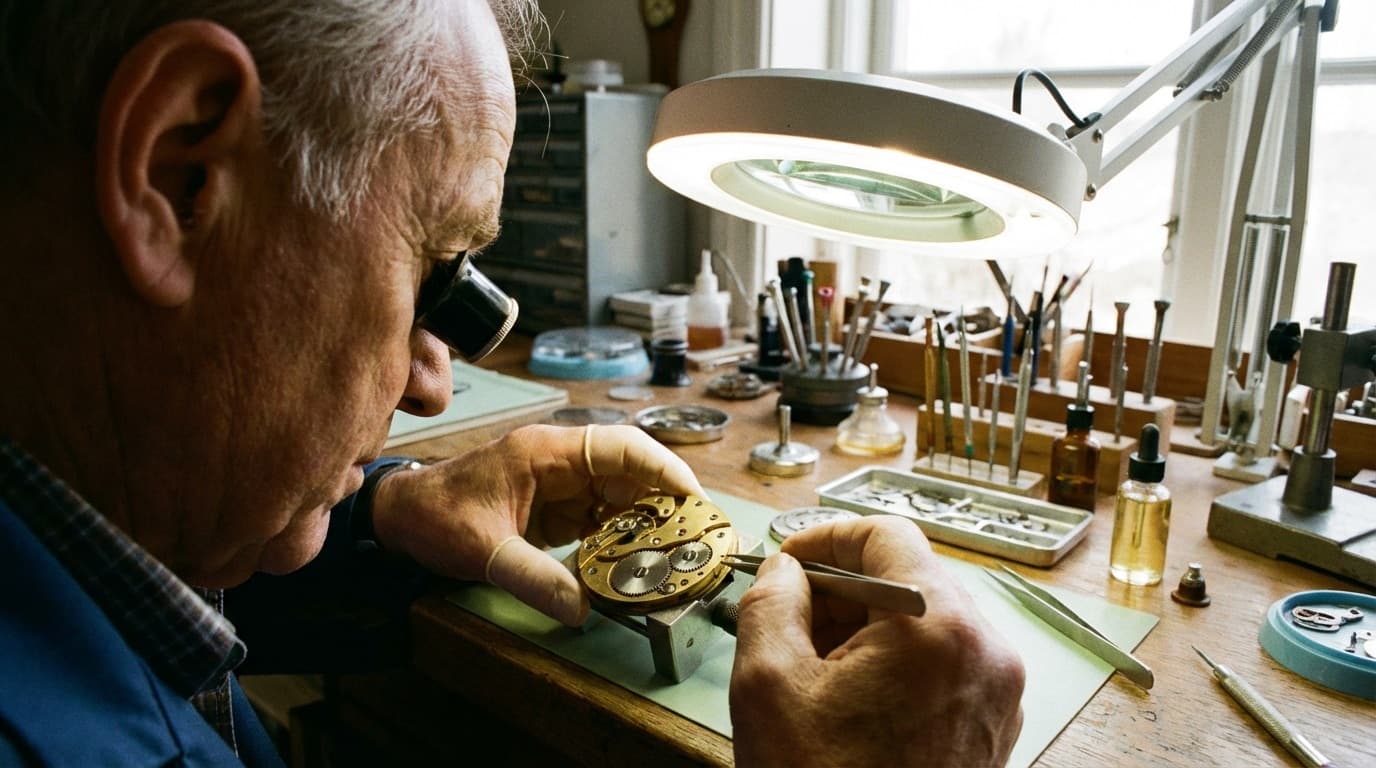
- Certified watchmakers with expertise in vintage horology (look for membership in AWCI — American Watchmakers-Clockmakers Institute)
- Auction house specialists: Christie's, Sotheby's, Phillips, and Antiquorum all offer free preliminary assessments for consignment candidates
- Specialist dealers: Hodinkee and regional vintage watch dealers often provide informal assessments
A professional appraisal typically costs $50–$200 and provides a written document useful for insurance purposes, estate settlement, or sale.
Know the Difference Between Retail, Wholesale, and Auction Value
Appraisers use different value standards for different purposes:
- Retail replacement value: What you'd pay a dealer to replace the watch — highest figure, used for insurance
- Fair market value: What a willing buyer and willing seller agree on — used for estate and donation purposes
- Liquidation value: What a dealer will offer to buy it from you — typically 40–60% of retail
- Auction estimate: Typically 60–80% of retail for estimated hammer price, before buyer's premium
When a dealer offers you $500 for a watch worth $1,200 at retail, they're not cheating you — they're pricing in their overhead, risk, and profit margin. If you have the time to sell privately through a marketplace, you'll typically realize 70–85% of retail value.
If you're unsure where to start, upload a photo of your watch to WorthLens.ai for an instant AI-powered estimate. It takes less than a minute and gives you a reference point before you talk to any dealer or appraiser.