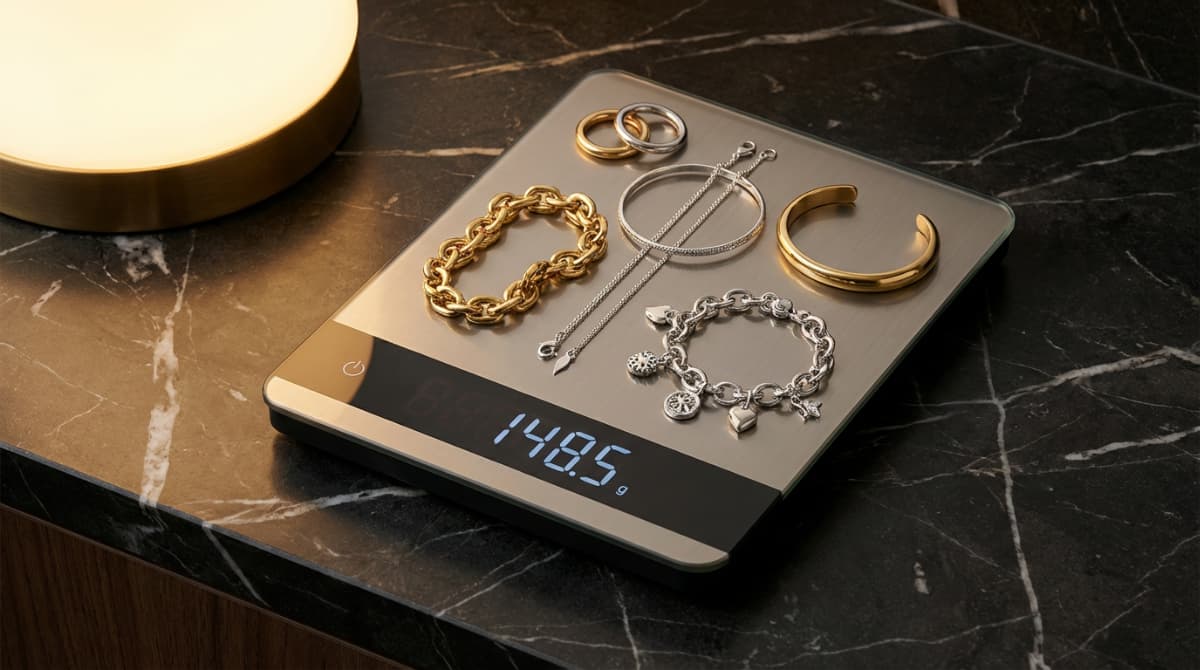
How to Calculate the Value of Gold and Silver Jewelry at Home
Learn the exact formula for calculating gold and silver jewelry melt value at home — with worked examples for every karat and live metal prices.
You pick up a gold chain and wonder: how much is this actually worth? Not what a jewelry store charges for something like it — what the metal itself is worth, today, in cash.
The good news is that calculating gold and silver jewelry value at home requires nothing more than a kitchen scale, the karat stamp on your piece, and a quick look at the current spot price. The formula takes under a minute once you know it.
This guide walks through how to calculate gold jewelry value step by step, with worked examples for every karat — including the gap between melt value and what you'll actually receive when selling.
Table of Contents
- The Formula: How Gold Value Is Calculated
- Step 1 — Find the Karat Stamp
- Step 2 — Weigh Your Jewelry
- Step 3 — Look Up the Spot Price
- Worked Examples: Gold Value per Gram by Karat (April 2026)
- How to Calculate Silver Jewelry Value
- Melt Value vs. What You Actually Get Paid
- When Is Jewelry Worth More Than Its Melt Value?
- FAQ
The Formula: How Gold Value Is Calculated
The gold melt value formula is:
Melt Value = Weight (grams) × Purity (decimal) × Spot Price per gram
For example, a 5-gram 18K gold ring at a spot price of $150/gram:
5 × 0.75 × $150 = $562.50
That's the melt value — the intrinsic metal content worth. It's the floor price for any gold piece, regardless of design or brand. Everything above that floor is craftsmanship, brand premium, or collector value.
Step 1 — Find the Karat Stamp
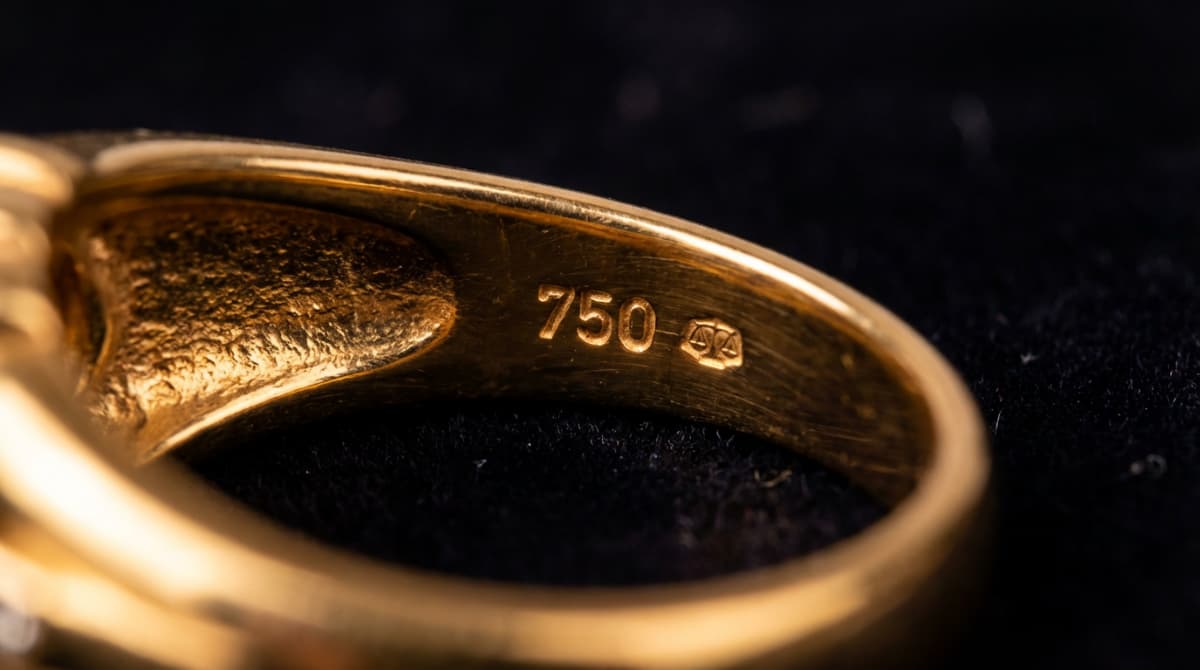
Before you weigh anything, identify the purity of your piece. Gold jewelry is stamped with a karat mark — typically engraved inside a ring band, on a clasp, or on the back of a pendant. You may need a loupe (jeweler's magnifier) to read it clearly.
Common gold karat stamps and their purity:
| Stamp | Karat | Gold Purity | Common Markets |
|---|---|---|---|
| 999 or 24K | 24 karat | 99.9% | Bullion, investment pieces |
| 916 or 22K | 22 karat | 91.6% | Indian & Middle Eastern jewelry |
| 750 or 18K | 18 karat | 75.0% | European fine jewelry |
| 585 or 14K | 14 karat | 58.5% | U.S. mainstream jewelry |
| 417 or 10K | 10 karat | 41.7% | U.S. budget jewelry |
| 375 or 9K | 9 karat | 37.5% | UK & Australian jewelry |
European jewelry often uses a three-digit hallmark (e.g., "750" for 18K gold) rather than the karat number. Both mean exactly the same thing — it's just a different notation system.
If you can't find a stamp, a jeweler can test purity with an acid test or XRF scanner for a small fee. Never assume the karat based on color alone — yellow, white, and rose gold can all exist at the same karat.
Step 2 — Weigh Your Jewelry
You need the gram weight of your piece. A digital kitchen scale accurate to 0.1g works fine for most jewelry. For very light pieces (under 2g), a jeweler's scale accurate to 0.01g gives better results.
Important: gold is measured in troy ounces in the commodity market, but grams are far more practical for home calculation. The conversion is: 1 troy ounce = 31.1035 grams. Since we'll be working in grams throughout, you don't need to convert.
If your piece has gemstones, note that the listed weight includes the stones, which contain no metal value. A rough rule: subtract ~0.2g per small accent stone cluster, or ask a jeweler for a metal-only weight.
Step 3 — Look Up the Spot Price
The spot price is the real-time market price for one gram of 24K (pure) gold. It changes throughout every trading day.
Reliable live spot price sources:
- Kitco — industry standard, free, real-time
- GoldPrice.org — shows price per gram directly
- APMEX — per-gram display
You can also see live gold and silver prices updated daily directly on WorthLens.ai:
Once you have the spot price per gram, you have everything you need for the calculation.
Worked Examples: Gold Value per Gram by Karat (April 2026)
As of early April 2026, the gold spot price is approximately $150.80 per gram (24K pure gold). Here's the melt value per gram for each karat:
Gold melt value per gram by karat (April 2026, spot ~$150.80/g)
Worked example — 18K gold bracelet:
- Weight: 8.5 grams
- Purity: 0.75 (18K)
- Spot price: $150.80/gram
- Melt value: 8.5 × 0.75 × $150.80 = $962.85
Worked example — 14K gold ring:
- Weight: 4.2 grams
- Purity: 0.585 (14K)
- Spot price: $150.80/gram
- Melt value: 4.2 × 0.585 × $150.80 = $370.22
Worked example — 10K gold chain:
- Weight: 12 grams
- Purity: 0.417 (10K)
- Spot price: $150.80/gram
- Melt value: 12 × 0.417 × $150.80 = $754.82
Gold prices have risen sharply — from under $2,000/oz in 2023 to over $4,600/oz in early 2026. Any price data you find in older articles may be dramatically understated. Always use a live source before making any selling decision.
How to Calculate Silver Jewelry Value
The process for silver is identical — weight × purity × spot price — but the purity system is simpler.
Common silver purity stamps:
| Stamp | Purity | Common Use |
|---|---|---|
| 925 | 92.5% sterling silver | Most jewelry |
| 999 | 99.9% fine silver | Bullion, some modern pieces |
| 800 | 80.0% | Continental European antique silver |
| 900 | 90.0% | Coin silver (older American pieces) |
Sterling silver (.925) is the standard for almost all modern silver jewelry. To calculate:
Melt Value = Weight (grams) × 0.925 × Spot Price per gram (silver)
Silver spot prices are much lower than gold — typically in the $1–$2/gram range, though this fluctuates significantly. Check Kitco or the live table above for today's price.
Worked example — 925 silver necklace:
- Weight: 22 grams
- Purity: 0.925
- Silver spot: $1.05/gram (example — check live price)
- Melt value: 22 × 0.925 × $1.05 = $21.38
Silver melt values are modest for most pieces. A 25-gram sterling chain might be worth $20–$30 in metal value alone. Where silver gains value is in antique or hallmarked pieces — a Georgian silver tea set has significant collector value beyond its melt weight.
Melt Value vs. What You Actually Get Paid
Melt value is theoretical. What you receive in practice depends on who you sell to.
Typical breakdown: where melt value goes when selling to a dealer
Cash-for-gold shops typically offer 50–70% of melt value. Convenient and fast, but expensive.
Online gold buyers (e.g., APMEX, Kitco) typically offer 80–90% of melt value. Better rates, but you mail your jewelry and wait.
Local jewelers vary widely — some offer 70–80%, others less. Always get multiple quotes.
Selling as jewelry (not scrap) via eBay, consignment, or estate dealers can exceed melt value — sometimes by 2–5x — if the piece has design, brand, or age value. See the next section.
Before accepting any offer, know your melt value calculation. If a dealer offers you significantly less than 70% of melt value, walk away — the market is competitive enough that better offers exist.
When Is Jewelry Worth More Than Its Melt Value?
Melt value is the floor, not the ceiling. Several factors push jewelry value above its metal content:
Brand and maker's mark. Signed pieces from Cartier, Tiffany, Van Cleef & Arpels, or Bulgari sell for multiples of melt value. Even lesser-known Victorian or Art Deco makers command premiums with the right collector.
Gemstones. Diamonds, rubies, sapphires, and emeralds can be worth more than the metal they're set in. These need separate appraisal — melt value calculation ignores them entirely.
Age and period. Georgian, Victorian, Edwardian, and Art Nouveau jewelry is collected as historical art. Selling it for scrap often destroys significant value.
Unusual or handcrafted work. A hand-chased 18K bracelet from a skilled artisan may be worth far more than its gold content to a collector.
If you're unsure whether your piece has value beyond the metal, don't sell it as scrap before getting an opinion. You can upload a photo to WorthLens.ai for an instant AI appraisal that considers both material and collectible value — useful for a quick sanity check before deciding how to sell.
FAQ
Knowing the melt value of your gold or silver jewelry takes the guesswork out of selling decisions. It's your baseline — the minimum your metal is worth before any premium for design, age, or brand. Once you know that number, you're in a much stronger position to negotiate, compare offers, or decide whether to sell at all.