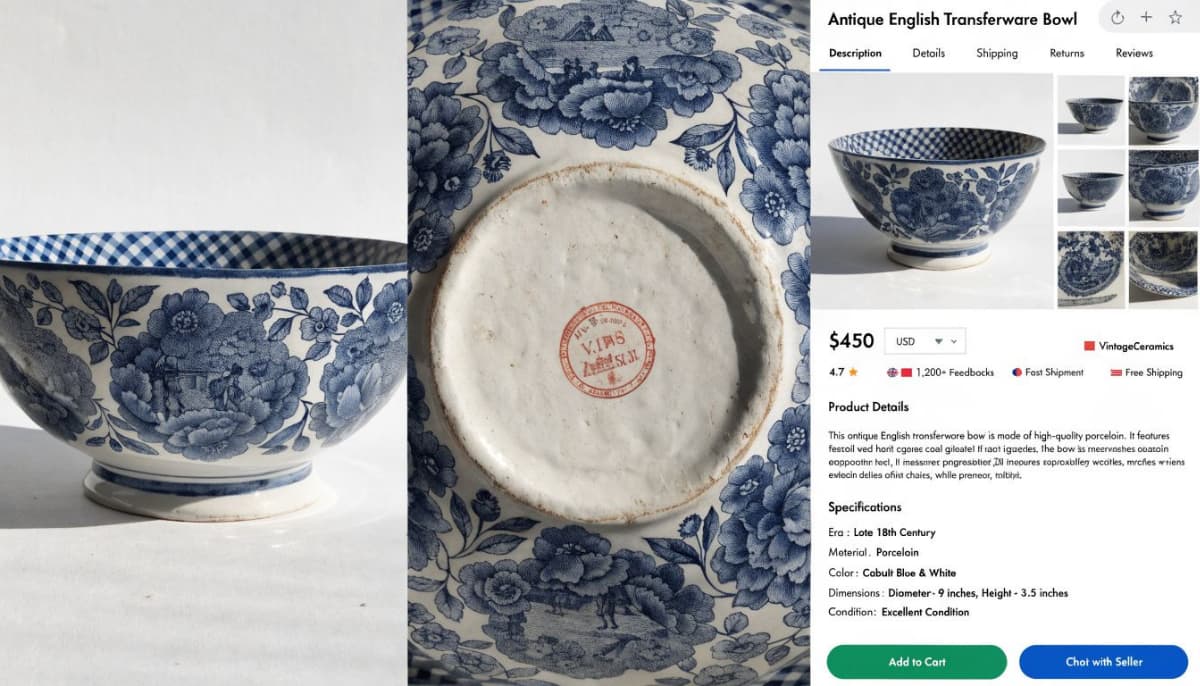
Selling Antiques Online: How to Price Your Items and Get a Fair Deal
Pricing is everything when selling antiques online. Too high and buyers scroll past. Too low and you leave money behind. Here's how to get it right.
Selling an antique online sounds simple until you actually try to price it. Search eBay and you'll find the same category of item listed anywhere from $30 to $3,000. Which number is real? Which reflects what buyers actually pay?
Most sellers make one of two mistakes: they price emotionally (this belonged to my grandmother, so it must be valuable) or they price defensively (I just want it gone, so I'll list it cheap). Both approaches cost money.
Getting the right price — before you list — is the single most important thing you can do to sell antiques successfully online. This guide walks through the research process, platform selection, listing strategy, and the most common mistakes that cause items to sit unsold for months.
Table of Contents
- Why Pricing Is the Most Important Decision You'll Make
- How to Find the Real Market Value of Your Antique
- The Five Factors That Set an Antique's Price
- Choosing the Right Platform for What You're Selling
- Writing a Listing That Actually Sells
- The Most Common Pricing Mistakes
- FAQ
Why Pricing Is the Most Important Decision You'll Make
In any other retail category, you can afford to experiment. List high, see what happens, drop the price if nothing sells. With antiques, this strategy backfires.
A listing that has been sitting for weeks or months triggers buyer suspicion. Online shoppers assume there's something wrong — undisclosed damage, a questionable attribution, an inflated price — and they move on. Items that sell quickly at a fair price don't leave that trace.
The second problem is that most sellers don't know which end they're on. A 2025 survey by the Antique Dealers Association found that 68% of serious collectors declined purchases due to insufficient provenance or ambiguous condition notes — and condition concerns often stem from sellers not understanding what they have. Overconfidence about value (and under-documenting condition) is just as costly as underpricing.
Getting a baseline appraisal before you list changes the dynamic completely. Upload a photo to WorthLens.ai and get an AI-generated estimate of your item's value range in seconds — before you open a single listing form.
How to Find the Real Market Value of Your Antique
The cardinal rule of antique pricing: research sold prices, not asking prices.
An item listed at $400 on eBay tells you nothing useful. The seller might be dreaming. The same item with a "Sold" label for $85 tells you exactly what the market is willing to pay.
Here's the research workflow that professional dealers use:
Step 1: Search completed listings on eBay.
Go to eBay, search your item, and filter by "Sold Items." Set the date range to the last 90 days and try to match your item's condition as closely as possible. If you see 50 completed sales in a consistent price band, that's the market. If you see wide variance, look for patterns — condition differences, different variants, or time-of-year effects.
Step 2: Check specialist auction databases.
LiveAuctioneers and Invaluable aggregate results from hundreds of auction houses worldwide. Search by category, artist, maker, or descriptive terms. These databases often include condition notes and photos alongside the hammer price — invaluable for calibrating where your specific example sits.
Step 3: Use WorthPoint for historical depth.
WorthPoint holds nearly two decades of historical pricing data from auction houses and online marketplaces. It's subscription-based but worth accessing for a month when researching a significant item.
Step 4: Check printed price guides.
Kovels Antiques and Collectibles Price Guide and Miller's Antiques Handbook are the two standard references. They're updated annually and provide a baseline for most major categories, though they lag real-time market conditions by a year.
AI appraisal tools like WorthLens.ai give you an instant baseline before you dive into manual research. They're especially useful for identifying what you actually have — the first step in any pricing process — and for quickly screening a large collection.
The Five Factors That Set an Antique's Price
Understanding these factors lets you assess where your specific item sits within its category — and explain that position to buyers in your listing.
1. Maker and attribution. Antiques with a confirmed maker — a manufacturer's mark, a designer's stamp, a signed piece — consistently outperform unmarked equivalents. A piece of Tiffany Studios glass commands multiples of a similar unsigned art glass piece. Check the base, back, underside, and interior surfaces for any identifying marks.
2. Condition. This is non-negotiable. Minor wear consistent with age is expected and acceptable. Cracks, chips, restoration, replaced parts, or structural damage reduce value significantly. Undisclosed damage discovered by buyers creates disputes and returns. Be specific and honest in your condition description — it builds trust and protects you.
3. Provenance. Any documentation of the item's history — auction records, receipts, exhibition catalogues, estate documentation, photographs of it in a previous owner's home — adds value. Research consistently shows that documented antiques sell for 3 to 5 times more than equivalent undocumented pieces.
4. Rarity and demand. The same piece at two different moments in time can command very different prices. Collector demand follows cultural trends: a successful museum retrospective, a popular TV series set in a particular period, or a major auction result can shift demand quickly. Check what's trending in your category before you list.
5. Completeness. For sets, services, matched pairs, or items with original accessories, completeness dramatically affects value. A complete Victorian tea service is worth significantly more than the sum of individual pieces sold separately. Conversely, incomplete sets should be priced accordingly and described accurately.
What drives antique resale value
Choosing the Right Platform for What You're Selling
The platform determines your audience. Choosing wrong costs you buyers, time, and fees.
eBay
Best for: Most categories, broad audience, auction-format items, lower to mid-range prices.
eBay connects sellers with 182 million+ active buyers globally. Use auction format for rare or desirable items where competitive bidding may drive prices above your estimate. Use fixed price (Buy It Now) for common items where you know the market rate. Fees: ~13.25% final value fee for most antiques categories.
Etsy
Best for: Decorative antiques, vintage items (20+ years old), items with strong visual appeal, buyers seeking home décor.
Etsy's 90 million active buyers skew toward home décor and lifestyle — ideal for aesthetic antiques like ceramics, glassware, prints, and textile. Fees: $0.20 listing + 6.5% transaction fee on sale price.
Chairish
Best for: Furniture, lighting, rugs, high-end decorative antiques, design-conscious buyers.
Chairish is curated and design-focused, attracting interior designers and serious collectors. Your items are reviewed before listing. Higher commission (20–30%) but better price realization for the right categories.
Ruby Lane
Best for: High-end, curated antiques, jewelry, fine art, serious collectors.
Ruby Lane is selective — not everyone is accepted — which means buyers expect quality and are willing to pay for it. Monthly shop fees apply. Best for established sellers with consistently high-quality inventory.
LiveAuctioneers / Invaluable
Best for: Significant individual pieces worth $500+, items where auction competition may drive price.
These platforms connect you with physical auction houses that conduct online bidding. Ideal for items where provenance and rarity make them suitable for specialist auctions — the right buyer may be anywhere in the world.
Facebook Marketplace & local groups
Best for: Furniture, large items difficult to ship, local buyers, quick sales.
No fees, but limited reach and no buyer protection. Good for items where shipping costs would erode margin significantly, or for quick liquidation of lower-value pieces.
Factor platform fees into your pricing before you list. eBay's ~13% fee, Etsy's 6.5%, and Chairish's 20–30% all come off your sale price. If you price at market rate without accounting for fees, you're effectively selling below market.
Writing a Listing That Actually Sells
Pricing gets buyers to click. The listing converts them.
Photography is everything. Items with clear, well-lit photos in multiple angles sell faster and at higher prices. Use natural light or a daylight bulb. Shoot against a neutral background. Always photograph:
- Overall item from multiple angles
- Close-up of any maker's marks, signatures, or stamps
- Close-up of any damage or wear (buyers will notice it anyway — showing it builds trust)
- Scale reference (a coin or ruler in the frame helps buyers understand size)
Write a description that answers buyer questions before they ask. Include dimensions (always), materials, period or date if known, maker or attribution, condition with specific details, and provenance if available. Buyers in 2026 are skeptical — 68% of serious collectors have declined purchases due to insufficient information. Give them confidence.
Use the right terminology. Buyers search with specific terms. "19th century French bisque porcelain figurine" finds the right audience. "Old statue" does not. Research what terminology appears in completed sales of similar items and mirror it.
Set a return policy. Buyers pay more when they feel protected. Offering returns signals confidence in your description and authenticity — and attracts more serious, higher-spending buyers.
The Most Common Pricing Mistakes
Pricing from asking prices, not sold prices. The most expensive mistake. Always filter by completed sales. The gap between asking and sold can be 50–80% in slow categories.
Emotional pricing. Sentimental value and market value are entirely different numbers. A piece that belonged to a grandparent matters to you; buyers are evaluating it against alternatives. Price the item, not the memory.
Ignoring condition in the price. A hairline crack in a ceramic piece that would sell for $300 in perfect condition might be worth $60 with damage. Price accordingly and disclose it upfront — undisclosed condition issues lead to disputes that cost you more than the discount would have.
Cleaning or restoring before selling. This deserves emphasis: do not clean patinated metal, do not re-glaze ceramics, do not repair chips before getting an appraisal. Many restoration attempts destroy the markers of age that collectors value and can reduce worth by 40–80%. A professional conservator is different from a DIY clean — but even professional restoration should be evaluated against the impact on value.
Listing on the wrong platform. A significant piece of Georgian silver listed on Facebook Marketplace will attract bargain hunters, not collectors. Match the item to the platform audience.
Not accounting for fees and shipping. Calculate your net proceeds: sale price minus platform fee, PayPal/payment fee, packing materials, and shipping. If the math doesn't work at market price, either find a lower-fee platform or consider whether selling this item individually makes sense versus including it in a lot.
Impact of key factors on antique sale price vs. unoptimized baseline
FAQ
Know your number before you post a single listing. An accurate starting value means you set the right price, choose the right platform, and avoid the months-long stall of an overpriced item that buyers have learned to ignore.