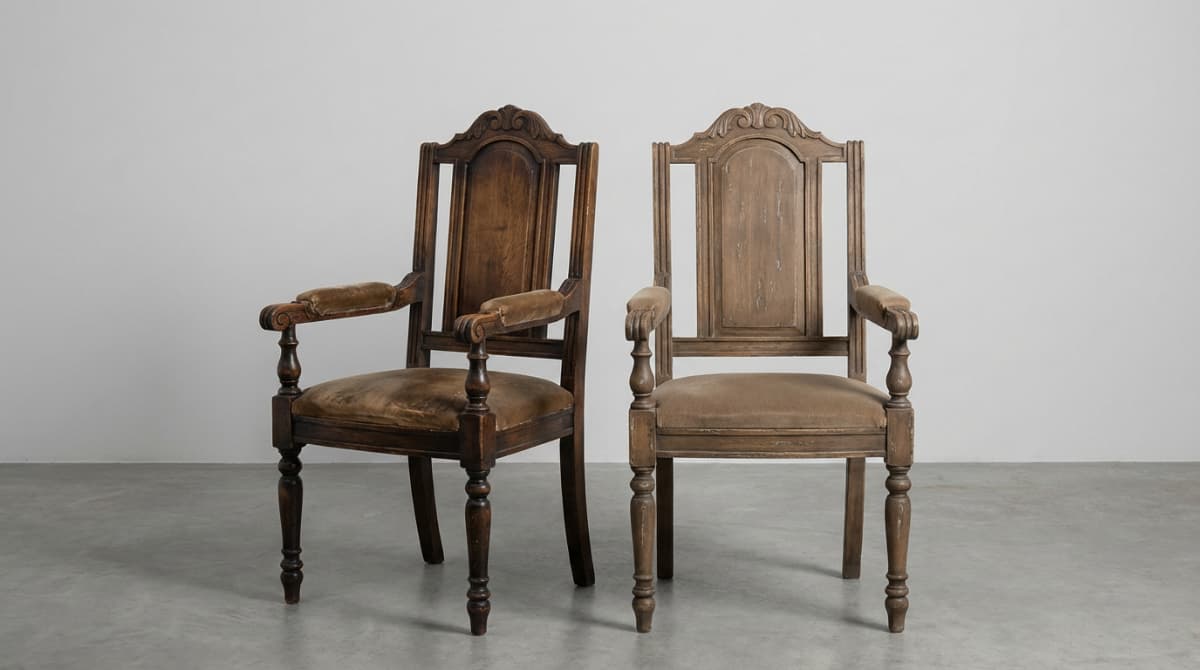
Antique Reproductions vs. the Real Thing: How to Tell the Difference
Paid antique prices for a modern copy? It happens constantly. Here's how to spot reproductions before you buy — across furniture, ceramics, silver, and more.
A buyer at a London auction paid £12,000 for a Georgian sideboard in 2019. Three months later, a specialist noticed the drawer backs were birch plywood — a material that didn't exist in the 18th century. The piece was a high-quality Victorian reproduction, worth perhaps £800. The seller hadn't lied. The buyer hadn't looked closely enough.
Reproductions have existed as long as antiques have been valuable. Some are obvious. Many are not. The most dangerous ones are made with aged wood, distressed by hand, fitted with period-style brass hardware, and sold at markets and even respectable auction houses as "possibly original" or "in the period style." At that point, the line between reproduction and deception is a matter of wording.
This guide gives you practical, specific tests to apply before you hand over serious money — across the four most commonly reproduced categories: furniture, ceramics, silver, and decorative art.
Table of Contents
- Reproduction, Fake, or Genuine? Understanding the Difference
- 6 Universal Red Flags for Any Antique
- How to Spot Reproduction Furniture
- How to Spot Fake Ceramics and Porcelain
- How to Spot Artificially Aged Silver and Metalwork
- The Price Gap: What a Reproduction Is Actually Worth
- When to Trust Your Gut — and When to Call an Expert
- FAQ
Reproduction, Fake, or Genuine? Understanding the Difference
These three terms are not interchangeable — and understanding the distinction changes how you approach a purchase.
Reproduction — a piece made in the style of an earlier period, without intent to deceive. A Victorian-era reproduction of a Georgian chair was made honestly; it was never claimed to be 18th-century. Problems arise when reproductions pass through enough hands to lose their context and get described as original.
Fake — a piece deliberately manufactured or modified to be sold as something it is not. This includes artificially aged new items, pieces with forged marks, and genuine antiques that have been altered (like adding a period mark to an unmarked piece).
Genuine antique — generally defined as a piece over 100 years old, made in the period it represents, showing authentic wear, materials, and construction consistent with that era.
Many reproductions are honest objects with real value — particularly high-quality Victorian and Edwardian reproductions of earlier styles. The problem is only paying antique prices for reproduction-value pieces.
6 Universal Red Flags for Any Antique
These tests apply across all categories before you look at category-specific details:
1. Wear where there shouldn't be wear. Artificial aging is often applied uniformly — the back of a drawer shows the same distressing as the front, or the underside of a table leg is as worn as the top of the foot. Real age accumulates logically: on handles, corners, and surfaces that were touched or set down. If the wear pattern doesn't map to how the object was used, it was applied.
2. Modern materials hiding behind old ones. Look underneath, inside, and behind. Fiberboard, plywood, MDF, staples, or Phillips-head screws anywhere on a piece claimed to be pre-1930s is an immediate disqualifier. Phillips-head screws weren't patented until 1936.
3. Patina that looks painted on. Genuine patina on wood, metal, or ceramics develops through years of oxidation, UV exposure, and handling. It's uneven: lighter where sunlight hit, darker in recesses where oil and dust collected. Artificially applied patina — whether paint, shoe polish, or chemical aging — looks flat, uniform, and often slightly too brown.
4. Too-perfect symmetry. Hand-crafted objects made before industrial production show slight irregularities — carvings that aren't exactly mirror images, dovetails that vary slightly in spacing, brushstrokes that differ. Machine precision in supposed pre-industrial pieces is a red flag.
5. The wrong smell. This sounds unscientific, but works. Very old wood has a distinctive dry, slightly sweet smell — almost like vanilla from lignin breakdown. New wood, even when distressed, smells like fresh timber or sometimes like the chemicals used to artificially age it. Inside a drawer or the back of a cabinet, smell is often the first tell.
6. Documentation that doesn't stack up. Provenance is powerful but also easily fabricated. A letter of authenticity from a dealer means little unless the dealer is traceable and reputable. Auction house sale receipts are more reliable. Ask specifically: who owned this before you, and can that be verified?
How to Spot Reproduction Furniture
Furniture is the most commonly reproduced antique category. Victorian craftsmen mass-produced Chippendale, Queen Anne, and Hepplewhite-style pieces. The 1920s and 1930s saw another wave of "antique style" production. High-quality reproduction workshops operate today.
Check the secondary wood
Antique furniture typically used expensive primary wood (mahogany, walnut, rosewood) for visible surfaces and cheaper secondary wood (pine, poplar, oak) for drawer backs, backs of cabinets, and interior structures. This was a deliberate cost-saving measure.
If the secondary wood matches the primary wood exactly — or if any part of the structure is made from plywood, particleboard, or MDF — the piece is not antique.
Examine the dovetail joints
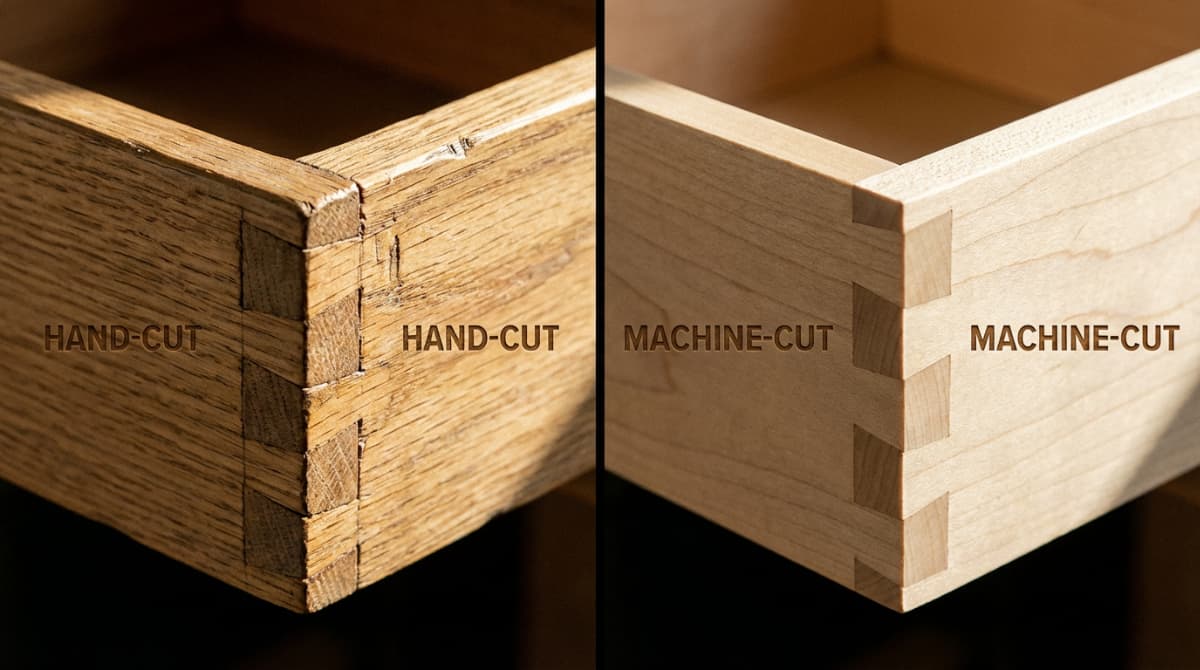
Hand-cut dovetails found in genuine antique drawers are slightly irregular — the spacing varies, the angles aren't perfectly consistent. Machine-cut dovetails (used from the mid-1800s onward in cheaper furniture, and consistently in 20th-century production) are perfectly uniform.
Country of origin also shows: English dovetails are typically larger and more widely spaced; French dovetails tend to be precise with pencil scribe lines visible nearby; American dovetails vary by region and period.
Check veneer thickness
Pre-19th-century veneers were hand-sawn and are noticeably thick — roughly 3–6mm. You can feel the edge with your fingernail. Modern reproductions use machine-cut veneers that are paper-thin (under 1mm). If you can see the veneer separating at an edge, measure it: thick veneer suggests authentic period work.
Look at the hardware
Hand-forged antique hardware — hinges, drawer pulls, lock plates — is slightly irregular, often with small hammer marks on the back. The screws holding hardware in place should have slightly off-center slots (hand-filed) not uniform machine-cut slots. Modern brass hardware looks too bright, too uniform, and too perfect.
Also look for ghost holes — plugged or filled holes from previous hardware replacements. On a genuine antique that has passed through multiple homes, hardware was often replaced. A piece with pristine, never-altered hardware may simply be newer than claimed.
Never use age of the wood alone to judge a piece. Forgers routinely use genuinely old reclaimed timber — barn wood, salvaged floor planks, dismantled period furniture — to build convincing reproductions with wood that dates to the right era. The construction method matters more than the timber's age.
How to Spot Fake Ceramics and Porcelain
Crazing: real vs. forced
Genuine aged crazing (the fine surface crack network in old glazes) develops organically over decades of thermal cycling. Real crazing shows dirt absorbed into the cracks, slightly varying line widths, and a pattern that follows the natural stress points in the glaze.
Artificially created crazing — applied by rapid cooling, acid, or abrasion — looks more uniform, often too regular or too evenly distributed. Run your fingertip lightly across the surface: real crazing feels smooth, with hairlines beneath the glaze surface. Forced crazing can feel slightly rough or sharp.
Check the base scratches
The bottom of any piece that sat on a shelf for a century shows organic, multidirectional micro-scratches from contact with surfaces. Faked scratches made with sandpaper or on a turntable create fine parallel or circular scratches — regular enough to be visible under a loupe.
Test the mark
Genuine factory marks painted underglaze are sealed beneath the glaze — they cannot be rubbed off. Marks painted on top of the glaze (overglaze) can sometimes be partially removed with light abrasion. A mark that rubs is suspicious. Applied transfer marks on reproductions can look too sharp and uniform compared to the slight imprecision of hand-painted originals.
Weight and translucency
Hold a suspect porcelain piece up to a bright light. Genuine hard-paste porcelain is translucent — light passes through thin walls with a warm glow. Modern ceramics and earthenware fakes remain fully opaque. Very old porcelain also has a specific density — it feels slightly heavier and more solid than modern equivalents.
How to Spot Artificially Aged Silver and Metalwork
Look at the hallmarks carefully
Genuine silver hallmarks — British assay marks, in particular — are precisely struck and clearly readable, showing specific symbols for the assay office, date letter, standard mark, and maker. Pseudo-hallmarks on fakes often use similar-looking symbols that don't correspond to any actual assay system, or reproduce a real mark imprecisely.
Never buy silver purely on a hallmark. Marks can be cut from one piece and let into another (a practice called "transposing"), or stamped onto unassayed silver using copied dies.
Tarnish patterns
Silver tarnishes where silver meets air, and clears where it was regularly polished. Genuine antique silver shows tarnish in recesses and engraving, cleared surfaces on high points. Artificial tarnishing (applied chemically) is often too uniform — recesses look the same as surfaces — or concentrated only on the most visible areas.
Check construction joints
Before modern soldering techniques, silver pieces were joined with different methods. Look at seams under magnification: visible machine-weld lines or synthetic solder are modern. Hand-raised silverware (hammered from a single sheet) shows slight tool marks and varying wall thickness — signs of authentic pre-industrial manufacture.
The Price Gap: What a Reproduction Is Actually Worth
Genuine antique
Value based on: age, rarity, historical significance, original materials, provenance.
A genuine Georgian mahogany sideboard: £4,000–£15,000.
A verified 18th-century Meissen vase: £5,000–£50,000+.
A hallmarked George III silver teapot: £800–£3,000.
Reproduction or fake
Value based on: quality of craftsmanship, materials used, decorative appeal.
A quality Victorian reproduction of a Georgian sideboard: £400–£1,500.
A reproduction Meissen-style vase: £50–£300.
A silver-plated teapot in Georgian style: £40–£200.
The gap is consistently large — usually 5x to 20x. For everyday pieces, this means a £200 reproduction being sold as a £3,000 antique. For high-value categories like verified Old Masters or rare Chinese porcelain, the gap can be orders of magnitude larger.
A quick way to establish a baseline before you buy is to upload photos to WorthLens.ai — the AI analyzes construction details, style characteristics, and visible aging patterns from your photos and flags potential concerns before you commit to a price.
When to Trust Your Gut — and When to Call an Expert
Your instincts matter. If something about a piece doesn't feel right — the wear is too even, the price is suspiciously low for what's claimed, the seller can't provide any provenance — that discomfort is worth listening to. Experienced dealers say the same thing: the pieces they regret buying are often the ones they had doubts about from the start.
But instinct alone isn't enough for high-value purchases. For any piece you're considering buying for over £500/$500:
- Request a condition report in writing, with the seller describing the piece, its period, and any restorations
- Use an ultraviolet (UV) light — repairs, filled cracks, and retouching on ceramics glow differently under UV
- For ceramics, have thermoluminescence (TL) testing done if the value is significant (£300–£500 per test, but worth it for a £10,000 purchase)
- Consult a specialist at a major auction house — Christie's, Bonhams, Sotheby's, and Heritage Auctions all offer free initial estimates and many will flag authenticity concerns at no charge
- Search auction databases (LiveAuctioneers, Invaluable) for comparable pieces to verify the price you're being asked is realistic
The single most reliable authentication method for most antique categories is still the hands-on expert with decades of experience in that specific category. A 20-minute consultation with a specialist ceramics dealer or furniture historian costs far less than buying the wrong piece.