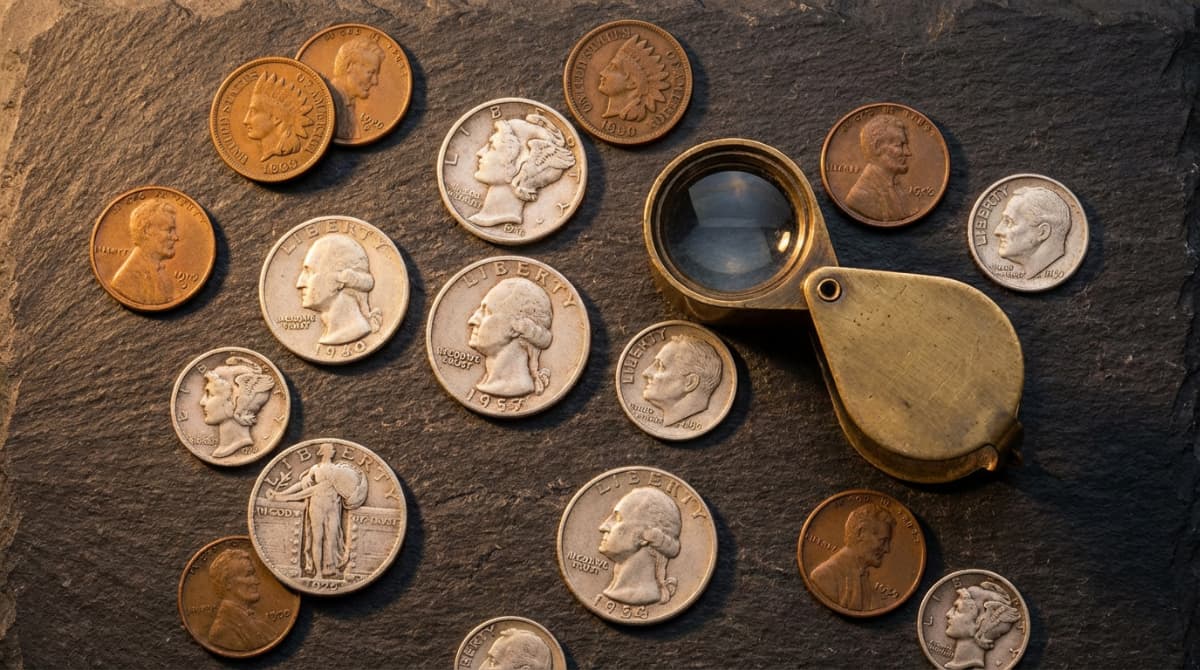
The Most Valuable Coins Still in Circulation: What to Look For in Your Change
Some of the coins in your pocket are worth hundreds — or thousands. Here's exactly what to look for before you spend your change.
In 1982, the Philadelphia Mint accidentally produced a batch of Roosevelt dimes without a mint mark — a detail so small most people never notice it. Those coins entered circulation like any ordinary dime. Today, a single one in uncirculated condition is worth around $300.
The same story plays out across dozens of coin varieties. A dime is just a dime until it isn't. Knowing the difference requires nothing more than checking a few details before you spend your change.
This guide covers the coins most likely to be hiding real value in everyday circulation — and exactly how to spot them.
Table of Contents
- The Quickest Check: Look at the Edge
- Pre-1965 Silver Coins: The Most Reliable Find
- Pennies Worth Real Money
- Valuable Dimes You Might Still Encounter
- Quarters Worth More Than 25 Cents
- How to Identify a Potentially Valuable Coin: 5 Checks
- What to Do When You Find Something Interesting
- Frequently Asked Questions
The Quickest Check: Look at the Edge
Before anything else, look at the edge of any dime, quarter, or half dollar you handle. Modern clad coins show a clear copper stripe — a layer of copper sandwiched between two layers of nickel. Pre-1965 silver coins show a solid, uniform silver-colored edge with no stripe.
That edge check takes two seconds. It filters out the most valuable category of circulating coins instantly.
The edge test works for dimes (10¢), quarters (25¢), and half dollars (50¢). Pennies and nickels don't apply — they've never been 90% silver.
Pre-1965 Silver Coins: The Most Reliable Find
Every dime, quarter, and half dollar struck before 1965 contains 90% pure silver. The U.S. government removed silver from these coins in 1965 when rising silver prices made the metal worth more than the face value.
What they're worth today:
At current silver prices, a pre-1965 dime contains approximately 0.0723 troy ounces of silver. A quarter contains 0.1808 oz. At around $30–$33 per ounce (typical 2024–2025 range), that translates to:
| Coin | Face value | Silver content | Approximate melt value |
|---|---|---|---|
| Dime (pre-1965) | $0.10 | 0.0723 oz | ~$2.20–$2.40 |
| Quarter (pre-1965) | $0.25 | 0.1808 oz | ~$5.50–$6.00 |
| Half dollar (pre-1965) | $0.50 | 0.3617 oz | ~$11–$12 |
| Kennedy half (1965–1970) | $0.50 | 0.1479 oz (40% silver) | ~$4.50–$5 |
How to spot them:
- Dimes: Check the date. 1964 or earlier = silver.
- Quarters: Same — 1964 and before. Washington quarters (the standard design) have been minted since 1932.
- Half dollars: Kennedy halves from 1965–1970 are 40% silver (not 90%), and still worth several times face value. Pre-1965 Kennedy halves (only 1964) and Franklin halves before that are 90%.
These coins still surface occasionally in rolls from banks, estate coin collections that entered circulation, and older parking meters and vending machines. Finding one in actual pocket change is rare but not impossible — especially in rural areas where old coin collections sometimes get spent.
Pennies Worth Real Money
Pennies are the most hunted coins for a reason: the gap between face value and collector value is extreme. A $0.01 coin worth $100,000 is more dramatic than a $0.25 coin worth $2,000.
The key dates and varieties to know:
1943 Copper Penny
In 1943, the Mint switched to zinc-coated steel to conserve copper for WWII. A small number of copper blanks from 1942 were accidentally struck — approximately 40 are known to exist. One sold for $1.7 million in 2010. How to check: 1943 pennies should stick to a magnet (they're steel). If yours doesn't stick, get it authenticated immediately.
1955 Doubled Die Obverse
The date and lettering show dramatic doubling visible to the naked eye. About 20,000–24,000 were produced before the error was caught. Values range from $1,000 for heavily worn examples to $15,000+ in uncirculated grades.
1969-S Doubled Die Obverse
Even rarer — only 40 to 50 are known. In 2022, the finest-known example sold for $601,875 at auction. The doubling is visible in "IN GOD WE TRUST" and "LIBERTY."
1982 Copper vs. Zinc — Check Your Scale
In 1982, the Mint switched from 95% copper to 97.5% zinc composition mid-year. Both compositions exist with both large and small date designs. A copper 1982 penny weighs 3.1 grams; a zinc one weighs 2.5 grams. The rarest combination — 1982-D Small Date Copper — sold for $18,800 in 2016. Any cheap kitchen scale reveals which you have.
Do not clean any penny you suspect might be valuable. A cleaned 1955 Doubled Die is worth a fraction of an original-surface example. Cleaning destroys the patina that graders use to assess authenticity and condition.
1970-S Small Date
Distinguishable by the "7" in the date sitting lower than the other digits ("high 7"). Even well-worn examples are worth $10–$35; uncirculated ones trade for considerably more.
Valuable Dimes You Might Still Encounter
Most modern dimes are worth exactly $0.10 — but a handful of varieties are worth checking.
1982 No Mint Mark Roosevelt Dime
Since 1980, Philadelphia dimes carry a "P" mint mark. In 1982, a production batch shipped without it. In MS-65 grade, these trade for $200–$300. In circulated grades, still worth $30–$75. Check any 1982 dime for the "P" on the obverse — if it's missing, set it aside.
Pre-1965 Roosevelt Dimes
As covered above, any Roosevelt dime dated 1964 or earlier is silver. Even the most worn, common-date examples are worth several times face value for the metal alone.
Quarters Worth More Than 25 Cents
Pre-1965 Silver Quarters
Same rule as dimes: any Washington quarter dated 1964 or earlier is 90% silver. At today's spot prices, even a worn example is worth $5–$6 in pure metal value.
2004-D Wisconsin Extra Leaf Quarter
During production of the Wisconsin State Quarter, a die error produced coins with an extra leaf on the corn stalk in the design — two varieties exist: "Extra Leaf High" and "Extra Leaf Low." Both were struck at the Denver Mint (look for the "D" mint mark).
- Extra Leaf High: $50–$280 depending on condition
- Extra Leaf Low: $20–$215 depending on condition
These were released into circulation and are found occasionally in the Midwest, where they were more likely to stay in local commerce.
1776–1976 Bicentennial Quarters
Common Bicentennial quarters (the drummer boy reverse) are worth face value — billions were minted. However, silver proof Bicentennial quarters were sold in collector sets. If you find one that passes the edge test (no copper stripe), it's a 40% silver collector issue worth $5–$10.
Approximate value of common circulation finds (circulated grade)
How to Identify a Potentially Valuable Coin: 5 Checks
You don't need specialized equipment to do a first pass. These five checks take under a minute:
1. Check the edge
Solid silver color = possible silver coin. Copper stripe = modern clad. Takes 2 seconds.
2. Read the date and mint mark
The mint mark is a small letter near the date: P (Philadelphia), D (Denver), S (San Francisco), W (West Point). Some valuable varieties have no mint mark where one should appear — that absence is itself the feature.
3. Look for doubling
Tilt the coin under a raking light source. Doubled die errors show a distinct shadow or halo around lettering and numerals — particularly in "IN GOD WE TRUST," "LIBERTY," and the date. Machine doubling (common and worthless) looks smeared; true doubled die shows sharp, separated doubling.
4. Weigh it
A $5 digital kitchen scale reveals composition. A pre-1982 copper penny: 3.1g. Post-1982 zinc: 2.5g. A steel 1943 penny: 2.7g. Weight anomalies on any coin are worth investigating.
5. Check the design details
Compare to a reference image of the same year and mint mark. Wisconsin extra leaf, missing elements, off-center strikes, and clipped planchets are visible once you know what the normal coin looks like.
If you find something interesting, WorthLens.ai lets you photograph the coin and get an AI-powered first assessment before you invest time in a deeper search or professional grading.
What to Do When You Find Something Interesting
Don't spend it. Set it aside in a soft holder or a 2x2 coin flip — never a stapled cardboard holder, which scratches surfaces.
Don't clean it. This cannot be overstated. Cleaning removes the natural patina and microscopic surface details that graders use to assess a coin. A cleaned 1955 Doubled Die sells for a fraction of an unclean example.
Do your research first. Check PCGS CoinFacts (pcgs.com/coinfacts) and NGC's Coin Explorer — both free, both authoritative. Search the specific year, mint mark, and variety. Look at recent auction results, not just listed values.
Then get it graded if it's significant. PCGS and NGC are the two major third-party grading services. Submitting a coin for slabbing (encapsulation in a tamper-evident holder) costs $30–$65 per coin for most submissions but adds enormous credibility and liquidity when selling. For anything potentially worth over $200, it's usually worth it.
Before paying for professional grading, photograph the coin clearly and run it through WorthLens.ai. An AI appraisal won't replace PCGS certification, but it's a fast, free way to see whether the coin is worth pursuing further.