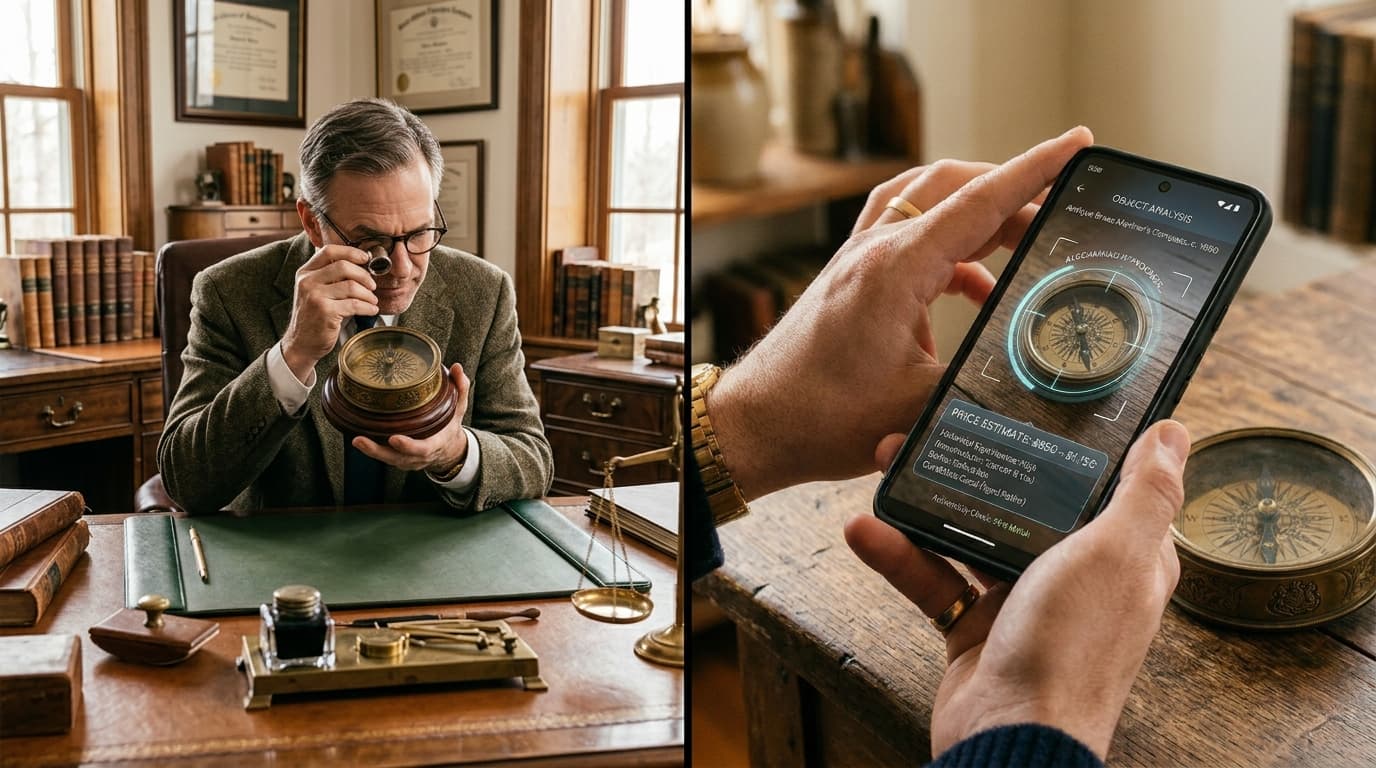
How AI Is Changing Antique Appraisals
Getting an antique appraised used to mean scheduling appointments and waiting weeks. AI has changed what's possible — and who can access expert-level valuation.
Not long ago, getting a professional appraisal meant finding a certified specialist, scheduling an appointment, shipping the item or traveling to them, waiting days or weeks for a written report, and paying $150–$500 for the privilege.
That entire process existed because valuation expertise was genuinely scarce. Building the knowledge to reliably price antiques, art, coins, and jewelry took decades of experience and access to proprietary price databases that the average person couldn't reach.
AI has fundamentally changed that access equation — and in doing so, it is reshaping who can get valuations, how quickly, and what they can do with the information.
Table of Contents
- What Changed — and Why Now?
- How AI Appraisal Actually Works
- Where AI Performs Extremely Well
- What AI Still Cannot Do
- AI vs. Traditional Appraiser: When to Use Each
- The Real-World Impact for Collectors and Sellers
- Frequently Asked Questions
What Changed — and Why Now?
Three things converged to make AI appraisal practical at scale.
First, the data became available. Decades of auction results from Sotheby's, Christie's, Heritage Auctions, eBay, and hundreds of specialist houses are now digitized. Platforms like WorthPoint contain over one billion historical price records. That volume of comparable sales data — the raw material of any valuation — had never been accessible to algorithms before.
Second, image recognition matured. Modern neural networks can analyze a photograph and identify style details, construction techniques, decorative motifs, maker's marks, and material characteristics with a level of precision that would have been science fiction a decade ago. For categories like coins and stamps, where grading is based on visible, quantifiable surface characteristics, AI image analysis is now genuinely competitive with human assessment.
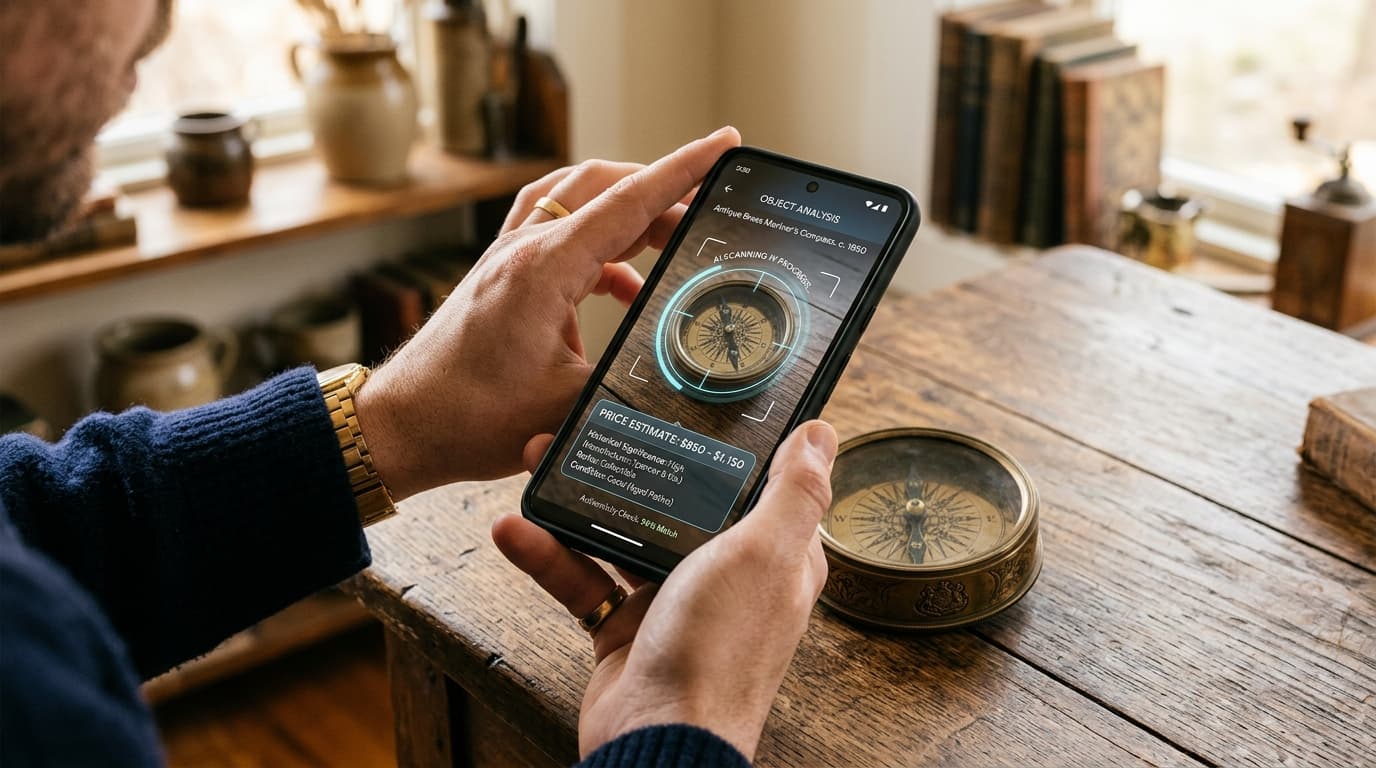
Third, large language models arrived. The AI systems that power tools like WorthLens.ai don't just match images to databases — they reason about what they see. They can identify an object's likely period, maker, and cultural context from a photo, then cross-reference that identification against comparable sold examples to produce a market estimate. The system combines visual analysis with contextual knowledge in a way that earlier, narrower algorithms couldn't.
The result: expert-level triage is now available to anyone with a smartphone, in seconds, for free or at very low cost. That is a structural change in access to information.
How AI Appraisal Actually Works
Understanding what's happening under the hood helps set realistic expectations.
Step 1: Image Analysis
When you upload a photo, the AI's vision system analyzes visual features — shape, construction details, decorative style, surface condition, marks, and signatures. Different categories require different trained models. The algorithm that evaluates a coin's grade is fundamentally different from the one assessing a painting's stylistic period or a piece of jewelry's construction.
For coins, image analysis can identify date, mint mark, and surface condition with high reliability. For ceramics, it can match factory marks and glaze characteristics. For furniture, it can identify period-appropriate joinery and stylistic elements.
Step 2: Identification and Context
The visual analysis feeds into an identification layer that maps what it sees to known categories, periods, makers, and styles. This is where broad contextual knowledge matters — recognizing that a particular chair silhouette corresponds to the Chippendale period, or that a specific backstamp places a piece of porcelain in a particular factory and date range.
Step 3: Comparable Sales Matching
Once the object is identified, the system searches comparable sold examples in its training data. The most reliable valuations come from categories with dense, consistent comparable sales — coins, certain categories of art prints, standardized jewelry by known makers. Categories with fewer comparables (rare antiques, highly individual artwork) produce wider estimate ranges.
Step 4: Market Value Estimate
The output is a market value estimate — typically a range rather than a single figure — reflecting what comparable items have actually sold for in recent transactions. This is fundamentally different from a replacement value or insurance value, which are calculated differently.
AI appraisal tools produce market value estimates based on comparable sales. For insurance purposes, you need a replacement value — typically 10–20% higher than market value. For estate or probate, you need a qualified written appraisal from a credentialed professional. AI tools support these processes but do not replace the formal documentation they require.
Where AI Performs Extremely Well
Not all categories are equal. AI appraisal is substantially more reliable in some areas than others — and understanding this distinction helps you use it appropriately.
Coins and Stamps
Research consistently finds that coins and stamps are the category where AI will first achieve genuine parity with human appraisers. In one survey, 36% of respondents identified coins and stamps as the category most likely to be successfully handled by AI — higher than any other collectible type.
The reason: grading in these categories is based on measurable, visible surface characteristics. Luster, surface marks, strike quality, and relief wear can all be assessed from high-resolution images. Population data from PCGS and NGC provides extensive comparables for every known date and grade combination.
Standardized Jewelry
For jewelry with defined material characteristics — gold purity, gemstone type and approximate grade, specific maker hallmarks — AI can provide reliable material value estimates tied to live precious metal prices. A ring photographed alongside a scale can yield an accurate estimate of its melt value within minutes. For branded pieces by known makers (Tiffany, Cartier, Van Cleef), comparable auction data is dense enough to support reliable valuations.
Art Prints and Limited Editions
Signed limited-edition prints by artists with active markets generate substantial comparable sales data. AI can reliably match print details to edition records and cross-reference realized auction prices for the same edition number, condition, and framing status.
AI appraisal accuracy by collectibles category (survey of industry experts)
What AI Still Cannot Do
Honest assessment of AI's limitations is as important as understanding its capabilities. The technology is powerful — but it has real boundaries.
Physical Examination
AI works from photographs. It cannot feel the weight of a piece, detect the smell of old materials, examine paint layers under UV light, assess the magnetic response of metals, or physically verify a coin's reeding depth. A skilled appraiser doing hands-on examination catches things that photographs systematically miss.
Provenance Verification
AI can identify an object's likely period and maker from its physical characteristics. It cannot verify the ownership history — whether a painting genuinely passed through the collection that's claimed, whether documentation is authentic, or whether a piece is a sophisticated reproduction with falsified provenance. Provenance research requires archival work, document verification, and human judgment.
Authenticity Determination for High Stakes
For museum-quality works, significant paintings, or items where authenticity is genuinely uncertain, AI can flag inconsistencies — stylistic anachronisms, construction details that don't match the claimed period — but it cannot render a definitive authentication judgment. That requires specialist expertise, laboratory analysis, and physical examination.
Highly Subjective or Cultural Factors
The premium commanded by a work with exceptional emotional resonance, a unique provenance story, or a specific cultural significance that drove bidder competition at a particular moment — these are factors that don't exist cleanly in comparable sales data. AI optimizes toward the center of a distribution; it is less reliable at the extremes where exceptional pieces command exceptional prices.
Almost 50% of experts surveyed believe that original paintings will never be fully appraised by AI alone. For significant art purchases or insurance coverage on high-value works, a human specialist remains essential.
AI vs. Traditional Appraiser: When to Use Each
The most useful frame is not "AI vs. human" but "AI for what, human for what."
Use AI when you need to:
- Quickly triage a large number of items (estate downsizing, collection inventory)
- Get a market sanity check before buying at a sale or fair
- Understand whether an item is worth pursuing further
- Get an instant baseline before negotiating a price
- Research a category you don't know well before consulting a specialist
- Track approximate values of a collection over time
Use a specialist appraiser when you need to:
- Insure a valuable item (insurance companies require certified appraisals)
- Settle an estate or probate (legal documentation requirements)
- Authenticate a potentially high-value or disputed piece
- Sell through a major auction house (they provide their own assessment)
- Resolve a dispute over value
- Make a purchase decision over $5,000 where certainty matters
A PricewaterhouseCoopers study found that AI-assisted appraisals were within 5% of the true value 90% of the time, compared to 70% for traditional appraisals alone. The key word is "assisted" — the highest accuracy comes from combining AI's breadth of comparable data with human expertise for edge cases and physical verification.
The Real-World Impact for Collectors and Sellers
The practical effects of AI appraisal on everyday collectors and sellers are already substantial — and they favor the buyer and small seller most.
The information asymmetry is shrinking. For decades, the antiques and collectibles market ran on information asymmetry — dealers and specialists knew what things were worth, private individuals largely didn't. That gap justified wide buy-sell spreads and allowed undervalued purchases at estate sales and flea markets. AI is closing that gap. A seller at a car boot sale can now check what their item is worth before pricing it. A buyer at an auction preview can verify whether the lot estimate reflects market reality.
Appraisal is no longer a specialist privilege. Before AI, getting a credible valuation on a $200 item made no economic sense — the appraisal would cost more than the item. Now, that same item can be assessed in 30 seconds. This democratization of access is particularly significant for inherited collections, where families have historically had no practical way to assess dozens of small-value items without significant cost.
The volume of appraised transactions is increasing. More items are being identified, valued, and traded correctly because the barrier to getting a quick assessment has dropped to near zero. This benefits the overall market — more accurate pricing means fewer wildly mispriced transactions in either direction.
Tools like WorthLens.ai sit at the center of this shift — providing the kind of instant, photo-based appraisal across coins, jewelry, antiques, and art that puts expert-level market intelligence in the hands of anyone who needs it.