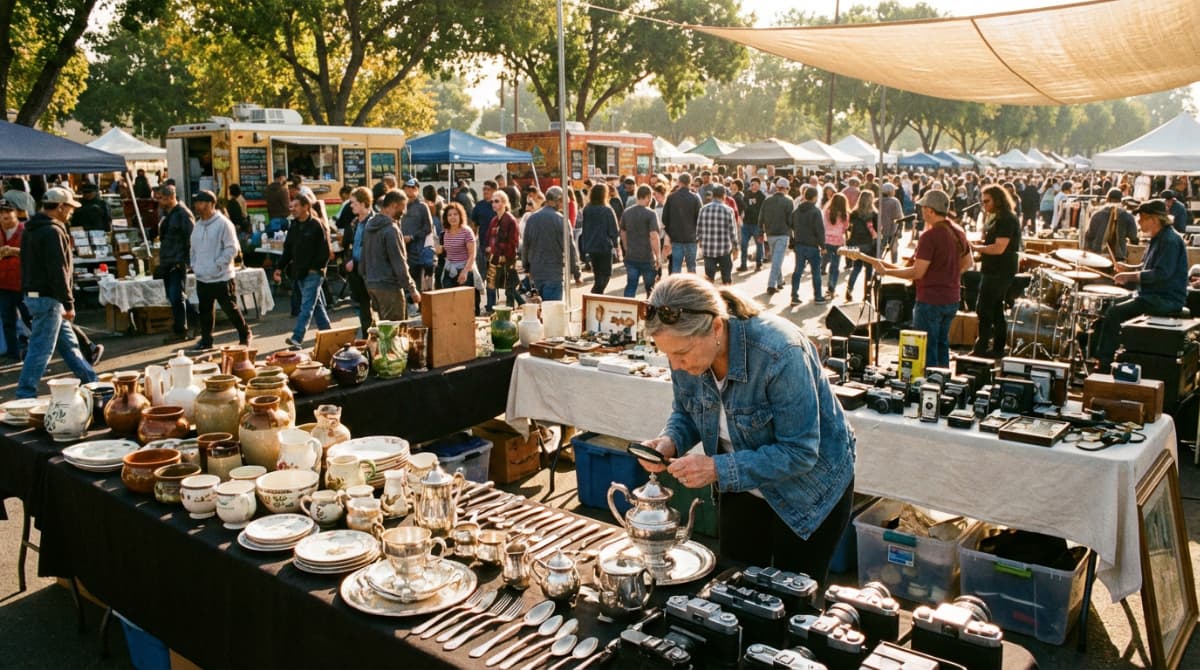
Flea Market Arbitrage: How to Buy Low and Resell for Profit
The same item can cost $20 at a flea market and sell for $200 on eBay — if you know what to look for. Here's the complete guide to flipping for profit.
In March 2021, a Chinese dish bought at a garage sale for $35 resold at Sotheby's for $721,800. That's an extreme outlier — but the underlying principle plays out in smaller amounts every single weekend at flea markets, estate sales, and thrift shops across the country.
Sellers who don't know what they have price items to clear space. Buyers who do know what they have turn that ignorance gap into profit. This is flea market arbitrage: the business of buying undervalued items where knowledge is scarce and selling them where buyers are informed and competition drives prices to their real level.
You don't need a shop or a warehouse. You need a good eye, some market knowledge, a smartphone, and the discipline to do the math before you buy. Here's how it works.
Table of Contents
- What Is Flea Market Arbitrage?
- Where to Source: Flea Markets, Estate Sales, and Thrift Stores
- The Best Categories for Consistent Profit
- How to Spot Hidden Value On the Spot
- Negotiation Tactics That Work
- Where to Sell and What Margins to Expect
- The Math: Know Your Margin Before You Buy
- Common Mistakes That Kill Your Margin
- FAQ
What Is Flea Market Arbitrage?
Arbitrage, in its simplest form, is buying something in one market where it's underpriced and selling it in another where it's correctly — or even generously — priced. Flea market arbitrage applies this to physical goods: you buy a mid-century modern lamp for $40 at a Saturday market, photograph it well, list it on eBay or 1stDibs, and sell it for $280.
The price gap exists because of information asymmetry. A retiree clearing out a storage unit doesn't know what their 1960s Danish teak credenza is worth to a buyer in a big city who's been searching for that exact piece for six months. You do — or you can find out in two minutes with your phone.
This isn't luck. It's a learnable skill built on pattern recognition, category knowledge, and consistent research habits.
You can start with as little as $50–$100. Begin with one category you already know something about — coins, vintage clothing, ceramics, tools — and build from there. Specialists consistently outperform generalists in this business.
Where to Source: Flea Markets, Estate Sales, and Thrift Stores
Not all sourcing venues are equal. Each has a different risk/reward profile.
Estate sales — highest quality, best prices for value
Estate sales are conducted when an entire household's contents are being sold, typically after a death or major life change. The sellers are professionals or family members under time pressure, not experienced antique dealers. Items are priced to move, not to maximize value.
Estate sales are where serious flippers find their best margins. Arrive early on the first day for the best selection, or arrive on the final day — typically Sunday — when remaining items are discounted 25–50%. The risk is competition: serious buyers and dealers also arrive early.
Flea markets — highest volume, most negotiable
Flea markets offer the widest variety and the most flexible pricing. Vendors at flea markets have often bought their stock in bulk and want to move it; they'd rather sell ten items at a small margin than carry everything home. This makes them the most negotiation-friendly environment.
The downside: quality is inconsistent and sorting through items takes time. Regulars who know a market well can work efficiently; first-time visitors often waste time on tables full of modern reproductions.
Thrift stores — low prices, high inconsistency
Thrift stores like Goodwill, Salvation Army, and local charity shops receive donations without curation. Staff are not specialists and pricing is often arbitrary. This creates regular opportunities — a genuinely valuable piece priced at $8 because nobody recognized it.
The challenge is volume: you may need to visit frequently and check quickly to find the good pieces before other pickers. Building a relationship with staff can give you early access to newly donated items.
Online sourcing — Facebook Marketplace, Craigslist
Many sellers listing locally don't research beyond a quick Google search and price items well below market. Facebook Marketplace in particular is full of underpriced furniture and collectibles being sold by people who want it gone before a move. The advantage: you can filter by category, search before driving, and make offers without leaving home.
The Best Categories for Consistent Profit
Not everything at a flea market is flippable. These categories offer the best combination of consistent demand, clear pricing signals, and knowledge advantage:
Typical resale multiple by category (purchase price × )
Mid-century modern furniture (1950s–1970s) — Danish teak, American walnut, and iconic designs from this period are in sustained demand. A teak sideboard bought for $80 at an estate sale can sell for $400–$600 on Chairish or Facebook Marketplace. Buyers know what they want; condition matters more than age.
Silver — Sterling silver (marked "STERLING" or "925") has intrinsic melt value independent of design. A tarnished serving set that looks worthless to the untrained eye may be worth $150 in silver content alone — before any collector premium. Test pieces with a magnet (real silver is not magnetic) and look for stamps on the base or clasp.
Jewelry — Flea market jewelry trays often mix costume pieces with genuine gold or silver. Check clasps, backs, and any hallmarks: "14K," "18K," "750," "925" all indicate precious metal. A gold ring bought for $8 in a mixed tray because it looked dull can be worth $80–$200 in metal content alone.
Ceramics and pottery — Named manufacturers (Wedgwood, Royal Doulton, Roseville, Moorcroft, McCoy) are regularly found at flea markets priced as decorative objects. Turn pieces over, look at the backstamp, and check condition. One undamaged piece from a sought-after manufacturer can cover an entire morning's sourcing budget.
Coins — Pre-1965 US dimes and quarters contain 90% silver. A jar of old coins priced by face value is actually worth roughly 20x that in silver content. Similarly, key-date pennies, proof sets, and foreign gold coins appear regularly in collections priced without knowledge.
Vintage clothing and accessories — Designer labels, quality wool, silk, and leather all command premiums on Depop, Vestiaire Collective, and eBay. A well-preserved 1970s cashmere coat at $15 can sell for $120. Look for labels, fabric composition tags, and construction quality.
Vintage electronics — Working Walkmans, vintage boomboxes, reel-to-reel tape players, and early synthesizers are fetching surprisingly strong prices from nostalgic buyers and collectors. Test before buying if you can.
How to Spot Hidden Value On the Spot
The ability to assess value quickly in a market environment is the core skill of successful flipping. Here's a fast decision framework:
Step 1 — Turn it over. For ceramics, silver, and small decorative objects: flip it and look for marks. A backstamp or hallmark tells you immediately whether you have a named manufacturer. Take a photo of any mark you don't recognize and look it up.
Step 2 — Check condition. Minor chips, cracks, and crazing reduce value. Missing lids, handles, or lids on serving pieces can make a set unsellable to collectors even if individual pieces are fine. On furniture, check for structural integrity — wobbly joints, split panels, or missing veneer that requires significant repair.
Step 3 — Check the metal. For anything that could contain precious metal: test with a magnet (gold, silver, and platinum are all non-magnetic; steel and nickel are). Look for stamps. Weigh it in your hand — solid silver has a distinctive density.
Step 4 — Research on the spot. Before buying anything over $20, check eBay's completed/sold listings — not asking prices, but actual sold prices. This is the real market. Search for the item name and key details (maker, model, period) and filter for sold listings. If comparable items are selling for 4x your potential purchase price, you have a viable flip.
Use WorthLens.ai to photograph pieces and get an instant AI appraisal when you're not sure about value — particularly useful for ceramics, coins, jewelry, and decorative antiques where identification and market value are harder to assess quickly.
Never buy furniture at an estate sale without checking the back and inside drawers. Plywood, MDF, staples, and Phillips-head screws indicate reproduction or low-quality 20th-century production, which sells at a fraction of genuine antique prices. A piece that looks Georgian may be Edwardian reproduction — worth a fraction of the price you'd pay expecting the real thing.
Negotiation Tactics That Work
Flea market sellers expect negotiation. The question is how to do it effectively without souring the interaction — you may want to buy from this person again.
Ask "What's your best price?" rather than making the first offer. This shifts the anchor without being aggressive. Sellers will often discount 10–20% without further prompting. Then stay quiet for a moment after they respond — silence often prompts a second, better offer.
Bundle items. If you want two or three pieces from the same vendor, offer a single price for all of them. "I'll take these three for $X" is easier to say yes to than three separate negotiations, and sellers appreciate clearing multiple items at once.
Point out flaws, politely. "I like this, but there's a chip on the base — would you take $X?" This is not rude; it's standard negotiating behavior. Sellers expect it. Keep your tone curious rather than critical.
Carry cash and keep it visible. Cash in hand closes deals that cards and PayPal don't. Seeing the physical money makes the transaction feel real and immediate to the seller.
Arrive early or arrive late. The first hour of a sale, sellers are motivated by making their first sale of the day. The last hour, they're motivated by not carrying things home. Both moments are more negotiation-friendly than midday.
Walk away cleanly. If a price isn't right, say "Thanks, I'll keep looking" and move on. Sellers sometimes call you back with a better offer when they see you're genuinely leaving. And if they don't, discipline is what keeps your margins intact.
Where to Sell and What Margins to Expect
The right platform for each item type matters almost as much as the sourcing price.
Best for broad reach
eBay — Still the dominant marketplace for coins, ceramics, collectibles, and most antiques. The auction format can push prices above market for sought-after items. Fees: ~12–15% of sale price.
Etsy — Strong for vintage clothing, jewelry, decorative items, and anything with an aesthetic or handcrafted appeal. Buyers here pay premiums for curated, well-photographed items. Fees: ~6.5% + listing.
Facebook Marketplace — Best for furniture and large items (no shipping). Local pickup eliminates postage cost. No selling fees.
Best for premium buyers
Chairish / 1stDibs — Mid-century furniture, quality antiques, and designer pieces. Buyers are interior designers and serious collectors willing to pay full market price. Higher commission (20–30%) but significantly higher sale prices.
Specialty auction houses — For anything potentially worth over $500, consigning to a specialist auction house (Heritage, Rago/Wright, Bonhams) gets your item in front of the most motivated buyers. Commission: 15–25%.
Typical margins by category:
| Category | Buy at market | Realistic sell price | Net margin (after fees) |
|---|---|---|---|
| Pre-1965 silver coins (face value priced) | $5 face value | $90–$110 melt + collector | $80–$100 |
| Tarnished sterling silver set | $25–$60 | $180–$350 | $120–$270 |
| Mid-century teak credenza | $80–$150 | $400–$700 | $200–$500 |
| Named pottery (Roseville, McCoy) | $15–$40 | $80–$200 | $50–$140 |
| Vintage designer clothing | $10–$25 | $80–$200 | $55–$160 |
| Gold jewelry (unrecognized) | $8–$30 | $80–$300 | $60–$250 |
The Math: Know Your Margin Before You Buy
The single most important habit in flipping is calculating your margin before you buy — not after. The formula is simple:
Net profit = Sale price − Purchase price − Selling fees − Shipping − Any restoration costs
If you're considering a piece at $45 that you think will sell for $180 on eBay:
- Sale price: $180
- eBay fees (13%): −$23
- Shipping (if you're covering it): −$15
- Your time to photograph, list, pack, post: factor this in
- Net profit: roughly $97
That's a solid flip. But if that same piece needs a $30 repair before it's sellable, or if comparable pieces are actually selling for $110 not $180, the math changes significantly. Always use sold prices (completed listings on eBay) — not asking prices — to set your sell-price estimate.
The target rule most experienced flippers use: aim for a minimum 3–4x return on purchase price before fees. Below 3x, you're working hard for small rewards. Above 5x, you've found a genuinely undervalued piece.
Common Mistakes That Kill Your Margin
Buying with your heart, not the math. Emotional attachment to a piece is the fastest way to overpay. Every purchase decision should start with the numbers, not the aesthetics.
Ignoring restoration costs. A $50 piece that needs $60 in professional restoration is a $110 item, not a $50 one. Get realistic about what repairs actually cost before you factor them into your profit calculation.
Using asking prices as comps. eBay is full of overpriced items that never sell. Only sold listings reflect real market value. One unsold listing asking $500 means nothing; ten sold listings at $180 means everything.
Buying too broadly. Generalists who buy anything interesting tend to accumulate slow-moving inventory. Specialists in one or two categories develop faster instincts, stronger category knowledge, and more reliable margins. Start narrow.
Poor photography. A well-photographed item on a clean background in good natural light sells for more than the same item in a dark, cluttered photo. Photography is not optional — it's part of the product.
Ignoring shipping reality. Heavy furniture, fragile ceramics, and oddly shaped items can cost as much to ship as they're worth. Always calculate shipping before you list, not after.