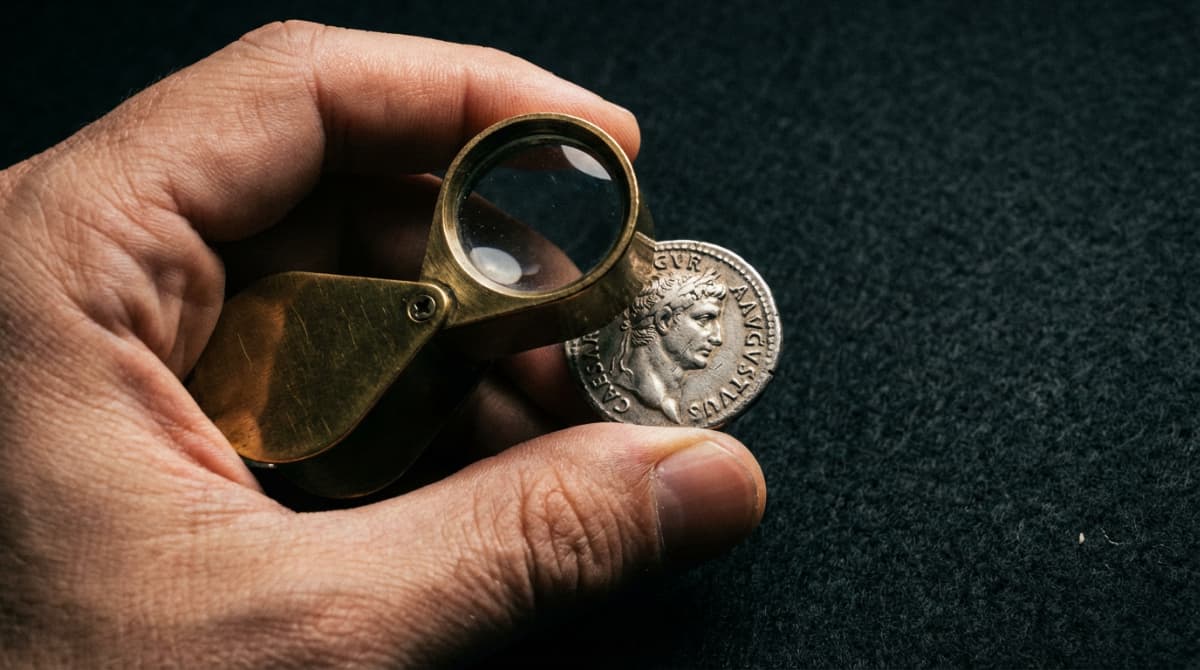
How to Spot Fake Coins: A Collector's Guide to Authentication
Counterfeit coins are more common than most collectors realize. Learn the exact methods, tools, and red flags used to detect fake coins before you buy.
A collector in Ohio paid $1,400 for what he believed was a rare 1893-S Morgan dollar. When he finally sent it to NGC for grading, the verdict came back: counterfeit. The coin was a common Philadelphia issue with an added "S" mintmark — a fake worth about $35.
Stories like this happen every week. Counterfeiting is the oldest fraud in numismatics, and modern fakes from overseas workshops have become frighteningly convincing. The good news: how to spot fake coins is a learnable skill, and with the right tools and knowledge, you can catch the vast majority of fakes before you spend a dollar.
This guide covers the exact methods professionals use — from a $10 scale to the specific measurements that expose the most common counterfeits.
Table of Contents
- Why Coin Counterfeiting Is More Common Than You Think
- The 6-Step Authentication Check
- The Most Commonly Counterfeited Coins
- How to Spot a Fake Morgan Dollar
- Tools Every Collector Should Own
- Mintmark Tampering: The Most Dangerous Fake
- When to Use Professional Authentication
- FAQ
Why Coin Counterfeiting Is More Common Than You Think
Coin fraud is not a niche problem. According to surveys of U.S. coin dealers, 43.3% report regularly encountering customers trying to sell counterfeit American Silver Eagles — one of the most widely recognized bullion coins in the world. Morgan silver dollars led all U.S. series in counterfeiting reports at 71.7%.
The source of most modern fakes is East Asia, particularly China, where workshops produce cast and die-struck replicas in bulk. Many are silver-plated base metal. Some use correct silver content but wrong weights or dimensions. The best ones are visually indistinguishable to the naked eye.
The risk is highest when buying:
- From unknown online sellers (eBay, Facebook Marketplace, local classifieds)
- At flea markets, coin shows without established dealers
- "Deals" priced significantly below market value
- Key-date coins (rare dates, rare mintmarks) from unverified sources
If a rare coin is priced at half its market value, treat it as a red flag, not a bargain. Legitimate sellers of scarce coins know what they have.
The 6-Step Authentication Check
For any coin you're considering buying or that you've recently acquired, run through these six checks in order. Each step eliminates a category of fake.
Step 1 — Check the Weight
Every genuine coin has a published official weight. Weigh the coin on a digital scale accurate to 0.01 grams and compare to the specification. Even a 0.5g deviation is suspicious.
Common authentic weights:
- Morgan Silver Dollar: 26.73g
- American Silver Eagle (1 oz): 31.10g
- American Gold Eagle (1 oz): 33.93g
- Pre-1964 U.S. Quarter: 6.25g
- Pre-1964 U.S. Dime: 2.50g
Most base-metal counterfeits come in light — counterfeit Morgan dollars often weigh 18–22 grams, nearly 5 grams short.
Step 2 — Measure the Diameter
Use digital calipers to measure the coin's diameter. A difference of even 0.3–0.5mm can indicate a cast fake made from an impression of a genuine coin (casting slightly shrinks the diameter).
- Morgan Silver Dollar: 38.1mm
- American Silver Eagle: 40.6mm
- American Gold Eagle (1 oz): 32.7mm
- Pre-1964 Quarter: 24.3mm
Step 3 — Apply the Magnet Test
Gold and silver are non-magnetic. Hold a strong neodymium magnet near the coin — genuine precious metal coins will not be attracted. Any magnetic pull indicates a ferrous (iron/steel) core, which means the coin is fake or heavily debased.
Note: This test only catches base-metal fakes. Sophisticated counterfeits made from correct-density alloys (like tungsten-core gold fakes) will pass the magnet test but fail weight/dimension checks.
Step 4 — Perform the Ping Test
Genuine silver coins produce a clear, high-pitched ring when tapped with another coin or a pencil. Base metal and lead-core counterfeits produce a dull, flat thud with no sustain.
Hold the coin on one fingertip (to let it vibrate freely) and tap its edge lightly. Compare the sound to a known genuine coin. Dedicated apps like CoinTrust or Bullion Test can analyze the sound wave and give a pass/fail reading.
Step 5 — Examine the Edge
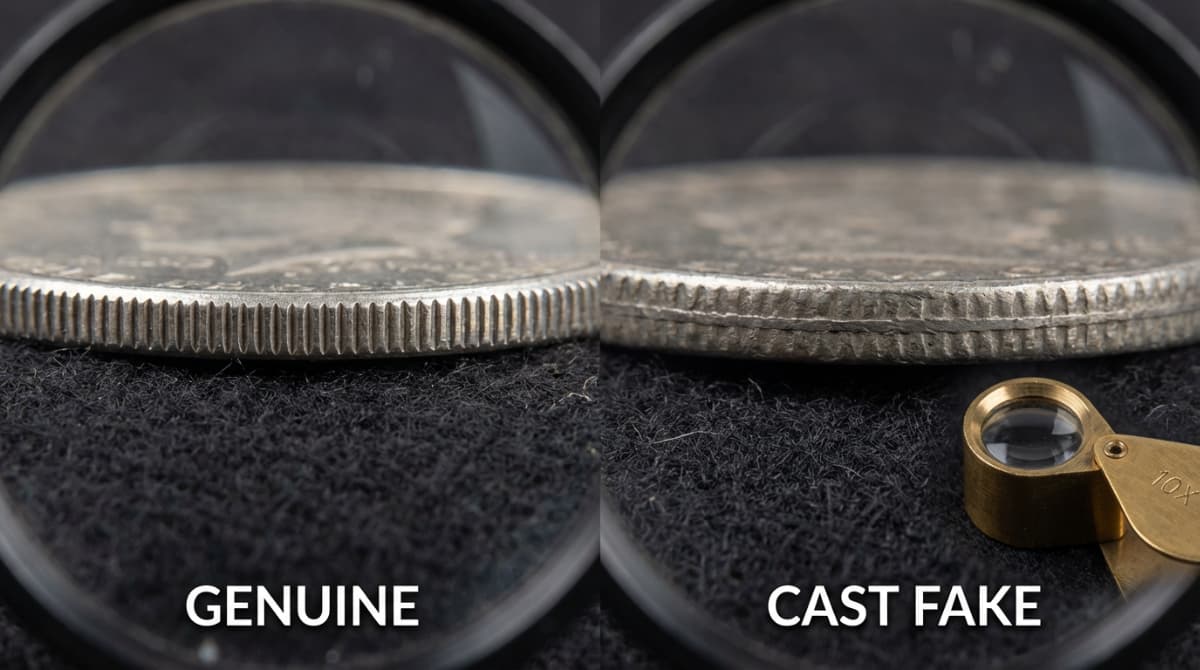
The edge (the "third side" of a coin) is the hardest element for counterfeiters to replicate precisely. Check for:
- Reeding consistency — on reeded edges (like the Morgan dollar), the ridges should be evenly spaced and sharply defined
- Seam lines — cast fakes often show a faint horizontal seam around the edge where the two mold halves met
- Correct edge type — some coins have lettered edges, plain edges, or specific reeding counts. Verify against official specifications.
Step 6 — Scrutinize Under Magnification
Use a 10x loupe or a digital microscope to examine:
- Date numerals — look for gaps, soft details, or incorrect font shapes
- Mintmark — should match the size, shape, and position of known genuine examples. A slightly crooked, too-large, or obviously added mintmark is a major red flag
- Surface texture — genuine struck coins have a specific luster and flow-line pattern. Cast fakes show a granular, orange-peel surface. Die-struck counterfeits may look sharper but still miss fine detail
- Hair and feather detail — on Morgan dollars, look at Liberty's hair above the ear and the eagle's breast feathers. These high-relief areas are difficult to replicate and often show softness or incorrect detail on fakes
The Most Commonly Counterfeited Coins
Most commonly counterfeited U.S. coin series (% of dealer reports)
Morgan Silver Dollars (1878–1921) are the most counterfeited series by a wide margin. Key dates like the 1893-S, 1889-CC, and 1895-P are particularly dangerous because their value ($10,000–$500,000+) makes the faking effort worthwhile.
American Silver and Gold Eagles are targeted for their bullion value. Fakes are often silver-plated steel or zinc, and pass casual inspection but fail weight tests immediately.
Pre-1933 U.S. Gold ($2.50, $5, $10, $20 denominations) are increasingly copied using gold-plated base metals or tungsten cores. Tungsten has nearly identical density to gold — these fakes pass basic weight and magnet tests and require XRF testing or ultrasound to detect.
Trade Dollars and Seated Liberty series are frequently cast from molds of genuine pieces and sold as collector examples.
How to Spot a Fake Morgan Dollar
The Morgan dollar is the single most dangerous coin to buy unverified. Here's a specific checklist for Morgan authentication:
Correct specifications:
- Weight: 26.73 grams (most fakes: 18–23g)
- Diameter: 38.1mm (cast fakes: 37.6–37.8mm)
- Thickness: 2.4mm
- Edge: Reeded, 189 reeds
Key visual checks:
-
Mintmark position and shape — the mintmark (O, S, CC, D) sits above the "DO" in DOLLAR on the reverse. It should be centered, upright, and the correct size for the era. Added or altered mintmarks often appear slightly raised, off-center, or have a different surface texture than the surrounding field.
-
Date font — Morgan dollar dates use a specific typeface. The "1" in dates should have serifs; the "8" should have equal-sized loops. Counterfeit dates often show slight irregularities in digit thickness or spacing.
-
Liberty's hair above the ear — this is the most complex area of the design and the hardest to fake. On genuine examples, individual hair strands are sharply distinct. On cast fakes, this area looks mushy or undefined.
-
Eagle breast feathers — each feather on a genuine Morgan has a clearly defined outline. Soft, blended feathers indicate a cast counterfeit.
Before buying any Morgan dollar valued over $100, cross-reference the date and mintmark against NGC's online population report. If you're being offered a coin that supposedly grades MS-65 but NGC has only certified 12 examples in that grade, extreme caution is warranted.
Tools Every Collector Should Own
You don't need an expensive setup to catch most fakes. This toolkit costs under $60 total and handles the majority of authentication checks:
Essential (under $60 total)
- Digital scale (0.01g precision) — ~$15. Catches almost all base-metal fakes immediately
- Digital calipers — ~$12. Measures diameter and thickness to 0.1mm
- 10x loupe — ~$10. Reveals surface texture, mintmark irregularities, edge seams
- Neodymium magnet — ~$8. Simple magnetic test for ferrous cores
Advanced (optional)
- Digital microscope (40–400x) — ~$30–$80. For detailed die analysis and surface comparison
- Sigma Metalytics Verifier — ~$200–$400. Tests metal composition through the slab or raw
- XRF analyzer — $5,000+. Professional-grade elemental composition; used by grading services
- Ultrasound thickness gauge — detects tungsten cores in gold coins
Mintmark Tampering: The Most Dangerous Fake
Mint mark manipulation is more dangerous than outright counterfeiting because the base coin is genuine — only a small detail has been altered. Common techniques:
Mintmark addition: A common Philadelphia (no mintmark) coin has an "S" or "CC" mintmark added by soldering, gluing, or die-punching. The 1895 Morgan dollar (Philadelphia only, no mintmark) is worth $50,000+ in genuine form. A common 1895-O with the "O" removed has been found in the market.
Mintmark removal: Conversely, a common "S" or "O" coin has its mintmark filed off to fake a more valuable Philadelphia issue.
Date alteration: Changing a digit to create a rare date — the classic example is converting a common 1944-D Lincoln cent into a 1914-D (worth thousands vs. pennies) by altering the first "4" to a "1."
Detection: Under magnification, an added mintmark shows a different surface finish, subtle solder lines, or slightly different metal color. A removed mintmark leaves a "ghost" — a faint depression or discoloration where the mark once was.
When to Use Professional Authentication
Home testing catches the majority of fakes but has limits. Submit to a professional grading service when:
- The coin's value exceeds $200–$300
- You're buying a key-date or rare mintmark coin
- You plan to resell at a significant price
- The coin is pre-1933 U.S. gold
- You suspect mintmark tampering (the subtlest fake)
The three major U.S. grading services:
PCGS (Professional Coin Grading Service) — the most recognized in the market, particularly for U.S. coins. A PCGS holder carries strong resale confidence.
NGC (Numismatic Guaranty Company) — the largest grading service by volume. Excellent for world coins and detailed counterfeit detection resources on their website.
CAC (Certified Acceptance Corporation) — adds a green bean sticker to PCGS/NGC coins it considers premium for their grade. Not a grading service itself, but a quality endorsement.
Both PCGS and NGC guarantee their authentication — if a coin they certified turns out to be fake, they will compensate you for the certified value.
For a quick first pass before deciding whether to submit to a grading service, uploading a photo to WorthLens.ai lets AI flag visual anomalies, inconsistent details, and known fake patterns based on the coin's image alone — useful for a fast pre-screening on coins you're considering buying.
Buying a PCGS or NGC certified coin doesn't mean overpaying — it means paying a known, verified price. For any coin worth over $500, the grading fee ($30–$60) is cheap insurance.
FAQ
The investment in a $60 toolkit and an hour of study protects you from thousands of dollars in potential losses. Most counterfeit coins fail basic weight and dimension tests — the fakery is only convincing to the unarmed eye.