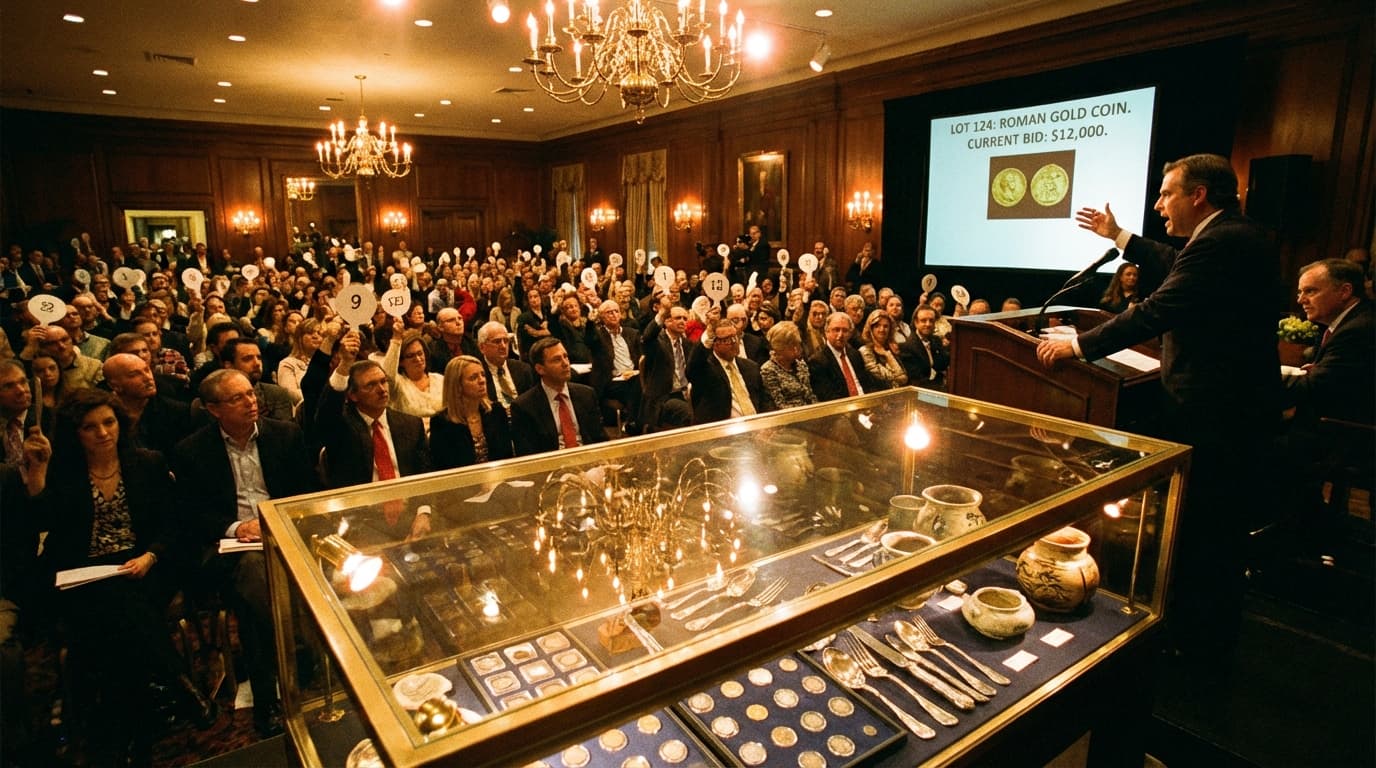
How to Prepare for an Auction and Not Lose Money
Going to an auction unprepared is the fastest way to overpay. Here's everything you need to know before you bid on coins, antiques, or collectibles.
You walk into the room, the auctioneer's voice rises, and before you know it, your paddle is in the air. You "won" — but at what price?
Auctions are exciting. They're also one of the easiest places to spend far more than an item is worth. The competitive atmosphere, the fear of losing a piece you love, the hidden fees you didn't read — they all work against you.
This guide covers everything you need to do before you bid: how to research item values, calculate true costs, spot fakes, and keep your head when everyone else is losing theirs.
Table of Contents
- Why Auctions Can Be a Trap for the Unprepared
- Step 1: Research the Items You Want to Bid On
- How Much Should You Actually Pay?
- Hidden Costs That Inflate Your Final Price
- How to Spot Fakes Before You Bid
- Your Bidding Strategy: How to Stay in Control
- FAQ
Why Auctions Can Be a Trap for the Unprepared
The auction format is deliberately designed to create urgency. Time pressure, competition from other bidders, and the social cost of "losing" all push prices higher than they should be. Research consistently shows that people pay a premium simply for the experience of winning — a phenomenon behavioral economists call the winner's curse.
For coins, antiques, and collectibles, this is especially dangerous. Values vary wildly based on condition, provenance, and market timing. A coin graded MS-63 can be worth half the price of the same coin at MS-65. An antique signed by the right maker can be worth ten times an unsigned equivalent.
The single biggest edge any bidder can have is knowing the true value of what they're bidding on — before the auction starts.
Step 1: Research the Items You Want to Bid On
Most auction houses publish preview catalogs days or weeks in advance. Use that time.
For coins and numismatics:
- Cross-reference the PCGS Price Guide and NGC Coin Explorer for grade-specific values
- Check recent realized prices on Heritage Auctions and Stack's Bowers — what a coin listed for is irrelevant; what it sold for is what matters
- Look up the specific date, mint mark, and grade — a 1909-S VDB Lincoln cent is worth thousands; a 1909-P is worth cents
For antiques and art:
- Search completed eBay listings (filter: "sold items") to see real transaction prices
- Check Christie's and Sotheby's past sale records for comparable pieces
- Look for maker's marks, signatures, and period-appropriate construction details
For jewelry and precious metals:
- Current gold and silver spot prices directly affect value — check live data before any auction
Contact the auction house before the sale and request a condition report and additional photographs. Reputable houses provide these for free, and it's the single best way to assess an item you can't inspect in person.
How Much Should You Actually Pay?
Before you step into the room, write a maximum bid on paper for every lot you're interested in. Not a rough estimate — a precise number. Then commit to not exceeding it.
The discipline sounds easy. It isn't. In a live auction room, the difference between your limit and "just a bit more" feels trivial in the moment and significant in hindsight.
A practical framework:
- Find the fair market value (FMV) for the item in its current condition
- Subtract the buyer's premium and taxes (see the section below)
- The number you arrive at is your true maximum hammer price — not your maximum bid
If you're uncertain about an item's value, tools like WorthLens.ai let you upload a photo and get an instant AI-powered appraisal based on the item's visible condition, markings, and category. Running a quick check before the auction gives you a hard reference point that's harder to ignore in the heat of bidding.
How grade affects coin value — example: Morgan Silver Dollar
MS-60 to MS-65 = Uncirculated (UNC) — never used in circulation. Higher grade means fewer contact marks and stronger luster.
Hidden Costs That Inflate Your Final Price
The hammer price — the number the auctioneer announces when the gavel falls — is not what you pay. Not even close.
The buyer's premium is the most significant hidden cost. It's a percentage added on top of the hammer price, and it goes to the auction house.
- Traditional auction houses: typically 20–25%
- Christie's: 25% on the first $100,000, 20% on the portion between $100,001 and $2 million
- Sotheby's: 25% on the first $400,000
- Online auction platforms: vary widely, often 15–23%
Then add:
- Sales tax or VAT — applied to both the hammer price and the buyer's premium in most jurisdictions
- Shipping and insurance — often $25–150+ for fragile or high-value items
- Storage fees — if you don't collect the item promptly
- Import/export duties — for international purchases
Always calculate your true all-in cost before placing any bid. A $500 hammer price can easily become $650+ once you add a 25% buyer's premium, sales tax, and shipping. If that number exceeds your FMV estimate, walk away.
Example: $500 Hammer Price
- Hammer price: $500
- Buyer's premium (22%): $110
- Sales tax (8%): $49
- Shipping: $35
- Total paid: $694
What This Means
If the item's fair market value is $600, you just paid $94 over market — a 16% overpayment before you've even factored in any resale margin. Always back-calculate from the all-in cost, not the hammer price.
How to Spot Fakes Before You Bid
Fakes and reproductions appear at every level of the market — from flea market tables to established auction rooms. The presence of a reputable auction house doesn't guarantee authenticity; it shifts liability, not risk.
The most reliable tells:
1. Wear patterns that don't match the story
Genuine age creates logical wear — on handles, edges, and high-contact surfaces. Artificially distressed pieces often show uniform wear across surfaces that would realistically age unevenly.
2. Materials that predate or post-date the period
A piece of "18th-century" furniture with Phillips-head screws is a modern reproduction — Phillips screws weren't patented until 1935. Similarly, look for synthetic fibers, machine-cut dovetails, and modern adhesives in pieces claiming pre-industrial origins.
3. Maker's marks that look too perfect
Authentic period marks show hand-applied irregularities, slight blurring, and wear consistent with the piece's age. A crisp, perfectly uniform mark is a red flag — particularly on coins, silver, and pottery.
4. Provenance documentation that's vague or unverifiable
Genuine pieces typically come with traceable ownership history. Auction lots with certificates of authenticity from unknown or unverifiable bodies, spelling errors in documentation, or gaps in provenance chain warrant skepticism.
5. Prices that seem too good
In a competitive auction environment, genuine rare pieces rarely sell at dramatic discounts. If something is priced suspiciously low, there's usually a reason.
For coins and jewelry, uploading photos to WorthLens.ai before an auction can flag inconsistencies in markings, weight characteristics, or surface treatment that suggest a fake or heavily cleaned item. AI-assisted analysis doesn't replace expert grading, but it's a fast first filter.
Your Bidding Strategy: How to Stay in Control
You've done the research. You know the value. You know the all-in cost. Now the auction starts.
Arrive early. Get to the preview at least 30 minutes before bidding begins. Examine the specific lots you're interested in. Familiarity with the actual item reduces the psychological pressure during bidding.
Don't bid first. Let other bidders establish the price. Early bids signal strong interest and can inflate competition. Step in once the momentum establishes a price level.
Set your limit, then ignore the room. The bidding atmosphere is engineered to make your limit feel arbitrary. Other bidders' enthusiasm is not evidence that an item is worth more — it's evidence that they didn't do their research, or that they value it differently for reasons irrelevant to you.
Use absentee or online bids strategically. Many auction houses accept maximum bids in advance. The house bids on your behalf up to your limit. This removes emotional decision-making from the process entirely.
Walk away cleanly. When you hit your limit, stop. The same category of item will appear at the next auction. Missing one lot is not a loss — overpaying is.
Never get into a prolonged bidding war with another determined buyer. Once two bidders are committed beyond fair value, the only winner is the auction house. Decide your maximum before the war starts, not during it.