How Much Do Pawn Shops Pay for Gold and Jewelry?
Pawn shops rarely offer fair value for gold or jewelry. Here's exactly what they pay, why — and how to know your item's worth before you walk in.
You walk into a pawn shop with a gold necklace you inherited. The pawnbroker weighs it, punches numbers into a calculator, and offers you $85. Is that a fair deal or a lowball? If you don't know the spot price of gold — and what percentage of it you should be getting — you have no idea.
That information gap is exactly how pawn shops stay profitable. This guide breaks down exactly what they pay for gold, silver, and jewelry, and how to walk in prepared instead of guessing.
Table of Contents
- How Pawn Shops Calculate Their Offer
- How Much Do Pawn Shops Pay for Gold?
- How Much Do Pawn Shops Pay for Silver Jewelry?
- Does Brand Name Jewelry Get a Higher Offer?
- Pawn Shop vs. Selling Online: Which Pays More?
- 5 Things to Do Before You Visit a Pawn Shop
- FAQ
How Pawn Shops Calculate Their Offer
Every pawn shop offer on gold or silver starts with the spot price — the live global market price per troy ounce. You can see today's prices in the table below.
From there, the pawnbroker:
- Tests the metal purity (acid test or electronic tester) to confirm the karat or fineness
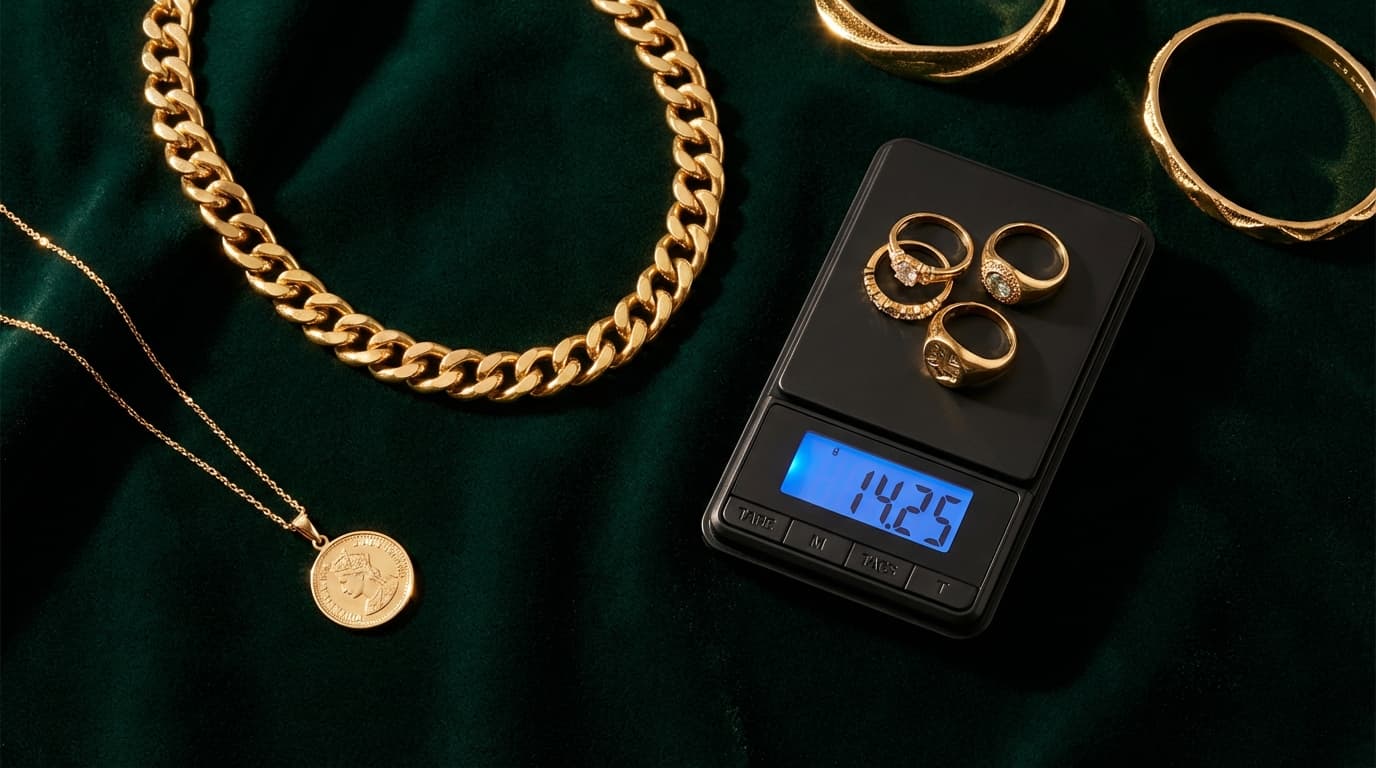
- Weighs the item in grams or troy ounces
- Calculates the melt value — what the raw metal is worth at spot price
- Applies their margin — typically paying 30% to 60% of melt value
The margin exists because the shop needs to cover overhead, the cost of refining, and their own profit. They're not buying your gold to keep it — they're going to resell it or send it to a refiner. That transaction chain eats into what you receive.
The "melt value" is not the same as what your piece is worth as jewelry. A well-crafted gold ring has artisan value on top of its metal value. Pawn shops almost always ignore the craft — they buy by the gram.
How Much Do Pawn Shops Pay for Gold?
Pawn shops typically pay 30–60% of the gold spot price, with the average landing around 40%. At current gold prices (approximately $4,700 per troy ounce as of early April 2026), here's what that translates to in real dollars per gram at the average 40% payout:
Estimated pawn shop payout per gram by karat (40% of spot at ~$4,700/oz)
These figures represent the midpoint of the typical pawn range. In practice:
- A competitive shop in a major city might offer 50–60% of melt value
- A small-town shop with less competition might pay as low as 20–30%
- A luxury pawn shop specializing in fine jewelry may offer up to 75% for high-quality pieces
The karat stamp on your jewelry tells you the gold purity: 10K is 41.7% pure gold, 14K is 58.3%, 18K is 75%, and 24K is 99.9% pure.
Never accept the first offer without doing the math yourself. Ask the pawnbroker what spot price they're using that day, then calculate 50–55% of your item's melt value as a reasonable target.
Before visiting any shop, use the WorthLens.ai appraisal tool — upload a photo of your piece, and the AI estimates its value using real-time metal prices alongside craftsmanship and condition factors. Walking in with a number in hand is the single most effective negotiating tactic available.
How Much Do Pawn Shops Pay for Silver Jewelry?
Silver follows the same logic as gold, but the margins are typically wider. Pawn shops pay approximately 30–70% of the silver spot price for jewelry, with most offers in the 40–55% range.
Sterling silver (marked .925) is 92.5% pure silver. Coin silver (.900) is 90% pure. Fine silver (.999) commands the best offers.
| Silver type | Purity | Typical pawn shop payout |
|---|---|---|
| Fine silver (.999) | 99.9% | 50–70% of spot |
| Sterling silver (.925) | 92.5% | 40–60% of spot |
| Coin silver (.900) | 90% | 40–55% of spot |
| Silver-plated items | Varies | Often rejected or $1–5 flat |
Silver-plated jewelry — which has only a thin silver coating over a base metal — is rarely worth anything to pawn shops. If there's no hallmark or the piece is unusually light, it may be plated, not solid silver.
The spot price of silver fluctuates daily — the current price is shown in the live table in the gold section above.
Does Brand Name Jewelry Get a Higher Offer?
Yes — but only at the right type of shop.
A standard pawn shop buys by weight and will treat a Tiffany & Co. silver bracelet the same as any other sterling piece. You'll get 40–55% of the melt value regardless of the brand.
Luxury pawn shops and estate jewelry buyers are different. They can resell the piece as a branded item, so they'll factor in the designer premium. Cartier, Van Cleef & Arpels, Bulgari, David Yurman, and Tiffany & Co. pieces frequently sell for 2–5× their melt value on the secondary market — a specialist buyer will pay you more to reflect that.
Standard Pawn Shop
Buys gold and silver by weight. Ignores brand, hallmarks, design, or provenance. Offers 30–60% of melt value for any piece regardless of maker. Fast transaction, immediate cash.
Luxury / Estate Jewelry Buyer
Evaluates craftsmanship, maker's marks, and secondary market demand. May offer 60–80%+ of actual resale value for recognizable brands. Slower process but significantly higher payout for quality pieces.
The rule of thumb: if your jewelry has a designer hallmark, take it to a specialist first. You'll likely leave more money on the table at a general pawn shop.
Pawn Shop vs. Selling Online: Which Pays More?
Pawn shops win on speed and convenience. Every other metric favors alternatives.
Typical payout as % of gold melt value by selling channel
Here's how the alternatives compare:
Online gold buyers (APMEX, Cash for Gold USA, others) typically pay 70–85% of melt value and mail you a check or direct deposit within a few days of receiving your item. The tradeoff is time — usually 5–10 business days total.
Local jewelers vary widely, but reputable ones often pay more than pawn shops because they understand jewelry value beyond raw metal weight. A jeweler who can resell the piece intact has more incentive to pay closer to retail value.
eBay and resale platforms can return the most money if your piece has collector or fashion appeal, but require effort: listing, photos, communication with buyers, and waiting for a sale. This only makes sense for items worth the effort.
Gold refineries pay 90–95% of melt value, but typically require minimum quantities (often 1+ troy ounce) and take several weeks.
If you need cash today, a pawn shop is a legitimate option. If you can wait a week, you'll almost certainly do better elsewhere. The 30–40 percentage point gap between a pawn shop and an online buyer can translate to hundreds of dollars on a single piece.
5 Things to Do Before You Visit a Pawn Shop
Preparation is the difference between walking away satisfied and kicking yourself on the drive home.
1. Check the current spot price. The live prices table above shows today's gold and silver spot price and per-gram melt values by karat. Note the price for your karat before you go — that's your baseline.
2. Know your item's weight and karat. Weigh your piece on a kitchen scale (grams) and note the hallmark stamp — usually 10K, 14K, 18K, or .925 for sterling silver. With these two numbers, you can calculate the melt value yourself.
3. Get an AI appraisal before you go. Use WorthLens.ai to upload a photo of your item. The AI analysis cross-references real-time metal prices with the item's visual details, condition, and craftsmanship — giving you a realistic value range before anyone else sees the piece.
4. Get multiple offers. Visit two or three shops. Offers for the same piece can vary by 20–30% between shops in the same city. Having a competing offer is the most powerful negotiating tool you have.
5. Don't accept the first number. Pawn shop opening offers are starting points. Politely counter with a specific number — say "I was expecting closer to $X based on the spot price today." The worst they can say is no.
Ask the pawnbroker what spot price they're using and what percentage of melt value they're offering. A reputable shop will answer both questions directly. If they deflect or claim not to calculate it that way, that's a signal to get a second opinion.
FAQ
The bottom line is simple: pawn shops offer speed, not value. If you walk in knowing your item's melt value and the going rate in your area, you're negotiating from a position of knowledge instead of guessing. If you walk in blind, you'll accept whatever number sounds reasonable — and it probably won't be.