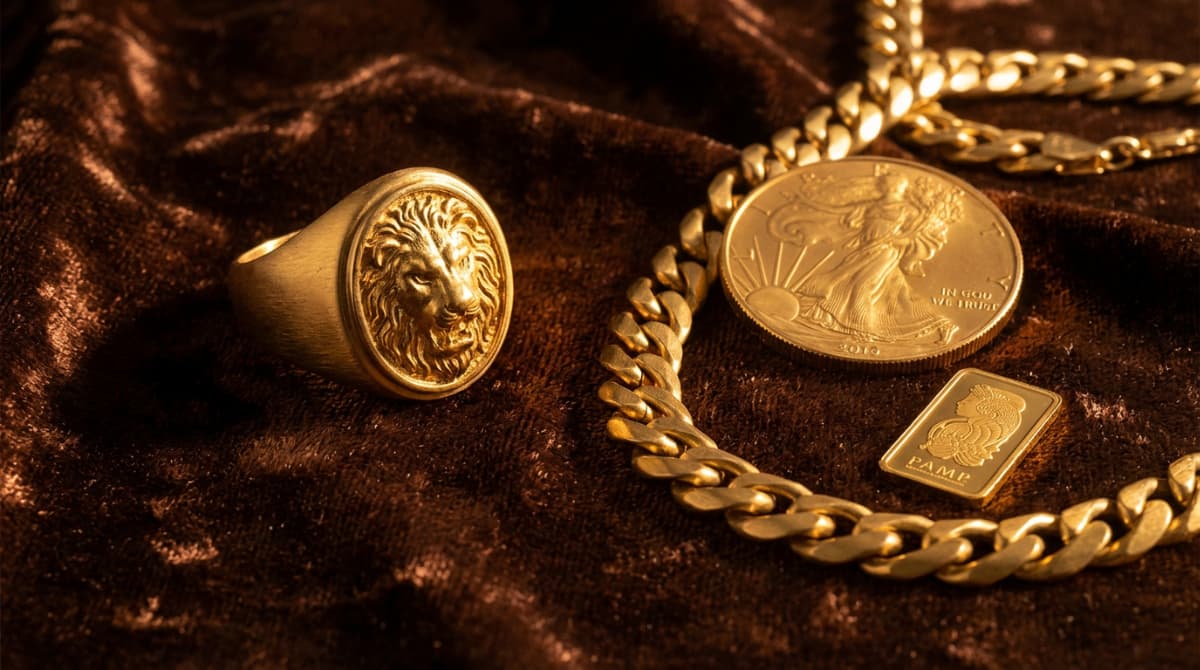
Gold Jewelry vs. Gold Bullion: Which Is the Better Investment?
hinking about buying gold? The difference between jewelry and bullion isn't just form — it's thousands of dollars in markup, resale value, and long-term returns.
You walk into a jewelry store and pay $3,000 for an 18K gold bracelet. The gold content in that bracelet is worth about $900 at today's spot price. The remaining $2,100 went to craftsmanship, retail overhead, and margin.
Now consider buying a 1 oz gold coin for $4,850. The gold spot value is $4,690. Your premium: about 3.4%.
That gap — between a 230% jewelry markup and a 3.4% bullion premium — is the core of the gold jewelry vs. gold bullion investment question. This article breaks down exactly where your money goes, when each form of gold makes sense, and what the numbers look like when you eventually want to sell.
Table of Contents
- The Core Difference: What You Are Actually Buying
- Gold Bullion: Coins vs. Bars
- Gold Jewelry: Where the Money Goes
- Is Gold Jewelry Ever a Good Investment?
- The Resale Reality: What You Actually Recover
- Live Gold Prices: What the Metal Is Worth Right Now
- Which Should You Buy?
- FAQ
The Core Difference: What You Are Actually Buying
When you buy gold bullion — a coin or bar — you are buying almost pure gold at a small, known premium over the commodity price. The transaction is transparent, standardized, and liquid.
When you buy retail gold jewelry, you are buying gold plus craftsmanship, plus retail markup, plus brand premium. None of those add-ons convert back to cash when you sell. A jeweler buying back your piece will pay melt value — the raw metal worth — regardless of what you paid for the design.
This distinction is the reason every serious precious metals investor separates the two categories entirely. Jewelry is not a substitute for bullion, and bullion is not jewelry. They serve different purposes.
One exception exists: 24K pure gold jewelry at fair premiums functions very close to bullion. With no alloy metals and minimal craftsmanship premium, it trades near spot and retains value similarly to coins or bars. More on this below.
Gold Bullion: Coins vs. Bars
Gold bullion comes in two primary forms: coins and bars. Both track the gold spot price closely, but they differ in premium, liquidity, and ideal use case.
Gold bars offer the lowest premium over spot — typically 1–4% for standard sizes (1 oz to 10 oz). A 1 kg bar from a reputable mint may trade at just 1–2% over spot. Lower markup means more of your money is pure gold. The tradeoff: bars are less liquid than coins for smaller sales, and authentication can be a concern when reselling to private buyers.
Gold coins carry slightly higher premiums — typically 3–8% for popular 1 oz coins — but offer better liquidity and global recognition. The most widely traded gold coins:
High Recognition Coins
- American Gold Eagle — 91.67% gold (22K), IRA-eligible, ~5–7% over spot
- American Gold Buffalo — 99.99% pure (24K), IRA-eligible, ~4–6% over spot
- Canadian Maple Leaf — 99.99% pure, ~3–5% over spot
International Favorites
- South African Krugerrand — 91.67% gold (22K), lowest typical premium ~3–5% over spot, not IRA-eligible in the US
- British Sovereign / Britannia — popular in Europe, CGT-exempt for UK residents
- Austrian Philharmonic — 99.99% pure, popular in Europe
Coins vs. bars — which to buy:
- Under $25,000 to invest: coins are generally better. Easier to sell in partial amounts, more liquid, better recognized by private buyers.
- Over $25,000: bars become more efficient. Lower premiums mean more gold per dollar, and institutional buyers will pay market price regardless of form.
Typical premium over spot by gold product type
Gold Jewelry: Where the Money Goes
A standard retail gold jewelry purchase includes layers of cost that have nothing to do with the gold itself:
Making charges: The cost of crafting the piece — 10–30% of the final price depending on complexity.
Retail markup: The store's overhead, profit margin, and marketing costs. A typical jewelry retailer marks up 100–200% over their wholesale cost.
Alloy dilution: Most jewelry is 14K (58.5% gold) or 18K (75% gold). You're not buying pure gold — you're buying a gold alloy. At $150.80/gram for 24K, an 18K piece is worth $113.10/gram in metal. An average retailer charges far more than this.
Brand premium: Pieces from Cartier, Tiffany, Bulgari, or Van Cleef carry premiums of 400–1,000% over melt value. You're paying for the name, the box, and the prestige.
The result: a $3,000 retail jewelry purchase might contain $800–$1,200 worth of gold. The rest is unrecoverable at resale.
In the UK and EU, retail gold jewelry purchases incur 20% VAT, which is non-recoverable — meaning you are immediately 20% underwater on any jewelry purchase, in addition to the retail markup. Investment-grade bullion is VAT-exempt in the UK and EU.
Is Gold Jewelry Ever a Good Investment?
In most cases, no — not if your primary goal is capital preservation or appreciation. But there are three exceptions where jewelry can match or exceed bullion returns:
1. Vintage and Antique Jewelry
A Georgian gold mourning brooch or an Art Deco Cartier bracelet carries value well beyond its gold content. Signed antique pieces from known makers appreciate on two axes: the gold price and the collector market. During gold bull markets, these pieces often outperform bullion because both drivers work simultaneously.
2. Investment-Grade 24K Jewelry
Some specialist makers (notably in Asia and the Middle East) produce 24K pure gold jewelry at markups of 30–55% — far below standard retail. If resold into the correct market, these pieces trade close to spot. The gold content is fully intact, and the premium reflects honest craftsmanship rather than retail theater.
3. Luxury Brand Pieces in Excellent Condition
A Cartier Love bracelet in 18K gold retains significant resale value not because of its gold content but because of secondary market demand for the brand. These pieces are collectibles that happen to be made of gold — and in that category, brand premium is real and recoverable.
For most people buying jewelry at a standard retail jewelry store with no brand, no antique value, and standard 14–18K purity: it is not a gold investment. It is a purchase that happens to contain gold.
The Resale Reality: What You Actually Recover
This is where the difference becomes starkly clear.
Bullion resale: Major dealers will buy back standard coins and bars at 97–99% of spot price. If you bought a 1 oz American Eagle at 6% over spot and sell it at 1% below spot, your total round-trip cost is roughly 7% — across however many years you held.
Retail jewelry resale: Dealers pay melt value — the metal content only, at 70–85% of spot. A piece purchased at 230% markup over melt is now sold at 75% of melt. The math:
- Bought: 10g of 18K gold at a retail store for $1,695 (typical retail)
- Gold melt value at purchase: 10 × 0.75 × $150.80 = $1,131
- Resale at 75% of melt: $848
- Loss: $847 (50% of purchase price)
Even if gold doubles in price over 10 years, you're often only breaking even on a typical jewelry purchase. Bullion would have doubled your money.
Where your money goes when buying retail 18K gold jewelry
Live Gold Prices: What the Metal Is Worth Right Now
Gold has been one of the strongest-performing assets of 2025–2026, rising over 55% in 2025 alone and hitting an intraday high of $5,595/oz in January 2026. As of early April 2026, spot is approximately $4,690/oz ($150.80/gram for 24K pure gold).
Whether you're evaluating a jewelry purchase or a bullion buy, the live spot price is your anchor. The premium you pay above spot is your true cost of entry — and the tighter that premium, the faster gold's price appreciation translates into your gain.
You can also use WorthLens.ai to instantly see how much of a piece's value is metal versus craftsmanship premium. Upload a photo and the AI appraisal breaks down the melt value component versus the total assessed value — showing you exactly what percentage you're paying above metal.
Which Should You Buy?
Buy Gold Bullion If...
- Your primary goal is capital preservation or appreciation
- You want to track the gold price directly
- You may need to liquidate quickly
- You are building an IRA or long-term portfolio position
- You want a transparent, auditable investment
- You're investing $1,000 or more
Buy Gold Jewelry If...
- You want to wear and enjoy the item daily
- You're buying antique or vintage signed pieces
- You're purchasing investment-grade 24K at fair premiums
- You want to give a gift that also has lasting value
- You're buying established luxury brands with strong secondary markets
- You understand the premium is partly for aesthetics, not investment
The cleanest answer: if the goal is growing wealth, buy bullion. If the goal is owning something beautiful that also preserves some value, buy quality jewelry with eyes open about the markup.
Many investors do both — bullion coins as their core gold holding, and occasional high-quality antique or 24K pieces as dual-purpose assets that they also enjoy.
Before buying any gold piece — bullion or jewelry — verify today's spot price and calculate exactly how much premium you're paying. For jewelry, upload a photo to WorthLens.ai to get an instant AI assessment of the metal value versus the asking price.
FAQ
Gold is a sound long-term store of value in any form. But the form you choose determines how much of gold's appreciation actually reaches your pocket. Bullion keeps you closest to the metal's performance. Most retail jewelry keeps the store's margin between you and the gold price.