How to Tell If Antique Furniture Is Genuinely Old (and What It's Worth)
Most people can't tell a genuine 18th-century chest from a Victorian reproduction. Here's the physical inspection checklist that dealers actually use.
Most people who inherit old furniture have no idea whether they're looking at a genuine 18th-century piece or a Victorian-era reproduction made to look like one. Both can be beautifully made. Both can look impressively old. But the difference in value can be $200 versus $20,000.
The good news: genuine antique furniture leaves physical evidence that's very hard to fake convincingly. Drawers, joints, hardware, wood, and wear patterns all tell a story — and once you know what you're looking for, that story is surprisingly readable.
This guide covers the physical inspection techniques that furniture dealers and appraisers actually use, the period styles worth knowing, and realistic price ranges for what you might find.
Table of Contents
- What "Antique" Actually Means (and Why It Matters)
- Start Here: The Drawer Test
- Five Physical Checks You Can Do Right Now
- How to Date Furniture by Construction Method
- Major Period Styles and What They're Worth
- Red Flags: Signs You're Looking at a Reproduction
- How Much Is Antique Furniture Actually Worth?
- FAQ
What "Antique" Actually Means (and Why It Matters)
By the standard definition used by U.S. Customs and most dealers, a piece must be at least 100 years old to qualify as an antique. Items between 20 and 100 years old are typically called "vintage." The distinction is more than semantic — it affects import duties, auction classification, and buyer expectations.
A chair made in 1924 is technically vintage, not antique. A chest of drawers made in 1895 qualifies. And a sideboard made in 1780 is genuinely antique — which puts it in a different conversation entirely when it comes to value.
The complication is that reproduction furniture has existed as long as furniture itself. Victorian cabinetmakers produced high-quality reproductions of Queen Anne and Chippendale styles. Edwardian craftsmen reproduced Sheraton and Hepplewhite. Modern factories produce convincing-looking aged pieces. Each era's reproductions are now themselves old — which creates genuine confusion even for experienced buyers.
Physical inspection resolves most of that confusion.
Start Here: The Drawer Test
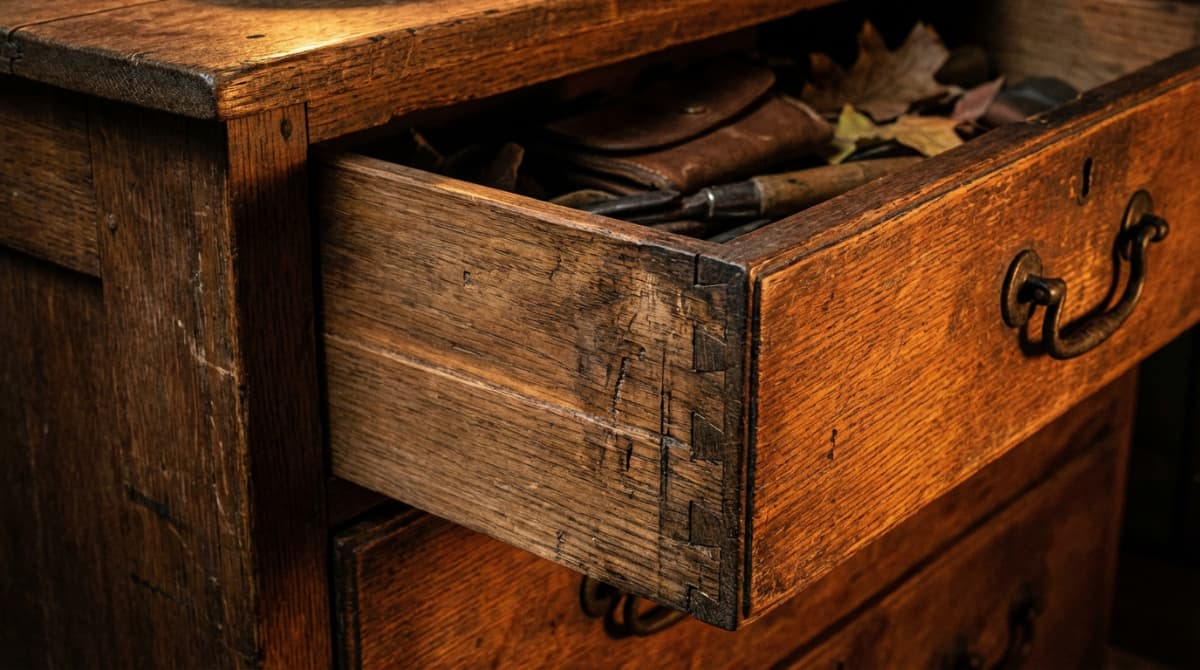
If the piece has drawers, they are your single most reliable dating tool. Pull a drawer completely out and examine it — the construction inside tells you more than any external detail.
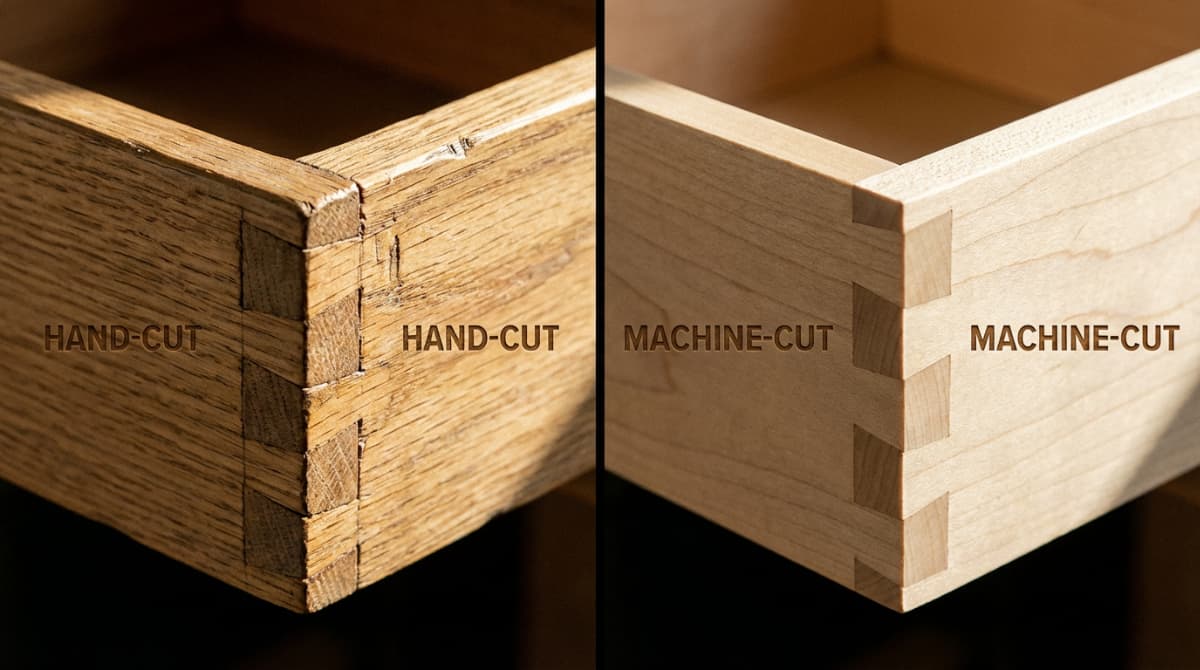
Hand-cut dovetail joints (pre-1860): The interlocking wedge-shaped cuts are slightly uneven. Pin widths vary. You may see faint scribe marks (the lines a craftsman drew to guide the saw) and tiny over-cuts at the corners where the chisel slipped. This irregularity is the signature of hand work — and it's almost impossible to fake convincingly because skilled reproduction would simply be too expensive.
Machine-cut dovetail joints (post-1860): Perfectly uniform. Pins and tails are exactly the same width and spacing throughout. The clean precision that looks impressive is actually the giveaway — hand craftsmen were never that consistent.
Knapp joint (1870–1900): A distinctive "pin and crescent" or scallop-and-peg pattern that appears almost decorative. This was the first widely-adopted machine-made drawer joint, used almost exclusively between 1870 and 1900. If you see it, you can date the piece to that window with high confidence.
Butt joint with nails (post-1900 or very early/crude work): Simply nailed together. Either very cheap early construction or 20th-century mass production.
Also look at the bottom of the drawer itself. Pre-1860 drawer bottoms are typically a single wide plank of secondary wood, running front-to-back, with visible hand-plane marks on the underside. Machine-sanded surfaces indicate post-industrial production.
The drawer is one of the best features to photograph clearly when uploading to an AI appraisal tool like WorthLens.ai. The joint type visible in a close-up photo directly informs the age estimate.
Five Physical Checks You Can Do Right Now
Beyond the drawer test, these five inspections cover the main physical evidence for genuine age.
1. Hardware
Original period hardware — knobs, pulls, hinges, escutcheons — was hand-forged or cast, not stamped. Look at screws: handmade screws (pre-1850) have an off-center slot, irregular threading that doesn't extend to the tip, and a slightly irregular head. Machine-made screws (post-1850) have a centered slot and uniform threading. Phillips head screws weren't invented until 1936 — finding one inside a purportedly 18th-century piece is conclusive proof of later work.
Also look for "ghosts" — faint outlines or filled holes where earlier hardware was removed and replaced. This is evidence of honest aging and repair history, not a red flag.
2. Patina and finish
Genuine patina develops slowly over decades and cannot be perfectly faked. On wood, look for color that is darker in crevices and recessed areas, lighter on raised surfaces and edges — the opposite of painted-on artificial aging, which tends to be uniform. The finish on old pieces often shows crazing (fine surface cracks in the varnish) that follow the wood grain organically.
Underneath the piece — on the back, the underside of the seat, the interior of a cabinet — genuine old furniture shows natural oxidation darkening the wood without any finish at all. Reproduction pieces often show staining or finishing even in these hidden areas, because the faker doesn't know to leave them alone.
3. Wood and secondary materials
Early furniture makers used expensive primary wood (mahogany, walnut, cherry) only where it would be seen — on visible faces, fronts, and tops. Backs, drawer interiors, and undersides were built from cheaper secondary woods: pine, poplar, oak, ash. Finding mixed woods in a structurally logical way is a mark of authentic construction.
Pre-industrial veneers are thick — typically 3–6mm (⅛ to ¼ inch), cut by hand saw. Modern machine-cut veneers are paper-thin (often under 1mm). You can often feel the edge of a veneer to estimate thickness.
Wood shrinks across the grain over time. Genuine old wide boards often show slight cupping or very fine splitting along the grain — not catastrophic damage, but a natural consequence of centuries of moisture cycling. A faker rarely introduces such subtle, realistic aging.
4. Construction and tool marks
Look at any exposed internal surface — the back of a case piece, the underside of a tabletop, the interior side of a door panel. Pre-mechanical surfaces show plane marks: slightly irregular, overlapping strokes that leave a gentle ripple texture. Circular saw marks (curved or arc-shaped) indicate post-1860 production. Band saw marks (straight, parallel lines) indicate post-1870. Perfectly smooth, machine-sanded surfaces suggest 20th-century or later production.
5. Wear patterns
Genuine wear follows logic. Chair arms are worn where hands rest. Drawer fronts are worn at pull height. Table legs are worn at the bottom from years of being moved. Floor contact points show genuine scuffing and darkening. Wear that doesn't correspond to how the piece would actually be used — uniform "distressing" across a surface, or wear on areas that would never be touched — is artificial aging.
How to Date Furniture by Construction Method
| Period | Joints | Hardware | Saws | Screws |
|---|---|---|---|---|
| Pre-1800 | Hand-cut dovetail, mortise & tenon, wooden pegs | Hand-forged, wrought iron or early brass | Pit saw (straight marks, irregular) | Handmade, off-center slot |
| 1800–1860 | Hand-cut dovetail, improving regularity | Cast brass, early machine-cast iron | Straight pit/mill saw | Handmade to early machine-made |
| 1860–1900 | Machine-cut dovetail, Knapp joint | Machine-stamped brass and iron | Circular saw marks (arcs) | Machine-made (uniform threading) |
| 1900–1930 | Machine dovetail or butt-and-nail | Standardized pressed metal | Band saw and circular | Modern screws, some slotted |
| Post-1930 | Dowels, biscuits, staples | Stamped metal, later plastic | Fully mechanized | Phillips head screws |
Major Period Styles and What They're Worth
Style provides the attribution context that, combined with physical authentication, determines value. The most significant American and European furniture periods:
Queen Anne (1700–1755): Characterized by cabriole legs, pad feet, and restrained ornamentation. Walnut is the primary wood. Genuine examples in good condition: $3,000–$40,000+ for case pieces.
Chippendale (1755–1790): Richer ornamentation, ball-and-claw feet, carved splats on chair backs. Mahogany dominates. Philadelphia and Newport examples command significant premiums. Range: $5,000–$100,000+ for signed or attributed pieces.
Federal / Hepplewhite / Sheraton (1790–1830): Neoclassical restraint, inlay decoration, tapered legs. American Federal furniture has seen strong sustained demand. Range: $1,500–$25,000+.
Victorian (1840–1910): Broad umbrella covering many sub-styles (Renaissance Revival, Eastlake, Rococo Revival). Mass-market Victorian pieces have softened significantly — down 22% since 2023 as younger collectors prefer cleaner lines. High-quality signed Victorian pieces remain strong. Range: $300–$8,000 for typical pieces.
Arts & Crafts / Mission (1880–1920): Stickley, Limbert, Roycroft — maker attribution drives enormous value swings. Signed Stickley pieces can reach $10,000–$50,000+. Unsigned Mission pieces: $400–$3,000.
Mid-Century Modern (1945–1975): The current market darling. Designer attribution (Eames, Knoll, Nakashima) creates auction records. Authenticated Nakashima tables have sold for $300,000+. Well-documented MCM pieces by known designers: $2,000–$30,000.
Typical antique furniture value range by period (USD, good condition)
Red Flags: Signs You're Looking at a Reproduction
A convincing reproduction shares the style but not the construction. These are the tells:
- Phillips head screws anywhere inside the piece — invented 1936, conclusive for anything supposedly pre-20th century
- Perfectly uniform dovetail joints in a piece claimed to be pre-1860
- Wear patterns that don't match use — distressed edges on surfaces that would never receive contact
- Veneers thinner than 2mm on a piece claimed to be 18th or early 19th century
- Consistent "aged" coloring on all surfaces including unexposed backs and undersides — real aging is uneven
- Modern plywood or particleboard in secondary areas — drawer bottoms, back panels, shelf undersides
- Uniform secondary wood — if backs and drawer interiors are all the same wood as the front, it suggests modern uniform production
A well-made reproduction is not worthless — a high-quality Victorian reproduction of a Chippendale style can itself be a century old and worth several hundred to a few thousand dollars. The problem is paying antique prices for reproduction value. Know what you have before negotiating.
How Much Is Antique Furniture Actually Worth?
The short answer is: it depends almost entirely on maker attribution, period, condition, and current market demand. The same style of chair made by a documented Philadelphia craftsman in 1770 and an unknown craftsman in the same period can differ in value by a factor of 10.
A practical framework:
Unattributed pieces in common period styles (solid construction, good condition, no damage): $500–$5,000 for most American and English examples.
Attributed pieces with documented maker or regional school: Add 200–500% over unattributed equivalent.
Signed or labeled pieces from significant makers (Goddard-Townsend, Phyfe, Herter Brothers, Stickley): Can multiply value by 10–50x over an unsigned equivalent.
Condition premium: Original finish, unrestored, with honest patina: typically 30–50% premium over a refinished equivalent in the same period and style.
Provenance premium: Documented ownership history, exhibition records, or published references: 20–100% premium depending on significance of the provenance.
For a quick baseline before you consult a specialist, upload photos to WorthLens.ai — including close-ups of the drawer joints, hardware, and any maker's labels or stamps. The AI identifies stylistic period and construction clues from the images and provides an immediate value range.
FAQ
Most people never look inside a drawer. That's where the evidence is. A five-minute physical inspection using the techniques above will tell you more about a piece than hours of searching by style alone.